Death Becomes Her
The lesbian ultraviolence of "Camp Miasma" pulls at the threads of queer desire.

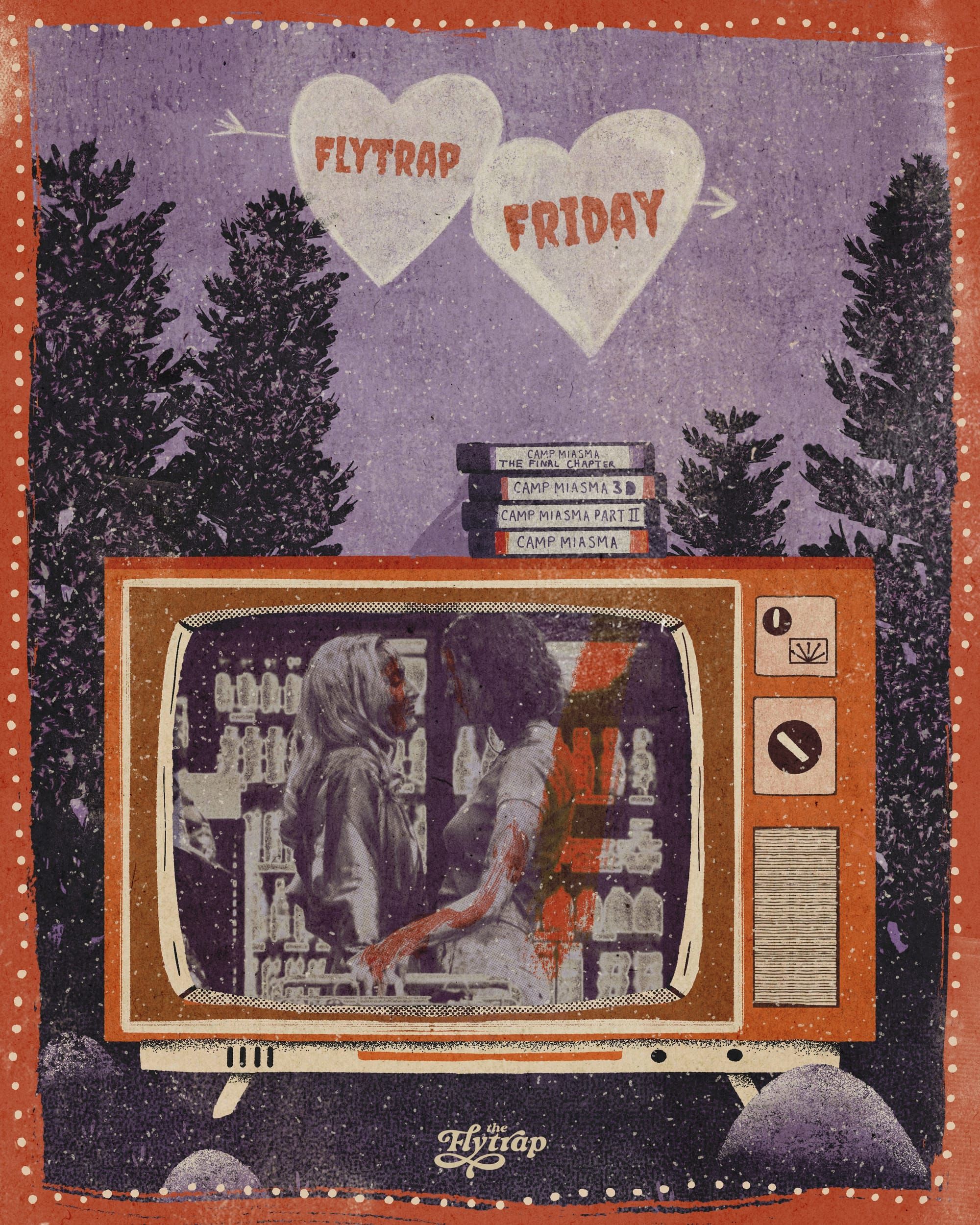
It's our annual spooky season tradition: Flytrap Fridays! Original features from the Flyteam, every Friday in October, about our favorite things that go bump in the night. Always free, but you can...
This piece contains spoilers for the film Teenage Sex and Death at Camp Miasma (2026).
Sexual desire can be a terrifying fantasy for queer people inside and outside of the closet. The seeking of pleasure through the practice of what we have been taught is wrong might feel scary—there is a terror attached to it that is often hard to shake. This can make us feel stuck within our bodies, in a paralysis of what we desire and the fear of desiring it. Teenage Sex and Death at Camp Miasma (2026) captures this paralysis, along with the momentum and consequence of breaking through it.
When queer filmmaker Kris Williams (Hannah Einbinder) is hired to reboot the slasher horror franchise Camp Miasma for modern, social-justice-minded viewers, she knows she is somewhat of a DEI hire. Hollywood execs are seeking a rebrand of the problematic, very-1980s series, which originally included transphobic treatment of the central villain, “Little Death” (Jack Haven). The film takes place in a summer camp, where Little Death is bullied and eventually drowned for being (and presenting as) both a boy and a girl. Little Death then becomes a mythical being who periodically rises from the Camp Miasma lake and kills campers with a spear, starting with their detractors. Little Death’s monstrosity transforms them into a powerful killer with paranormal skills. Williams is tasked with converting a younger, more modern audience into Camp Miasma fans who will, if she is lucky, buy Little Death merch for the coming years.
This is the conundrum Williams finds herself at the center of, one that challenges her moral compass and her sense of authenticity to herself: the (un)lucky chance to remake her favorite problematic movie.
Williams is not unconcerned with sex, but instead carries a deep shame around sex and her own sexual desire that she goes to great lengths to mask with intellectualization and Gen Z-coded therapyspeak.
In her quest to preserve the voice of the original film while also modernizing it, Williams travels to the Pacific Northwest to meet Billy Presley (Gillian Anderson), the actress who played the final girl in the original film. Her character, a camp counselor, is murdered along with the boy she is losing her virginity to in a cabin in Camp Miasma. Their death scene is a mixture of breathy horniness and unawareness from the boy as he gets stabbed by Little Death from behind, mid-thrust, and a quiet and persuasive look of curiosity, verging on ecstasy, on Presley’s face as death, in the form of Little Death, looms. We’ll return again and again to this scene, and especially the tight close-up on young Presley’s face, throughout the film.
Williams drives to Presley’s home; she lives in the old Camp Miasma set. As she walks into the first cabin she sees, the all-important scene is already playing through a projector in the dark. She admires Presley’s face onscreen, perhaps trying to discern if her character is lustful or or fearful as Little Death is about to strike. The current Presley watches Williams watching her old self on the screen, startling her when Presley finally greets her. The mood is cozy, but creepy. Dark, but warm.
Presley welcomes Williams with a sensuous dinner of crispy fried chicken and a myriad of dips, which they eat with their hands. Their powerful connection is immediate and undeniable. In a recent interview to The New York Times in the Anatomy of a Scene column, Jane Schoenbrun commented on this part of the film: “In its simplest form, this is kind of a movie about two women matching each other’s freak,” she said. But to match a freak, we first have to unearth it.
Williams is weirded out by Presley’s continued residence at Camp Miasma, but not enough for it to matter. Presley’s home is cozy but filled with Camp Miasma memorabilia, including a cardboard cut-out of Little Death that Presley keeps in her room—which looks conspicuously like the room Little Death killed her in, in the film. Despite the strange sense that Presley got stuck in Camp Miasma due to a failed acting career, Williams joins Presley on her porch for a smoke, taking the joint she is offered and sucking on it. She is infatuated.
Presley presses Williams to tell her about herself, and Williams discloses that she just doesn’t really care that much about sex, telling Presley she prefers to focus on her work, rather than on her physical connection with her partner, with whom she is in a somewhat fraught polyamorous relationship.
You can find Flytrap posters, tees, trucker hats, and more at our merch store! And if you like our Flytrap Fridays art, good news: We have that too.
All profits in September and October from our charity bandana designed by our Art Director rommy torrico will be going to Gaza Soup Kitchen.
But as Presley and Williams start to fool around, it becomes clear that in fact, Williams is not unconcerned with sex, but instead carries a deep shame around sex and her own sexual desire that she goes to great lengths to mask with intellectualization and Gen Z-coded therapyspeak. Despite her shame, Williams seems to know exactly what she wants. When prompted by Presley to describe a sexual fantasy, Williams struggles through several layers of moralistic posturing parsed through the terror of the original Camp Miasma film—sex and the terror of bleeding for it. She describes herself in the original movie, running away from Little Death as her boobs bounce deliciously—and misogynistically, Williams says—with each step. Her enemies are slayed and that turns her on. Her orgasm coincides with being near death, at the hands of the “villain.” It’s shameful for Williams to admit to all this.
This sexual tension—between and within characters, about and despite their own identities and genders and queerness—is at the core of the film. Despite queer people’s deepest desires for pleasure and closeness to a body we have often been taught not to want, there is a terror attached to owning up to that wanting that, while socially constructed, can be felt at the very core of our existence. Williams feels it, but displaces and dissociates from her interest in queerness into her work. It is easy to intellectualize everything as a way to escape connections we deem too scary to experience.
Even as a bisexual woman that has been out of the closet for nearly a decade, sometimes bypassing the shame can be difficult, herculean. Inside my head, I understand that lesbian sex is not wrong, a crime, or morally reprehensible. But does my body always know that? It is easier to think about the intricacies of queerness socially than to untangle desire within myself.
Camp Miasma is Schoenbrun’s third film, but their second post-transition. The director’s self-actualization as a trans nonbinary person is obvious in every scene, dripping with confidence in its weirdness and the obvious desire to create their own world. “This movie comes from a place of the good having kicked in,” Schoenbrun said in an interview after the film was shown in Cannes. “It’s a movie about the strange and beautiful and tender process of, for the first time in your life in your 30s, experiencing what most people do in their teen years: coming into a body, a sexuality, and an identity as an adult that feels right.” Feeling safe to explore what you want is to make a queer fantasy come true.
Sometimes we are told we are the monster, we are the thing to be feared. Or that the monster lives inside us and we must dig it out, exorcise it, remove it at all costs. This need for exorcism is taught through biopolitics and cultural imperatives of heteronormativity, but monsters are resilient and capable of growing their strength and power, to break out of their assigned prisons. It is only a matter of time until the monster bubbles to the top, shows its teeth. That’s why queer people are called monsters in the first place; because we manage to break free and give into our darkest desires. And Little Death’s desire is to murder.
It is Little Death’s violence, their need for blood, that turns first Presley, then Williams, on. Presley’s best orgasm ever was the one she experienced when she was being killed in the original Camp Miasma film. She wants to feel that way again, and recruits Williams to draw Little Death out of the lake for another killing.
"If it gets too real, you can always turn it off," Presley tells Williams. But as Little Death kills all of the people in Williams' life who didn't respect her, she doesn't turn it off at all. In fact, the more real it gets, the closest she gets to who she really is and what she really wants. It’s unclear how Presley survived Little Death’s first attack with only the memory of the best orgasm ever, or how Williams and Presley survive their Little Death attack with a post-sex glow and bloodied (but unblemished) bodies.
Camp Miasma exists in a liminal space—the in-between of shame and desire, of living and dying—and Williams is never going back home. In a world where we are understood as monsters, isn’t that where we belong?
This post was edited by Andrea Grimes and copyedited by s.e. smith.