Sometimes You Need an Apocalypse to Survive
A summer of unrelenting pain revealed the disaster that is being disabled under late-stage capitalism.
One morning in mid-April, I woke up with severe pain in my lower back that extended into my right glute and thigh. All of a sudden, it was tremendously difficult to perform basic tasks, such as getting up from bed and using the restroom.
Overnight, my physical mobility was limited for the first time in my life.
“How did this happen?” became a frequently asked question from medical providers, office staff, and friends. “I woke up with it,” was always my matter-of-fact response, often resulting in an expression of horror, confusion, or a mix of the two.
Their expression revealed they feared one day waking up disabled. Most able-bodied people who haven’t unpacked their ableism have immense fear of becoming disabled. The reality is that everyone will face disability in their lifetime—if they are privileged to live long enough for it to happen.
This so-called “injury” wasn’t triggered by a singular event. Like many people, I previously misunderstood disabling events as singular traumatic occurrences: hate crimes, vehicle crashes, work-related injuries, the aftermath of certain illnesses, major slips-and-falls, athletic injuries, etc. I did not know that one day I could simply wake up with a physical disability.
My primary care doctor hypothesized the pain was a result of hip misalignment, chronic pelvic pain being the likely culprit. He referred me to physical therapy.
By May, sciatic nerve pain occurred daily. This affected my mobility, but for the most part, I could still get around.
By mid-June, I needed a cane as a mobility aid. I soon couldn’t walk or stand up straight. And then I started to walk with a hunch, even with a cane. Then I lost my ability to drive. My doctor ordered imaging. I promptly received an X-ray that appeared to show nothing wrong with my spine. My insurance company dragged its feet on providing prior authorization for an MRI that would have provided more insight into my condition.
By July, walking had become too painful. I used a wheelchair to get around, which I luckily acquired for free via a local Buy Nothing group that enables community members to exchange items they want and need. I spent many days wondering whether my mobility limitations were temporary or permanent—a new normal. Meanwhile, my insurance company continued to stall on authorizing an MRI.
Unable to move my body in the ways I previously could, I lost movement-based somatic processing tools such as walking, yoga, and swimming. In light of my new mobility limitations, I yearned for a new emotional outlet.
I turned to disaster films.
Through the screen, I sought out horrific circumstances as affirmation that my material conditions could be worse.
Escaping into the Horror
Like many disabled people, my mobility limitations kept me indoors. Though I already theoretically knew the world was physically inaccessible, this was my first time experiencing it firsthand.
I couldn’t leave my house without assistance from a caregiver, which mostly ended up being my girlfriend. Because I didn’t yet have a diagnosis, I didn't qualify for assistance from paid caregivers, so my girlfriend’s care work was uncompensated. When we did leave the house, she pushed me in my wheelchair across Philadelphia’s erratic, uneven sidewalks in the ungodly heat of summer.
When unable to leave the house, I still had the comfort of my bedroom, which had a television mounted to the wall. I passed the time with movies, finding myself particularly drawn to disaster films.
Growing up, I loved disaster movies because I was drawn to the “it could always be worse" perspective. Amidst a traumatic childhood, disaster movies provided a unique escapism. Instead of daydreaming about how life could be better, I appreciated how much worse my life could be. “At least you’re not stuck in a natural disaster,” I told myself.
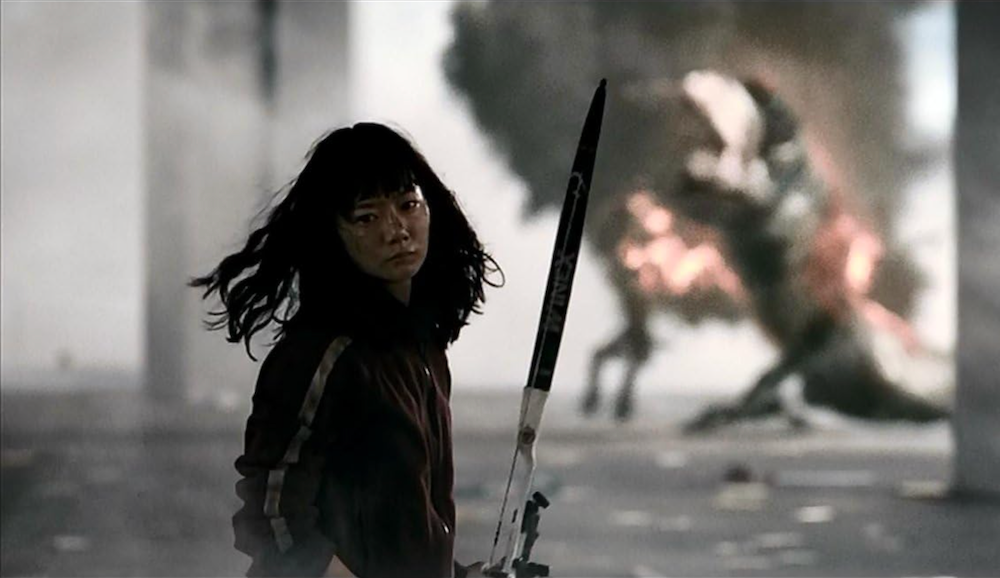
Now as a mostly bed-ridden adult, I spent most of the summer watching movies about natural and manmade disasters. Some movies combined both, such as 2006’s The Host, about a monster birthed from formaldehyde that American military personnel carelessly dumped down a drain in South Korea. Through the screen, I sought out horrific circumstances as affirmation that my material conditions could be worse.
In her 1965 essay “The Imagination of Disaster,” Susan Sontag writes, “Science fiction films are one of the most accomplished of the popular art forms, and can give a great deal of pleasure to sophisticated film addicts. Part of the pleasure, indeed, comes from the sense in which these movies are in complicity with the abhorrent.”
Sontag distinguishes between science fiction and horror as film genres. Disaster films fall somewhere between the two: some are science fiction, others horror, and many are both. Science fiction tends to locate catastrophe in technological, extraterrestrial, or speculative futures, while horror is more concerned with fear, bodily vulnerability, and the encounter with an incomprehensible threat. Disaster cinema can borrow from both genres, which in the 21st century, overlaps with climate change, pandemics, ecological collapse, and technological failure as sources of catastrophe. Her thesis on sci-fi films also holds true for disaster films that blend elements of both genres:
What I am suggesting is that the imagery of disaster in science fiction films is above all the emblem of an inadequate response. I do not mean to bear down on the films for this. They themselves are only a sampling, stripped of sophistication, of the inadequacy of most people's response to the unassimilable terrors that infect their consciousness.
By “inadequate response,” Sontag doesn’t mean that characters in disaster films respond irrationally to catastrophe. Instead, she argues that the films reflect a broader inability to psychologically and politically assimilate threats that are too enormous to understand. The catastrophe may be imaginable, but imagining such an event does not necessarily give us the tools to understand how we should respond to it. Disaster films, therefore, become a kind of cultural symptom; they transform otherwise “unassimilable terrors” into narratives to be watched, experienced, and contained within the duration of a film. Needless to say, this is something I could relate to.
Occupying a disabled body felt unfamiliar to me, and there was so much uncertainty that I had trouble making sense of it. When my physical pain was an 11 out of 10, it was difficult to envision my future in an ableist world because it was already exhausting to simply live in the moment.
Sontag’s reflections helped me understand the pleasure I derived from disaster cinema. These films give viewers like me a controlled space in which to experience fears and fantasies that might otherwise be difficult to articulate: the fear of bodily destruction, the collapse of social order, the loss of control, or even just the destruction of what is familiar. The disaster film makes these anxieties visible and spectacular, while also providing us with a safety net: we know that the catastrophe is fictional and eventually the film will end.
But what if the catastrophe isn’t fictional, and there is no end in sight? What happens when our survival is not predeterminally written into a script?
The mystery surrounding my condition left me wondering whether I would be permanently disabled. The actual disability didn’t frighten me as much as living in an inaccessible culture, in an unforgiving economic system. How do I hold down a job? I asked myself.
I struggled to emotionally process how quickly the daily sciatic nerve pain intensified, and how that pain contributed to my growing loss of mobility. Despite the speed with which this condition was altering my body and my daily life, I still couldn’t comprehend what I was losing. I couldn’t grasp that the body I knew was becoming a body I couldn’t understand.
I was also running out of time to receive a diagnosis and treatment plan.
Graduate school was starting in August. I earned a teaching assistant position in a competitive literature PhD program with full tuition funding. I worked hard to earn this opportunity and suddenly, I didn’t know if it was going to happen. While universities are legally required to make campuses accessible to disabled students and workers under the Americans with Disabilities Act (ADA), I had trouble envisioning my time on campus as a physically disabled student. While I utilized ADA accessible entrances, I was unable to open heavy doors on my own. I worried about needing maintenance to open the door for me every time I had a class. For me, the disaster was not using a wheelchair, but living in a world that is hostile towards the people who need them.
It felt like I was having a deeply personal encounter with what Sontag described as "unassimilable terrors.” The possibility of becoming permanently disabled under late stage capitalism wasn't just frightening; it felt impossible to conceptualize. Intellectually, I understood that disability could, and eventually would, become part of my future. I just didn’t think it’d be so soon.
The rage and grief inside me didn’t have a place to go, to be processed, to be moved. Because I knew that emotional distress would manifest itself physically, I unconsciously found myself looking for a way to process it: through film.
You can find Flytrap posters, tees, trucker hats, and more at our merch store!
Grab yourself our blockbuster "Keep On Fuckin'" tee for all your Labor Day barbecue needs!
Cue the Disaster Scene
While disasters can be disabling—take for example the 2019 crocodile attack disaster film Crawl in which multiple characters lose limbs to violent crocodile attacks—these injuries are framed as events. The characters are able-bodied until chaos ensues.
Watching the 2007 film Rogue, however, broke the fourth wall for me. I recognized myself in a disaster film for the first time.
In Rogue, a group of tourists become stranded in the Australian Outback after a saltwater crocodile attacks their tour boat, which then crashes into a mote in the middle of a river. As dusk approaches, high tide looms and the miniscule island will become submerged in a crocodile-infested river. When no one comes looking for them, the group of tourists attempts to cross their river and return to civilization. One attempt involves baiting a crocodile with two dead geese attached to an anchor. The effort successfully distracts the giant reptile long enough for some of the people to cross the water.
One of the tourists, Elizabeth, is a mother undergoing cancer treatment. Without access to her medication, she becomes increasingly immobile. As the group attempts to swim across the crocodile-infested water, her physical limitations prevent her from being able to make the swim on her own. Another tourist assists her to shore.
Before my summer of pain and before ever watching Rogue, I was hopeful and even confident that I could survive a disaster. But that hope didn’t hold while disabled. Elizabeth was hopeful, but why wouldn’t she be? Someone was there to assist her across the crocodile-infested waters. Without a live-in caregiver, who could carry me down the stairs if there was a house fire? I realized how unlikely it was for me to survive alone. I ruminated on how easily I could die amidst disaster.
Prior to becoming physically disabled, “it could always be worse” often meant “you could be disabled.” Now that I was physically disabled, I realized what I really feared was being disabled in a disaster.
And then one Saturday morning in mid-July, my condition took a turn toward disaster.
Just as I experienced the most painful, gruesome sciatica yet, I also had to pee. I tried and failed to walk down the stairs to the restroom. Unable to process this new level of immobility, I told myself it was okay to take a break and try again. I tried again, somehow persevering through the pain and making it down the stairs, mostly because I didn’t have another option.
When I finally sat on the toilet, I was relieved, but a new problem emerged: I couldn’t release my bladder. I shrugged it off to anxiety. I took deep breaths in an attempt to relax my pelvic floor, but it was to no avail. This went on for 20 minutes.
I tried not to panic.
I reached for my phone and called my girlfriend. “I need to go to the hospital,” I told her. It was finally time for an emergency room visit, something I dreaded on a marketplace insurance plan. “I’ll be over in a half hour,” she told me, lethargic and soft-spoken.
For me, the disaster was not using a wheelchair, but living in a world that is hostile towards the people who need them.
Hours later with a catheter inserted to finally release my urine, an MRI revealed a “yuge” herniated disc, according to the ER doctor. I also finally received a diagnosis: cauda equina syndrome, or a “medical emergency that happens when an injury or herniated disk compresses nerve roots at the bottom of your spinal cord,” according to the Cleveland Clinic.
That night, I received emergency spine surgery. By the next morning, I could stand upright and walk without pain.
If my life this past summer were a movie, my personal disaster turned into a medical emergency: frightening yet temporary and treatable. I survived the disaster, just like the characters who got me through the summer. I can attend graduate school. I can walk again. I no longer live in chronic pain.
But I can’t seem to shake the fear that we live in a society that is unrelenting towards disabled people. Many able-bodied people cannot conceptualize physical disability, let alone emotionally process it—until they become disabled. It is our inability to reckon with our fear of disability that fuels so much ableism.
When I tell people I had emergency surgery, I often share this information enthusiastically, because of how much of my “normal” life I got back. Ableism is integral to maintaining capitalism, which I now recognize as the primary reason I preemptively grieved the loss of my PhD program. Nothing was lost; the opportunity just seemed impossible to maintain while disabled.
My surgery helped me regain my mobility, but it cannot help me unsee the world I saw while physically disabled: the real disaster.
This piece was edited by Tina Vásquez and copyedited by s.e. smith