Worst Vacation Ever
Underneath every quaint small town, there's class war. It's just a little more literal in some.

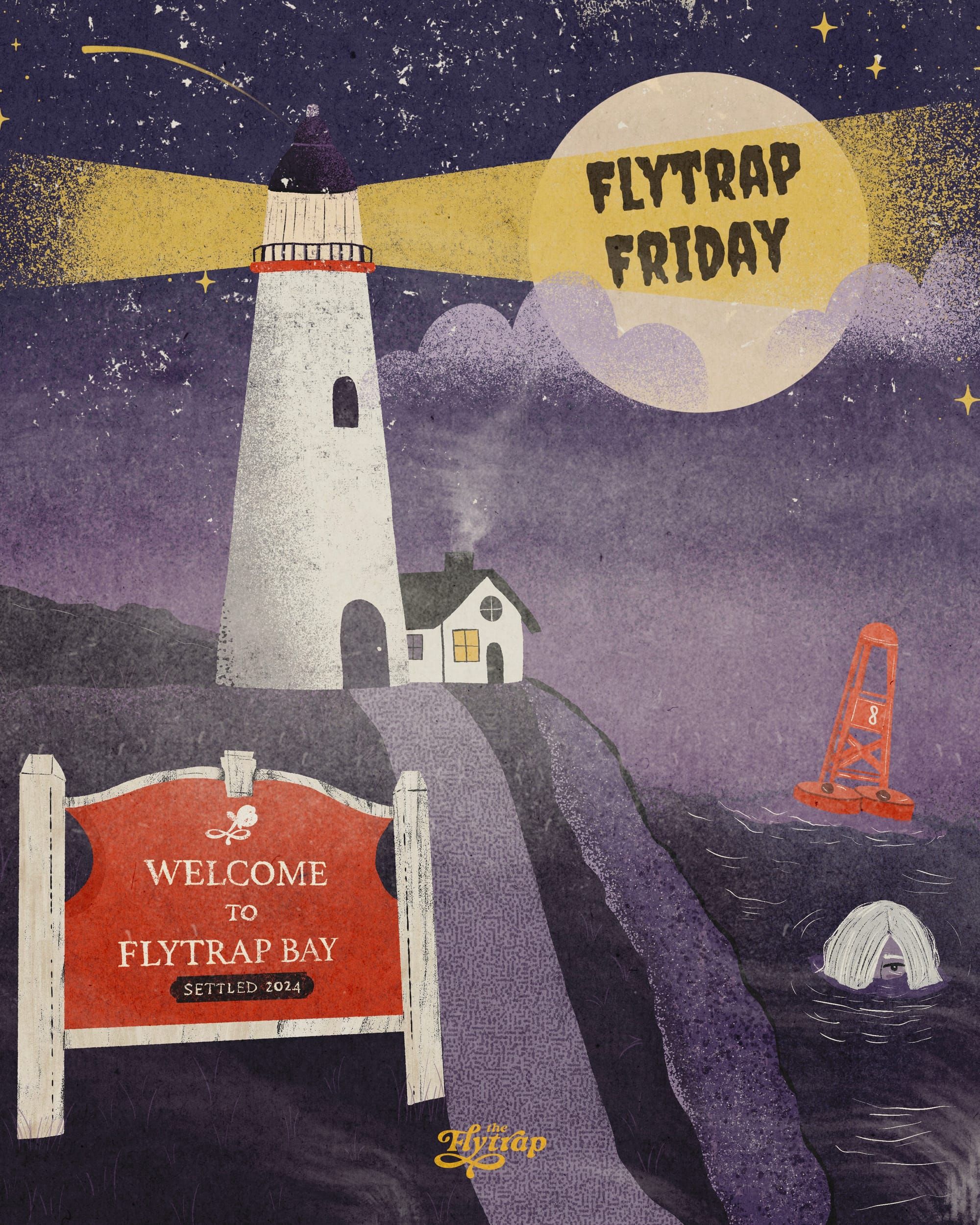
It's our annual spooky season tradition: Flytrap Fridays! Original features from the Flyteam, every Friday in October, about our favorite things that go bump in the night. Always free, but you can...
“If it’s tourist season, why can’t we hunt them?”
In my town, which is an absolute tourist trap, this is an eternal sentiment conveyed via bumper sticker on a range of vehicles, from lifted trucks with thin blue line flags in the windows to Priuses with “No Offshore Oil Drilling” placards. The local government spends tens of thousands of dollars on marketing to convince people to come here, promoting a “tourist economy” now that both the fishery and the logging industries have collapsed. This economy predominantly benefits a handful of business owners while nearly everyone else works six minimum wage jobs to afford a cardboard shack that costs $2,220 a month.
The neighboring town is even worse, caught in Victorian-adjacent amber thanks to the Historical Review Board, which “maintains character” by forcing people to get approval for any changes to their property beyond breathing near their shrubbery. (The town also hosts the Murder, She Wrote house, despite the fact the show actually takes place on the East Coast, and yes, you can stay there.)
Summer, known better as peak season, is a time of continual tourism-related frustrations in both towns, and it does lead one to, shall we say, a little wish fulfillment. What if we could hunt them, though, like for real?
Horror—good horror—is always wrapped up in larger social commentary and criticism.
This sense of pent-up frustration may explain why I have a deep and abiding affection for the pop culture archetype of the “pretty little tourist town where everything goes wrong,” usually featuring a hubristic mayor and some plucky kids. Jaws (1975) comes to mind for many people, and it is indeed a classic for a reason; I watch it with friends every Memorial Day, which tends to be the kickoff for Tourist Season. Peak camp, Jaws is truly a delight, especially when watched outside on a projector screen. And we recently had a shark attack, so, you never know (seriously though, I’m glad James is okay).
But I like things a little darker than Jaws. Creepier. More unsettling. I don’t just want everything to go wrong; I want it to go wrong in an uncomfortable, uncanny, surreal, disturbing, haunted way. I want my “what if my vacation was ruined” or “what if we really could hunt them” to come with a deeply-rooted sense of horror because horror—good horror—is always wrapped up in larger social commentary and criticism.
For a long time, people thought about horror in terms of schlock and garbage, gore and shock value, jump scares and final girls. Some of it certainly still is, whether by art, design, or carelessness, but it’s a mistake to paint all horror with the same brush. There’s a rich cultural history in horror, a beauty found in terrible things. And it’s always been here.
We’ve been telling scary stories to each other for a long time. Shakespeare’s Titus Andronicus is usually described as a tragedy, but it can be considered horror, in a way—Titus, the 1999 film adaptation, certainly leaned in on that. Dracula, published in 1897, is horror. Frankenstein, another enduring novel with a significant cultural legacy? Horror, and also evocative and compelling. Se7en (1995) is horrible, but also oddly beautiful. NBC's Hannibal (2013-2015) turns the most ghastly things into subjects of uncanny, graceful beauty—compelling and disgusting at the same time—with incredible staging. The show was a cult hit, but primarily because it connected to an existing franchise with its own built-in fans.
There is elegance in repulsion, pride and power in monstrousness.
Finally, I think the rest of the world might be catching up with me when it comes to getting on the bandwagon of understanding horror as art rather than just entertainment, as something gorgeous and monstrous that can also be extremely political. Apple TV’s Widow’s Bay (2026) feels like it was expressly made for me, from the opening minutes of the very first episode until the last minute of the season finale. I know the feeling of this township so well: Flailing for relevance, Mayor Tom Loftis (Matthew Rhys) is attempting to woo a New York Times reporter into visiting Widow’s Bay, a fictional island town in New England that can only be accessed by boat or ferry, and writing a puff piece on the town to generate tourism revenue.
When the reporter, Arthur Lloyd (Bashir Salahuddin), arrives in Widow’s Bay, he finds an obligatory cute restaurant, an oddly-menacing town history museum, and something that’s... not quite right. From the start, things go awry, with a constant, subtle, remorseless undercurrent of the supernatural. It becomes more and more apparent that things are deeply wrong in Widow’s Bay, not only for the tourists—who 100% will be hunted—but also for the townspeople and the town itself. After centuries of mayhem, the residents have come to tolerate the wild conditions, feeling themselves locked into something too big to fight.
The island town is a place where people want to pretend there’s something different, better, if only they can move out of the snarl of oppressive conditions around them.
Widow’s Bay is intensely creepy and beautiful; the cinematography works with the story, with the sets and costumes feeding into the show’s extremely unsettling nature. Here, too, we see monstrous people, both literally and figuratively, turned into something elegant, compelling. Every movement and scene is carefully staged to be an homage to the rich history of horror. The ones who get it, get it.
The show’s positioning as a comedy-horror may be one reason people felt comfortable watching it. And Widow’s Bay is funny, also tapping into a long tradition of folksy small towns in pop culture. It’s not a coincidence that Katie Dippold, a writer on Parks and Rec, created it—the two shows share so much of the same energy, down to trying to run local government on a shoestring and a prayer. But the heart and roots of Widow’s Bay lie in horror, in the knowledge small-town denizens have that we are just as fucked up as people in the big city, sometimes even more so, because secrets and lies fester and boil so intimately, hitting all of us within the confines of a one-horse town.
You can find Flytrap posters, tees, trucker hats, and more at our merch store! And if you like our Flytrap Fridays art, good news: We have that too.
All profits in September and October from our charity bandana designed by our Art Director rommy torrico will be going to Gaza Soup Kitchen.
It is a town trapped in a sacrificial relationship with mysterious powers, so some residents keep to the old ways and others live in a perpetual state of denial. No one born in Widow’s Bay can ever leave, which is also very relatable. So many of us never leave these towns, despite claiming we want out the minute we graduate high school. Others, like me, leave and return, caught in the town’s inexorable orbit. We aren’t identical, but I see much of my town—which thankfully lacks the unsettling religious symbolism—in Widow’s Bay, although we do have plenty of mysterious things that move in the night.
Every time I watch Widow’s Bay, I find some new facet and angle of intrigue, which is also a marker of good horror, a master of misdirection. You’re so amped up waiting for the needle to drop the first time around that the story only really starts to bloom on the second and third watch, once knowing what to expect allows you to start reading between the lines. The brilliance of Widow’s Bay is in the way it stands up to rewatch after rewatch, and the horror is in every layer you peel back.
Widow’s Bay just received an astonishing 14 Emmys, which brings to mind a recent horror film that absolutely crushed it at the box office and during the awards circuit: Sinners (2025), which took home four Oscars, two Golden Globes, four Critics’ Choice Awards, and numerous other accolades. In Sinners, it is the tourists who are doing the hunting during a wild, blood-soaked night of chaos. Sinners is, again, beautiful and cinematic, from stunningly long vistas across cotton fields to the aching beauty of dancing turning surreal, possessed, and strange.
At times, the visuals in Sinners remind me of Dorothea Lange’s work, which is apt, given the period (1932) and setting (the rural South), and it, too, is about so much more than its supernatural visitors. The film is also deeply informed by, as Flytrap cofounder Evette Dionne puts it, “the decadent intimacy of the Black South,” a love letter to a complex cultural legacy that can only come from those rooted in it. In the film, every moment, every twitch of fabric and thump of body, is carefully, beautifully calculated, coalescing around a story that is deeply confrontational. Horrible, yes, too.
That boundary-pushing sendup of tourism and horror also shows up in Chuck Tingle’s Fabulous Bodies (2026)—an instant USA Today bestseller. The novel is an absolute masterpiece of gonzo horror that, like Sinners, unfolds through a single night of chaos. In Fabulous Bodies, people with a deep sense of place collide with the outside world and ancient things beyond their understanding. Our heroine, Poppy, is a Palm Springs local struggling in a city that’s chosen to prioritize tourism and the wealthy over the people who actually live there. Poppy is desperately trying to make it as an influencer, but is doomed to robbing graves by night to scrape by. Fabulous Bodies is, and I say this affectionately and with delight, absolutely disgusting. I love it. Tingle deftly pulls graphic gore, over-the-top characters, and the obligatory brave female protagonist together into a glittering and mesmerizing story that contains myriad nested references beneath the blood spatters, complete with his trademark lively characters and goofery with a bite.
Is the horror the blood and gore, or is it being confronted with the realities of the ways people oppress each other, and what happens when marginalized people fight back?
What draws me to works like this isn’t just the pleasure of thinking about how delightful it would be to see the asshole tourist who wasn’t paying attention and almost hit me and a friend while we were crossing the street absolutely eat shit. It’s also the exploration of what it’s like to live in the shadows—the service corridors, the places that make tourist towns possible, when no one wants to admit that you exist. We are the people building strength and solidarity together, screaming in the walk-in, cleaning revolting hotel rooms, enduring untold hours of abuse behind the counters at quaint shops. These are narratives about culture, class, and identity, three things that lie deep beneath the surface of some of the greatest works of horror. At times, readers may not realize that they are not the target audience, but the butt of the joke, the source of the critique, and the vexing problems these narratives are trying to solve.
There is a sweet pleasure in the solidarity of inside jokes, the knowledge that the people you are mocking are so self-absorbed that they think everything is about them without fully realizing what “about” means in this context. The macabre hilarity embedded here is not simple comedy, but a reflection of the dark humor so many of us have to deploy because we will scream if we do not. Is the horror the blood and gore, or is it being confronted with the realities of the ways people oppress each other, and what happens when marginalized people fight back? Is the horror in bodies deemed monstrous, in any number of themes around marginalized identity, or is it in the way you are treated because of who you are, the misunderstood ghosts and things that go bump in the night who are just trying to communicate? The ghosts who are just vibing?
At the same time, these works also probe at what it means to see what’s around you, surrender to the inevitable, and position your home—the place you are rooted—as a commodity to buy and sell, so by extension, you are a commodity, too. In Widow’s Bay, there’s a sharp tension between the mayor, forever an outsider, and the locals, who he refuses to listen to about the dangers in the town. Mayor Loftis thinks that if he can just get his in the end, all of the strife will be worth it. But even that raises a question: What’s the difference between those willing to betray and sacrifice their communities in the hopes of getting a sliver of something better, those who stand in solidarity with their comrades, and those who pretend to be pawns in the game but are actually its architects?
The White Lotus, an anthology series on HBO, is perhaps the most heavy-handed about this “service workers versus the world” framing. For those willing to sit and actually look in the mirror we hold up, horror can reflect something about ourselves. (And yes, a thread of horror runs through The White Lotus, even if it is not what viewers conventionally think of as horror.) The show wraps merciless cultural commentary around stunning locales and sharply critiques our cultural values around wealth and power by dunking on rich people vacationing in expensive locations. By the way, the amount of on-location filming for The White Lotus is extremely ironic, with the show’s own production engaging in the very extractive practices it sets out to mock.
Hey there, comrade! You obviously love feminist media because you've gotten this far. Support us by becoming a member: We're offering you a week-long free trial!
Those who serve laughs because they will otherwise scream endure the endless horror of being treated like a playground for the wealthy and selfish. Those who walk the tourist path see something in The White Lotus, perhaps even getting an imagined glimpse into how the other half lives while assuring themselves that they aren’t like those tourists. They’re built different. The service workers who lay that path, rake it, and keep it weeded, find something else: A few hours in which they get to channel all the things they keep inside into imagining that this time, maybe the house loses.
But the house always wins. In Widow’s Bay, the mayor thinks selling the town out is the path forward, while he fixedly refuses to reckon with the town’s past—even though history will find Loftis whether he likes it or not. In Sinners, Smoke and Stack (both played by Michael B. Jordan) set up a juke joint as they return home to Clarksdale, Mississippi, their community that they have a complicated relationship with, but this is a segregated town where sharecroppers are paid in scrip rather than cold, hard, cash. This reality begins to warp their dreams, even before the vampires arrive In Fabulous Bodies, Poppy longs for validation and status, and learns that her heroes are more, or sometimes less, than they appear. In all three, the horror is in watching characters realize what so many of us already know: You will always lose, unless you’re willing to burn the house down and walk away.
The hunger for ambitious horror suggests that we may finally be breaking containment, not just on horror itself, but also on the themes these works explore. Parasite (2019) resonated so sharply with global audiences for a reason. A growing number of readers and viewers are coming to the slow understanding that they may be closer to the servant than the served. As we look around a world dominated by a handful of obscenely, perversely wealthy horrible men who have turned everything into their piggybank—a grotesque parody of the most terrifying monsters horror has to offer—it’s impossible to deny who the villains are.
Horror is fundamentally an exploration of power and control, whether blunt or subtle. It is deeply subversive. Dismissed as “genre,” horror becomes a container for some of our violent impulses and our longing for a decisive resistance to oppression. Horror, then, is a perfect vehicle for the class and culture politics of a tourist town against the world—served versus server. It upends our expectations about the bucolic sleepiness of small towns and idyllic tourist destinations, places where nothing bad happens and everyone knows your diner order. These are places of passivity and tradition that also hold unexpected depths. Those who are written off as simple know their worth.
Why not turn “eat the rich” into something a little more literal?
This piece was edited by Nicole Froio and copyedited by Evette Dionne.