
We Got Women’s Safety All Wrong
Not only does gender-based violence remain pervasive, narratives of fear are successfully pushing us toward increasingly carceral solutions.

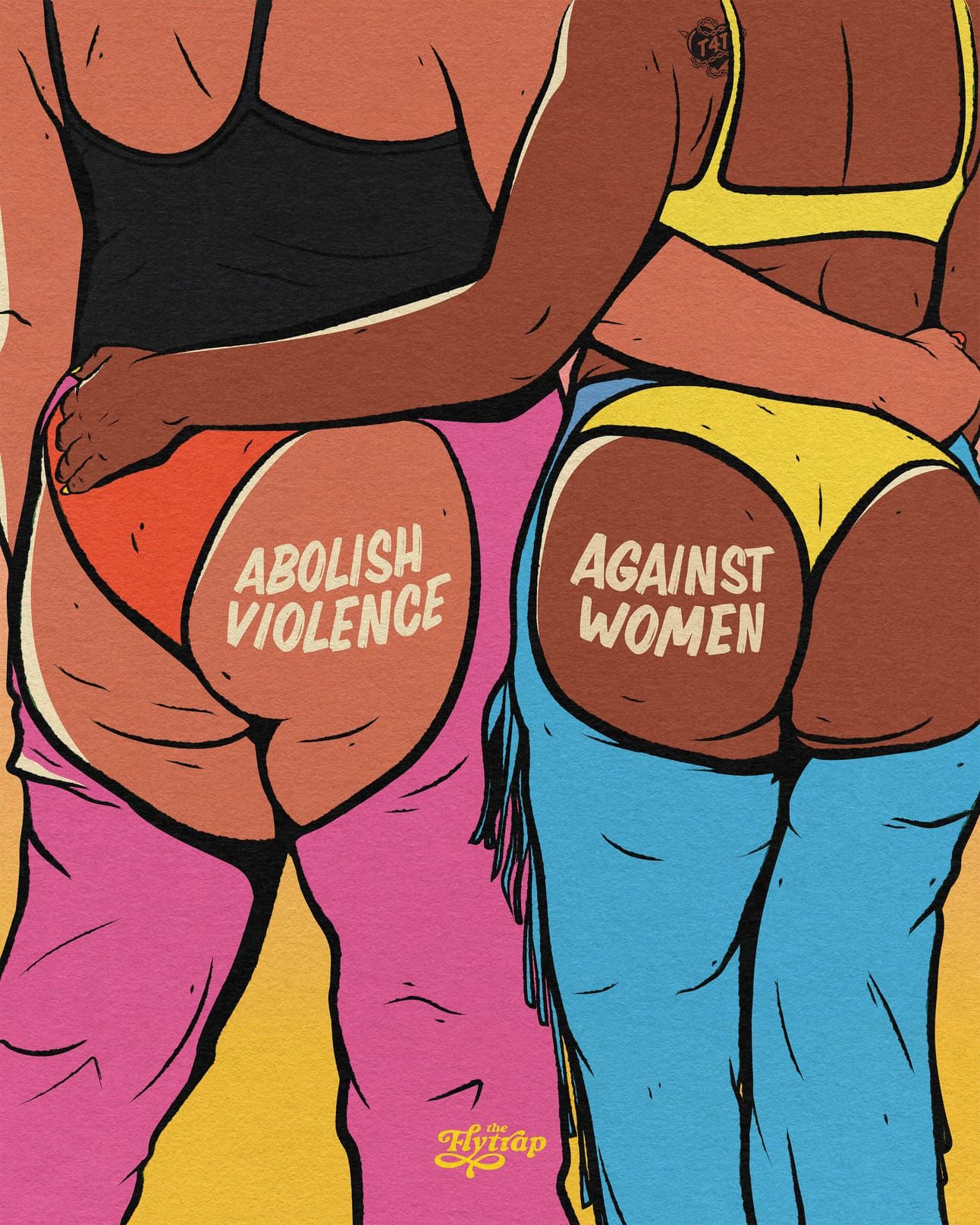
Note from The Flyteam: The Flytrap merch store is now open! Buy a poster and/or stickers of the art for this piece or get dripped out in the latest Flytrap merch. ALSO: The Flytrap is a Bookshop.org affiliate. If you buy a book we mention or recommend in the post below, we may earn a small commission.
There is no denying that a patriarchal society is dangerous for women, but the rhetoric of women’s safety has historically been used to justify state violence, incarceration, and the social exclusion of some of the most marginalized people. While abolitionist feminists note that the weaponization of violence against women to increase police powers and racialized incarceration isn’t a new phenomenon, the divisions sowed by a politically empty feminist analysis of gender-based violence are accelerating as authoritarianism is on the rise globally, making scapegoats out of whole populations and, importantly, not actually solving the issue of women’s safety.
Patriarchy is everywhere, including right next to you, and the challenge that abolitionist feminism poses is that to actually protect women, to really hold perpetrators to account, society has to change completely. Radical change is required to keep people in our communities safe, both internally—in how we see ourselves, in how we understand our desires, and each other, and externally—how power and work are organized in society, how we deal with harm, and how we distribute resources. While there are many kinds of feminism, this is what I personally and politically understand as a feminist movement: The world needs a complete overhaul to finally destroy patriarchy.
But the issue of women’s safety, and white women’s safety in particular, has historically been co-opted to destroy communities rather than transform them; to tear them apart before accusations of sexual violence and deviancy are truly investigated or verified. These moral panics around sexual violence almost always direct the public look to places where violence is not actually happening. For example, think of QAnon’s claims of child sex trafficking and how believers of the conspiracy theory looked away from Donald Trump’s admission to sexual violence and harassment. Or Hillary Clinton’s infamous “superpredator” claims, which aided in the disproportionate incarceration of Latino and Black men while Bill Clinton took advantage of White House intern Monica Lewinsky. (Lewinsky herself was only able to process her experience as an abuse of power after #MeToo.)
Despite how these moral panics unfold, women’s safety is still a real issue that has to be solved. Our lives depend on it. When the #MeToo movement picked up on social media, women who lent their testimonies to the hashtag shifted several paradigms about sexual violence. Similarly to consciousness-raising circles of the 1960s, women shared their encounters with sexual violence and harassment at work and dispelled the common belief that workplace sexual violence isn’t commonplace. They also exposed how allegations of workplace sexual violence aren’t believed by authorities, employers, and the wider public. Challenging the neoliberal notion that patriarchy is defeated in the workplace simply because women are now allowed to work, the women who posted under #MeToo helped expose that patriarchy is, in fact, everywhere—especially in the workplace.
The world needs a complete overhaul to finally destroy patriarchy.
According to numerous studies done in the last 30 years, approximately 80% of rapes are committed by someone who is known to the survivor. It could be a friend, acquaintance, family member, or neighbor. Usually the perpetrator is the same race or ethnicity as the survivor. Rapists and sexual harassers are usually a part of our communities and the systems we navigate daily—the workplace, the nuclear family, our broader communities—work very hard to protect them. Hence the need for radical and complete societal transformation, one that addresses women’s material and social subjugation and makes our interpersonal relationships more equal. This transformation could diminish the occurrence of gender-based violence before it happens, instead of aiding and abetting a patriarchal society in which perpetrators are only punished after the fact, vast populations of traumatized women to navigate an increasingly misogynistic world.
The use of women’s safety rhetoric to justify state violence does not cancel out that women’s safety is a very real problem. In fact, strengthening police powers makes violence against women objectively worse, since police routinely ignore red flags in cases of domestic violence, Black women are also victims of police brutality, and police officers perpetrate domestic violence at a higher rate than the general population. But the reality of women’s subjugation outside systems of policing is exactly why the specter of sexual violence against women is so effective in turning the public against marginalized communities. Feminists who purport to have an intersectional analysis of society have a duty to challenge narratives that weaponize violence against us to marginalize, exclude, and oppress other minority populations. This fear mongering is being deployed in our name, for our supposed safety, especially as President Donald Trump ramps up his authoritarian rule over the United States by sending the national guard and active duty military to combat protesters he calls “bad, sick people.”
Identifying Specters
It’s easy to control people when they are scared, which is why identifying the specters of sexual violence that supposedly threaten women’s safety is necessary to dispel myths, build unity between communities, and strategize around threats of actual violence. What is actually behind specters of sexual violence that authorities tell us to fear? How are these specters encouraging division?
I have identified three specters of violence against women that destroy and divide communities in the United States and beyond.
The first is the deployment of narratives of fear in the systematic destruction of trans rights globally, especially in the U.S. and the United Kingdom. This specter draws directly from women’s fear of sexual violence in women’s spaces, where trans women are cast as men posing as women with the goal of perpetrating sexual violence against cis women. The social inclusion of trans women and their ability to enter women’s spaces and exist publicly as women becomes a matter of “safety” for cis women. This specter is deployed despite the fact that trans people are four times more likely to experience violent crime than cisgender people and that, again, sexual violence perpetrators are more likely to know their victims. But fear is effective; it makes trans women into monsters even though they are more likely to be victims of violence due to misplaced transphobic fear. The dehumanization of trans people also directly affects their access to life-saving health care, as we saw in the recent SCOTUS ruling that upholds a Tennessee law that outlaws gender-affirming care for trans youth.
The second specter of violence I have pinpointed is becoming worse as I write this: Trump’s campaign against migrants. Casting migrants, especially migrants of color, as “drug dealers, criminals, rapists” since at least 2016, Trump’s own violence against women has been widely reported on and conveniently ignored by Republicans.
Earlier this year, the White House claimed it has removed “killers, rapists and drug dealers” from the streets. Never mind that 90% of the migrants deported to a mega-prison in El Salvador had no U.S. criminal record, and that it’s pretty fucking clear that the Immigration and Customs Enforcement (ICE) is racially profiling anyone they suspect of being a migrant—regardless of whether the agency has a legal warrant. The creation of ICE in 2003 as a response to 9/11 was a turning point for how the U.S. deals with immigration, renewing its efforts to patrol borders and remove “illegal aliens” for the safety of the American population. The specter of gender-based violence in this case are brown men who are framed as an inherent danger to white American women.
An example of this is the Laken Riley Act, a law with bipartisan support that Trump passed in January. Named after a white woman who was murdered in Georgia by an undocumented migrant previously charged with theft, the law allows ICE to detain migrants without bond who are accused of certain crimes. Under the law, an arrest based on a fake accusation or a confession is enough for ICE to detain a migrant indefinitely, according to the National Immigration Project. In New York and Indianapolis, early applications of the law earned young migrant boys indefinite detention and potential deportation for shoplifting charges. Passed due to fear mongering about the need to protect white women from murder, the law also allows state attorneys general to sue federal authorities over which immigrants are detained or released and grants the ability for state authorities to block visas. In short, gender-based violence justifies the strengthening of fascist policies and politicians.
While Trump’s current immigration policies terrorize migrant populations, it’s worth noting that the number of deportations under former Democratic President Joe Biden surpassed Trump’s during his first term. Unfortunately, specters of violence against women—and violence more generally where racialized populations are cast as inherently dangerous—are deployed by both sides of the American political spectrum.
Finally, narratives of fear are also being deployed to justify, aid, and abet the genocide of Palestinians in Gaza. After the events of Oct. 7, 2023, my social media feed was flooded with claims of mass sexual violence perpetrated by Hamas against Israeli women. In Dec. 2023, the New York Times published an exposé on Hamas’ use of rape as a weapon of war, a report that has now been widely debunked by The Intercept, Al-Jazeera, and other publications. Rape is often used as a weapon in war and I don’t dispute that it was used on Oct. 7, but the New York Times report about mass rape was so baseless and shoddily reported that multiple journalism professors called for it to be reviewed. The omission of how common sexual violence against Palestinian women is by members of the Israeli Defense Forces (IDF) was also a convenient sleight of hand. The specter of Hamas rapists and terrorists justifies the continued slaughtering of Palestinians and the ongoing rape and torture of Palestinians in facilities such as Sde Teiman, all in the name of defending Israeli settler women from hypothetical sexual violence.
The perceived lack of safety loop posed by countries in the Middle East was officially closed June 22 when President Trump chose to bomb Iran, destroying the country’s nuclear program and inserting the U.S. into Israel’s war. Days before, Israeli Prime Minister Benjamin Netanyahu claimed his war against Iran was in part, about liberating Iranian women from their own government. However, it remains unclear how bombing civilian areas will improve women’s rights. We have been here before and soon, we will hear the narrative that Iranians are inherently a threat to the world, leading to more police and border control within the U.S.
These three examples cast sexual violence as an issue to be solved with state violence, incarceration, and the slaughtering of people who are deemed too violent to live in society. In all of these cases—rest assured there are others, but it’s beyond the scope of this newsletter to list them all—fear is used to demonize a population as undesirable, thus justifying their extermination or social exclusion. To look beyond fear is indispensable feminist praxis.
A Feminist Society is a Society Without Fear
The destruction of patriarchy will not happen through the arm of the state or the strengthening of law and order. It is urgent that we understand this, and that we recognize that both Democrats and Republicans support the toughening of the state as a solution for an increasingly unsafe society, without ever actually addressing the root causes of unsafety. Patriarchy and inequality must be addressed together, otherwise we are doomed to repeat the same cycle of societal violence.
A feminist future is one where gender-based violence no longer exists, not one where gender-based violence still exists but we depend on the state to punish perpetrators.
Abolitionist feminists have warned for years that liberal feminism’s support for incarceration and policing as a solution for women’s safety does not keep women safe; it actually makes society more unsafe for women. Incarceration and policing are often used to criminalize women’s attempts to escape their abusers, court proceedings to incarcerate perpetrators of sexual violence regularly retraumatize survivors, and now, an increasingly prohibitive legal landscape for seeking abortions is deploying the police and the state against people seeking reproductive health care. Undocumented women who suffer domestic violence can now be detained in shelters due to the Department of Homeland Security rescinding its “sensitive zones” policy that allows ICE to carry out enforcement in churches, schools, shelters, and other locations previously thought of as off limits. Additionally, sexual violence in carceral systems runs rampant and the police can also be a perpetrator of this violence, such as in the case of Haitian immigrant Abner Louima. This is not the future abolitionist feminists imagined when advocating for societal transformation around gender hierarchies.
A feminist future where all women are protected requires that we respond to these specters of gendered violence with non-carceral solutions as well as principled positions against militarization and incarceration. I no longer want to mourn women who lost their lives to their partners while we hope the perpetrators of violence are arrested and punished. I no longer want to hear women tell their stories of sexual violence and harassment, hoping people will believe them. A feminist future is one where gender-based violence no longer exists, not one where gender-based violence still exists but we depend on the state to punish perpetrators.
This piece was edited by s.e. smith and copyedited by Tina Vasquez.