Meet a Founder: Nicole Froio
I see cultural criticism as a way of saving our brains from the stasis the overlords obviously crave for us.


Welcome to our Meet the Founders series! Once a month, you will receive a juicy interview with one of The Flytrap's founders so you can get to know each founder better. Each founder makes The Flytrap special, and we wanted to share why, offering a glimpse at each individual worker-owner's politics, hobbies and reading habits. This month, we are talking to Nicole Froio, who has been writing about feminism and pop culture for over a decade, works as a freelance journalist, and runs our social media accounts. You can follow Nicole on Bluesky.
The Flytrap: A big part of being a The Flytrap founder is believing that feminism is still a worthwhile political framework. So, what first brought you to feminism?
Nicole Froio: I became interested in feminism during the boom of girlboss memoirs in the early 2010s. I was fresh out of college and trying to figure out who I was in the world, and in those books—Bossypants (2011) by Tina Fey and Yes Please (2013) by Amy Poehler, just to cite a couple—I found language to explain my own experiences of being dismissed or looked down on because of my gender. Today, I wouldn't exactly recommend those books as feminist, but they inspired me to look for more books about the experience of being a woman. I used to be really ashamed of having found feminism through such a painfully mainstream path, but ultimately, it doesn't really matter how you get into feminism. What matters is that you find it in the first place, and keep looking for more knowledge, frameworks, and writing that expand your feminist lens beyond that first step.
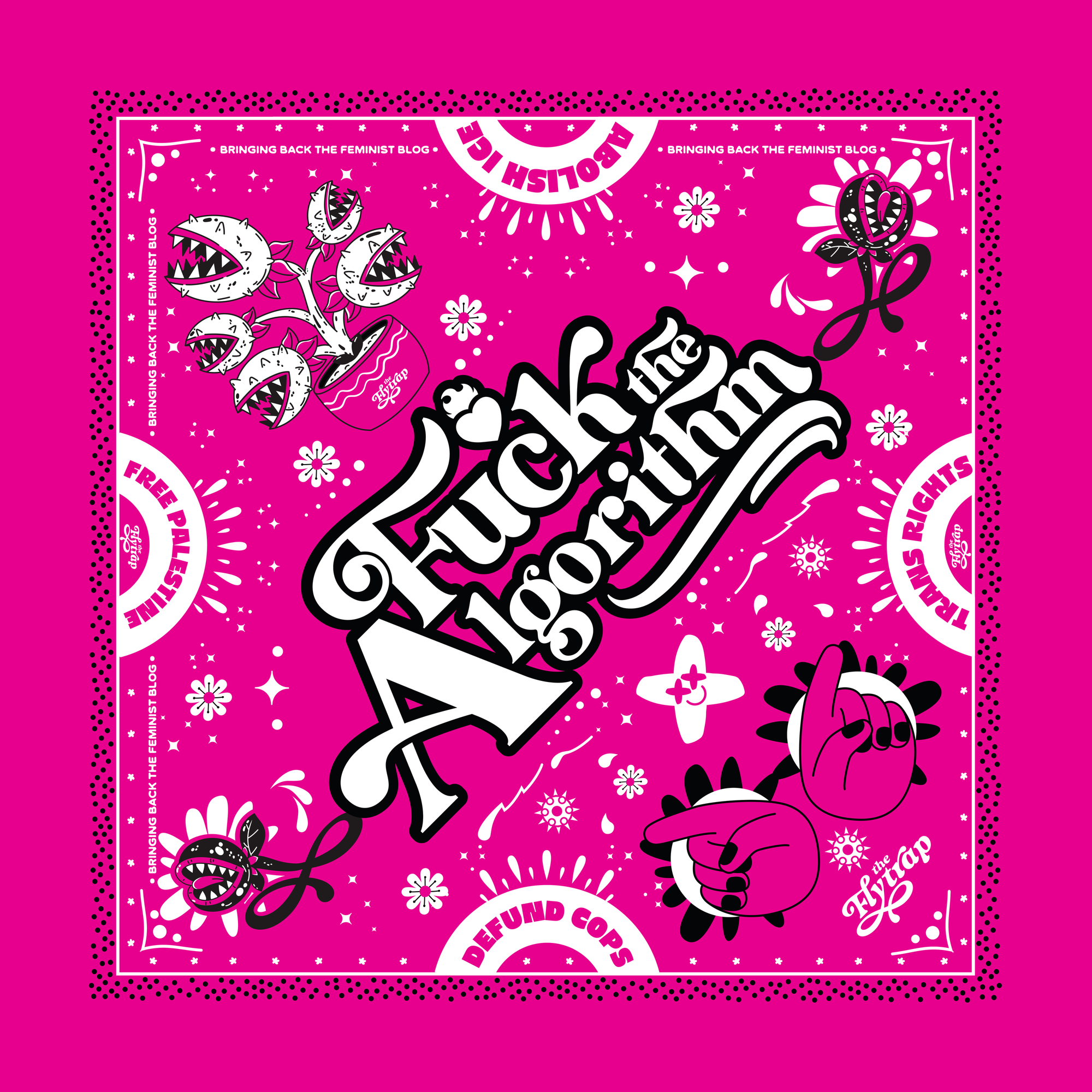
Contributing to our community is very important to us at The Flytrap.
All profits in July and August from this fantastic bandana designed by our Art Director, rommy torrico, will be going to the Homeless World Cup Foundation, which supports unhoused people all over the globe with football programs.
TF: Another big part of The Flytrap is insisting that cultural criticism still matters, even at a time where media execs and Big Tech fascists keep insisting it's useless. Why do YOU think cultural criticism still matters?
NF: I think cultural criticism matters precisely because media execs and fascists dismiss it. In a world where media consumption is constant, I don't see any other way out other than media literacy and cultural criticism. We might want to hide away in the mountains from all this slop, but other people won't do the same, they're just going to consume it uncritically. So I see cultural criticism—that is, engaging with the media we consume critically rather than just eating it up like slop piggies—as a way of saving our brains from the stasis the overlords obviously crave for us.
TF: What's your favorite thing to cook when you don't feel like cooking?
NF: I love anything I can just throw in a blender and eat with chips. Guacamole, hummus, chunky salsa—all of these are valid. If I do have a little bit of energy to cook, I'll probably do vegan plantain ceviche, which does require a lot of chopping, but is fairly smooth-sailing once the chopping is done. I just eat big bites on top of tortilla chips.
TF: What's a forgotten or underrated piece of feminist media that you love? Why is it feminist?
NF: When I think about feminist media, I always remember how in Living a Feminist Life, Sara Ahmed analyzes three feminist movies: 9 to 5 (1980), Persepolis (2008), and Born in Flames (1983). These three films depict different kinds of feminist struggles and different women trying to reckon with them. 9 to 5 is a film about women in the workplace (Jane Fonda, Lily Tomlin, and Dolly Parton play the main characters), and the oppressions they face outside of the home, under sexist, violent, and womanizing bosses. Born in Flames, a film by Lizzie Borden, tells the story of an insurgent army of women who fight against a socialist American government that does not recognize the struggles of Black women and lesbian women. And Persepolis tells the coming of age story of Iranian graphic novelist Marjane Satrapi, delving into Iranian history, the dangers of imperialism, the cruelties of authoritarianism and the alienness of being transient.
You can find Flytrap posters, tees, trucker hats, and more at our merch store! Tell the world: FUCK THE ALGORITHM.
TF: What are some of your favorite cultural criticism pieces that you've ever read and why?
NF: It really sucks that a lot of the ones I can remember are now completely unlinkable because the websites that published them died. I often think about Flavia Dzodan's "My Feminism Will Be Intersectional Or It Will Be Bullshit" and how it changed the direction of my own feminist lens. I also often think about bell hooks' takedown of Beyoncé's Lemonade in 2016, in which she insisted the album was not radical or revolutionary, a contention that caused a seismic shift in online feminist communities. There were a lot of things hooks got wrong—she never seemed comfortable taking femme people very seriously—but her review contradicted almost every single review I read at the time, which is what made me think she was right about the album not shifting structures like many other commentators were claiming. The best cultural criticism makes you feel uncomfortable and both of these pieces did that to me, leading me to actually think in ways I hadn't before.
TF: What's a piece of cultural criticism you've written that you consider to be an addition to the Discourse(TM)?
It's probably my deep dive into how the #MeToo movement was co-opted by the market via the book publishing industry for Harper's Bazaar. It's a really heartbreaking piece about how women's stories were being mediated by capitalism, and whose story was more marketable (usually white women's).
TF: What's your favorite feminist book and why?
NF: I have two favorites. The first is Teaching to Transgress: Education as the Practice of Freedom by bell hooks, because it outlines some methodology for cultural criticism, although hooks has refused to really do so more overtly. And Gloria Anzaldúa's Borderlands/La Frontera: The New Mestiza because it gave me language to think about my own experiences of crossing borders and the racialization of immigration in the U.S. and Europe.
TF: Why did you agree to be a part of The Flytrap in the first place?
NF: Because I was really tired of seeing cultural criticism and feminism simply disappear. And my voice isn't really welcome in most publications. I'm an anarcho-feminist, so much of my work is outside the scope of mainstream discourse. I don't really care that much about commenting on the issue of the day, and I felt that most publications were asking me to do that. I wanted to help build a place that didn't follow the whims of techno-fascists on social media.
TF: What are your hobbies?
NF: I have way too many. I play percussion in a brass band, I crochet, and I am learning how to sew. I am also an avid reader and I love films. I am unfortunately a person who goes to cross fit classes because it helps me to stay sane. And whenever I can, I work on my book proposal.
TF: Who is your least-favorite billionaire?
NF: There's way too many to choose from. I've been feeling really depressed about AI ruining everything I love, so Sam Altman and all his little AI startup billionaire friends will forever be on my shitlist.