Meet a Flytrap Founder: rommy torrico
Flytrap worker-owner rommy torrico reveals their love for Golden Girls, thrifting, and watching movies.
Welcome to our Meet the Founders series! Once a month, you will receive a juicy interview with one of The Flytrap founders so you can get to know each founder better. Each founder makes The Flytrap special, and we wanted to share why, offering a glimpse at each individual founder's politics, hobbies and reading habits.
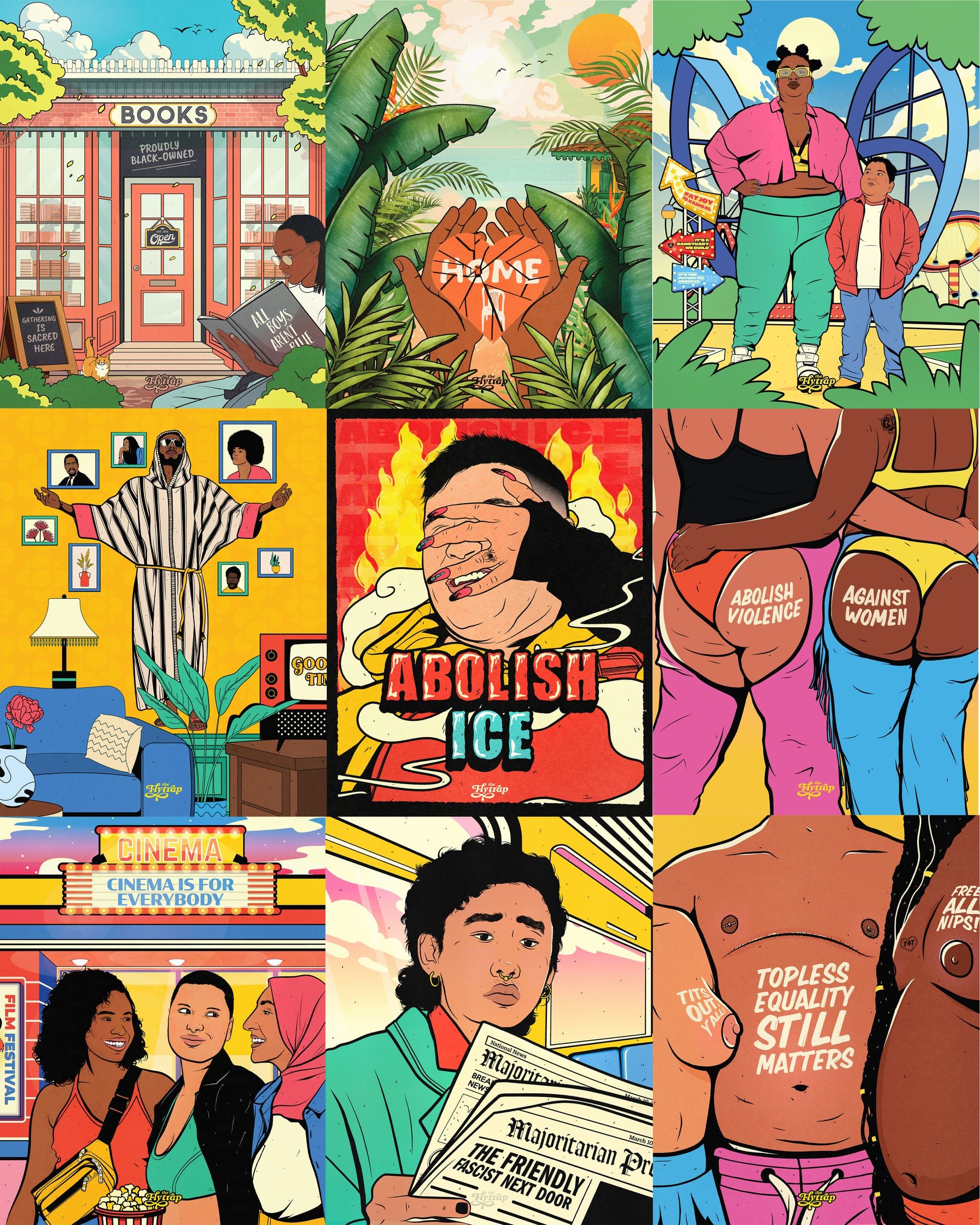
This month, we are introducing you to rommy torrico, The Flytrap's art director and the creative force behind The Flytrap's aesthetic excellence. rommy is a formerly undocumented, queer, trans nonbinary visual artist born in Iquique, Chile, raised in Florida and currently residing in Durham, NC. They’ve been involved in social movement spaces encompassing (im)migrant, queer and trans rights struggles for two decades. Their work delves into the nuances of life to portray the stories of their communities beyond a flattened or binary experience. torrico’s art has been included in several publications and exhibited at the Getty Museum, the Smithsonian Museum, the Library of Congress, and the Museo Nacional Centro de Arte Reina Sofía as well as many galleries and museums throughout the Americas and internationally. And, of course, you can see their work here at The Flytrap, and even buy prints of many of torrico's illustrations.
The Flytrap: A big part of being a The Flytrap founder is believing that feminism is still a worthwhile political framework. So, what first brought you to feminism?
rommy torrico: my own experience as a queer, trans migrant living in the empire as undocumented for 1/4 century definitely pushed me to seek and help co-create worlds when the ones offered to me had no place for me. over the years, as I had the privilege of hearing and archiving the stories of other migrant QTBIPoC folks and having those same people invite me in to the spaces and futures they were collectively building, all the pieces just fell into place for me. I saw what we could have and realized my piece and place in the larger, collective whole.
TF: Another big part of The Flytrap is insisting that cultural criticism still matters, even at a time where media execs and Big Tech fascists keep insisting it's useless. Why do YOU think cultural criticism still matters?
rt: Our reality is now ruled by clickbait and bite-sized bits of content that we are meant to absorb and repeat back, without context or a bare-minimum analysis at best. In a world where so much of our daily lives is centered around convenience, distraction and consuming things as quickly as possible, thoughtful and nuanced cultural criticism ask us to pause, reflect and hopefully engage more deeply within the context we're living in.
TF: What's your favorite thing to cook when you don't feel like cooking?
rt: Bread and butter (sometimes cheese if past me made good choices)
TF: What's a forgotten or underrated piece of feminist media that you love? Why is it feminist?
rt: Probably not forgotten or underrated but I do love the Golden Girls; a crew of elders unabashedly living all aspects of life to the fullest, preserving the art of storytelling, celebrating each other in kinship and still learning from each other and the world every day.
Hey there, gentle reader! Did you know we run original features every Tuesday for The Flytrap's paid members? Consider upgrading your membership to get full access to our archives! Our memberships start at $6.66/month for the budget conscious...
TF: What are some of your favorite cultural criticism pieces that you've ever read and why?
rt: really enjoyed Nicole Froio's piece, "'DeBÍ TiRAR MáS FOToS' is Bad Bunny’s Latest Decolonial Text." As a formerly undocumented Chilean migrant, themes around displacement, loss and home are ones i continually come back to over the years. I was particularly moved by her explanation of how art (in this case music, and in my case illustration) is a way to archive our memory, history and feelings during times when the empire deems them (and us) as dangerous things that should be erased.
TF: What's your favorite feminist book and why?
rt: I've always loved Octavia Butler's Parable of the Sower and recently read Kung Li Sun's Begin the World Over (so good)! Parable of the Sower was one of my first introductions into the frameworks of liberation as a collective process and practice, and that we get to create the worlds we want and need. Kung Li continued with those frameworks in their book and incorporated gender expansiveness as something to be celebrated as divine, something that has always existed-drawing from the life of historical transcestors who have led the way to liberation.
You can find Flytrap posters, tees, trucker hats, and more of rommy's delightful designs, along with work created by Flytrap freelancers, at our merch store!
TF: Why did you agree to be a part of The Flytrap in the first place?
rt: I wanted to be part of a collective of values-aligned folks who not only had sharp analysis and feminist frameworks but also were just tender and intentional baddies. another pull was that this would be structured as a worker-owned space that could put out pieces that we were wanting to read (and create)/pushing against the algorithm at every step of the way.
TF: What are your hobbies?
rt: I recently had the opportunity to explore clay modeling and made little derpy-looking creatures full of whimsy–would recommend to friends and am excited to continue my mini derp menagerie. Always nice to be able to work with my hands vs doing work on a screen. ALSO LOVE THRIFTING, WATCHING MOVIES, DISCOVERING NEW MUSIC AND LAYING IN BED IN THE DARK IN COMPLETE SILENCE.
TF: Who is your least favorite billionaire?
rt: Musky Musk takes the cake