Meet a Flytrap Founder: Tina Vásquez
Flytrap co-founder and worker-owner Tina Vásquez talks about what brought her to feminism, her favorite risotto, and her least-favorite billionaire.

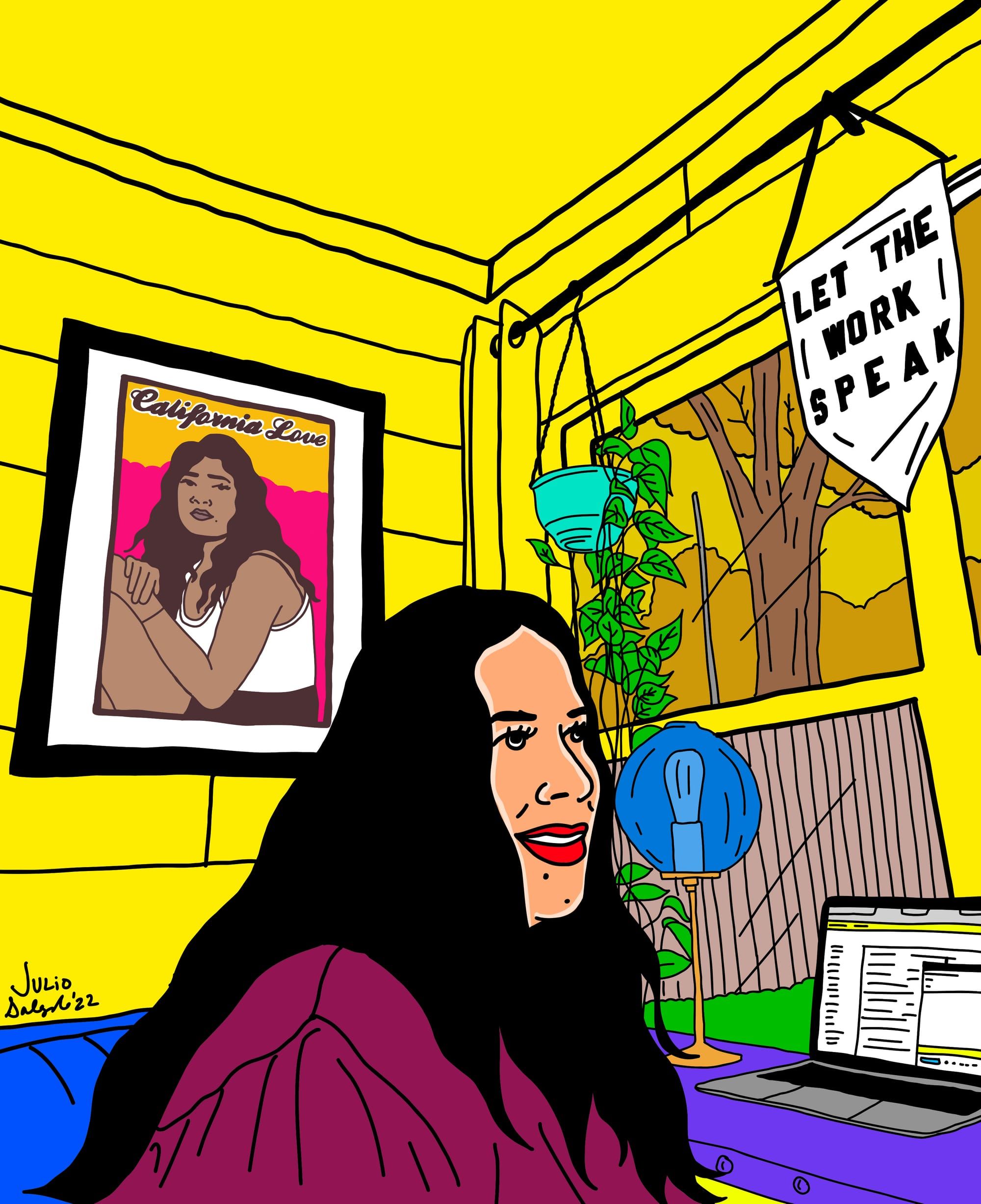
Welcome to our Meet the Founders series! Once a month, you will receive a juicy interview with one of The Flytrap's founders so you can get to know each founder better. Each worker-owner makes The Flytrap special, and we wanted to share why, offering a glimpse at each worker owner's politics, hobbies and reading habits. This month, we are talking to Tina Vásquez, a veteran immigration reporter and thrifting enthusiast who currently works at features editor at Prism. Tina is a sharp editor, a killer reporter, and the kindest co-worker in the world.
The Flytrap: A big part of being a The Flytrap founder is believing that feminism is still a worthwhile political framework. So, what first brought you to feminism?
Tina Vásquez: I owe so much of my life to punk rock, including feminism. I was a young kid in the '90s and through my older brothers' love of Nirvana, I found my way to riot grrrl. Bands like Bikini Kill, Sleater Kinney, and Bratmobile led me to a broader feminist punk movement that really saved my life as a young person—especially in middle school. Around the same time, an English teacher introduced me to journalism, letting me use the school newspaper to publish baby feminist screeds and write-ups about local punk bands. "Speaking truth to power" felt like a feminist act to me, and very punk rock. Years later in my 20s, one of my first Bitch Magazine bylines was an interview with Mimi Thi Nguyen about her essay "Riot Grrrl, Race, and Revival," which was the first time I can recall anyone discussing the overwhelming whiteness of the feminist punk movement. It felt like a full circle moment, and like feminism led me down the media path I was meant to be on.
TF: Another big part of The Flytrap is insisting that cultural criticism still matters, even at a time where media execs and Big Tech fascists keep insisting it's useless. Why do YOU think cultural criticism still matters?
TV: I once interviewed Janet Mock about her love of pop culture and her show "So Popular!" that used a feminist and social justice lens to explore pop culture, while also aiming to have deeper conversations about shows such as The Real Housewives. Something I've thought of a lot over the years, especially as feminist media imploded, is how Janet said pop culture is "our culture." Pop culture is seen as "lowbrow" for many complicated reasons largely related to race and class, but as Janet said, it's always been just as worthy of analysis. I think it's really easy to dismiss shows such as The Real Housewives, though there are many, many complicated dynamics in the series related to gender, race, class, sexuality, etc. Writing a thoughtful, insightful, and scathing critique that challenges how people view and consume and understand pop culture is not easy! It's an art form that matters, and it's one that we're losing in the dumpster fire that is today's media landscape.
TF: What's your favorite thing to cook when you don't feel like cooking?
TV: This oven risotto recipe from Yvette van Boven's cookbook "Home Made." I've given this recipe to dozens of people and so many of them have told me that it's now a staple in their homes. It takes 30 minutes and as long as you follow the rice-to-liquid ratio, this recipe is endlessly adaptable. You can make it vegan. You can throw in whatever veggies/meats are on their way out. You can just use pantry items. Make it yours!
TF: What's a forgotten or underrated piece of feminist media that you love? Why is it feminist?
TV: As teens, my first girlfriend and I became really obsessed with this book by Andrea Juno called Angry Women in Rock: Volume One that she found at the local public library. We must have checked it out more than a dozen times. Fast forward more than 20 years and I recently found a copy at a used book sale and I'm happy to report the book is still fucking fantastic. The questions, the framing, the people featured, it's all overtly feminist. On the back of the book, there's a quote from Tribe 8's Lynn Breedlove that sums up the spirit of the book: "Yes, I meditate and have a spiritual practice; yes, I carry a knife and wear steel toes. I'm ready at all times—to hurt whoever's going to try to hurt me."
TF: What are some of your favorite cultural criticism pieces that you've ever read and why?
TV: I know this will read as blowing smoke, but I really, really loved Nicole's Flytrap piece about Bad Bunny's “DeBÍ TiRAR MáS FOToS” that unpacked the album as a decolonial text. If you read all of the media in recent years about Bad Bunny and his work, almost none of it has the range exhibited by Nicole in that piece, which touches on colonization, cultural erasure, imperialism, and the importance of the album given the current political landscape in the U.S. under the Trump administration. I have also never gotten over this Vice story written by my friend and colleague, Cynthia Greenlee. Broadly, it explores how food is about relationships and power, but specifically it delves into the history of how Black, Southern women have used grits as a weapon against cheating men, pulling from historical examples across Black pop culture and media. It's everything you want a story to be: interesting, funny, engaging, educational. It's also brilliantly written, in a way that only Cynthia could deliver as a historian, journalist, and unparalleled wordsmith.
TF: What's a piece of cultural criticism you've written that you consider to be an addition to the Discourse(TM)?
TV: If you were a feminist writer on Twitter during its heyday, you saw in real time how white cisgender feminists (in particular), some with very large platforms, were becoming very vocally and publicly transphobic, many using the same hateful rhetoric as the right-wing movements they otherwise fought against. There was one prominent attorney, in particular, who made a practice of harassing trans women, going as far as contacting their workplaces and healthcare providers. In 2014, I wrote a story for Bitch Magazine focused on the attorney and reporting on this larger movement and history of trans-exclusionary radical feminists. Central to the story was calling on my fellow cisgender feminists to do more to fight against transphobia. The story received an overwhelming response. Like, Bitch had to shut down the comments section. It's imperfect reporting, and there's a lot I'd approach differently about that story today. (For example, the attorney at the center of the story was extremely litigious and to avoid a costly lawsuit, we had to make some language concessions I'm still mad about.) Still, I think it's an important story and one that sadly remains very relevant.
You can find Flytrap posters, tees, trucker hats, and more at our merch store!
All profits in May and June from our charity bandana designed by our Art Director, rommy torrico, will be going to Red Canary Song, a collective of migrant massage workers, sex workers, and supporters of the Asian diaspora.
TF: What's your favorite feminist book and why?
TV: The first one that comes to mind is Sandra Cisneros' poetry collection, Loose Woman. Reading it for the first time as a young person was one of those defining moments. I'd never before read a poem such as "Down There" that is about menstruation and is so funny and biting. And for all of the pitfalls and complications of "representation," that Cisneros was a Mexican American woman made me feel... ecstatic. She was a feminist who lambasted traditional gender roles and wrote about loving sex and living alone and enjoying her solitude, while also acknowledging the realities of operating within machista culture and coming from a traditional Mexican family. When I revisit the collection, it still feels groundbreaking and relevant—especially now that I'm older. A couple of years ago, I legit cried reading Xochitl Gonzalez's piece about Cisneros in The Atlantic. Because Cisneros did, in fact, teach so many of us how to be free. It's also probably worth nothing that it was feminist media (yet again) that allowed me to be in conversation with Cisneros for this story about how she is the Patron Saint of Chingonas.
TF: Why did you agree to be a part of The Flytrap in the first place?
TV: I know it sounds cheesy, but: the people. It was a really good excuse to reconnect with talented writers and reporters I worked with in previous newsrooms or that I'd otherwise loved from afar as we freelanced in the same, tiny feminist media ecosystem. This is definitely true of Nicole. I've followed and read Nicole's work for years and when we started to work together at Prism and The Flytrap, it felt so bizarre, like I was being allowed to work with a feminist hero. Andrea Grimes, who I've also read and followed online for years, was actually the first person to reach out to me about The Flytrap. When she told me s.e. was helping to build this thing, I was immediately sold. I've been a s.e. smith fangirl for longer than I care to admit and I can happily report they are somehow even smarter and funnier than they are online. Also: rommy. I would do just about anything to be closer to rommy's brilliance and their sweet and tender soul. To know rommy is to love rommy.
TF: What are your hobbies?
TV: I aim to be the oldest 41-year-old you've ever met, so I stay gardening, birding, thrifting, reading, and puttering around my cute little house working on my weird little projects so that one day I can give the next generation of weirdos the estate sale of their dreams.
TF: Who is your least-favorite billionaire?
Today, Sam Altman. I can't believe how quickly the U.S. is racing to the bottom of the AI shit pile, or how many people are OK with outsourcing large portions of their lives to bad tech. On the very difficult days when I'm watching AI decimate journalism in real time or I catch sight of parents at the grocery store asking ChatGPT what snacks to buy for their children—who are standing nearby playing on very loud devices as they bump into customers—I funnel every ounce of hatred toward this greedy, amoral man.