
Into The Charnel House
In this excerpt from 'All My Dead Cats and Other Losses,' Flytrap co-owner s.e. smith discusses growing up in death-positive culture in Greece.

Editorial note: This post contains Bookshop.org affiliate links. The Flytrap may receive a commission for products ordered via these links.
In the late 1980s as a child in Greece, one of my favorite places to go was the cemetery, a packed assortment of jagged-toothed grave markers under the glaring sun. My memory of the cemetery is always fixed in a hot day, insects droning dully, heat waves shimmering, the white of the surrounding buildings and brilliant blue of their trim so intense that it was almost blinding.
I liked wandering through the graves, loved it even more when there was a funeral and all the drama that accompanied it, but I really wanted to go to the charnel house.
Greece is one of many countries that exhumes their dead and places the bones in an ossuary, a building where bones are stored in boxes. The process of exhumation and transfer was somber, but also a last opportunity to connect intimately with the decedent, to touch that which was once hidden under the skin. Outsiders may find this strange or gruesome, but is it so wrong to renew the memory of someone who has passed by celebrating the remains of their form?
In the tight quarters of the chaotically packed rows of graves, family members and the priest would gather and the bones would be ceremoniously laid out on a cloth next to the grave, with the gravedigger keeping close track in order to avoid losing one of the two hundred and six, counting them out with care and picking through them to find rings and belt buckles, buttons and rivets, rotting boots and tattered remains of shawls. Some families were superstitious, believing that if the body had not decayed sufficiently in the years it spent in the grave, they were cursed, or a witch, and needed to be reburied or subjected to mysterious additional rites that I never had an opportunity to observe.
I am deeply informed by my childhood in the charnel house. Handling the bones of the dead wasn’t harmful, kissing the foot of a dead saint didn’t traumatize me.
The bones were painstakingly packaged in a wooden box and the grave prepared for the next decedent, the next round of wailing over the coffin as it was lowered into the earth. I loved watching these proceedings, peering through the stiff black dresses of widows and sisters and listening to the mumbling of the priest.
The charnel house was blessedly cool, a welcome break from the blasting heat outside. If you imagine rows of neat, carefully labeled shelving sloping off into the darkness, you would be wrong. The ossuary was a tumble of boxes, some of which were actively breaking open or losing their plaques, decorated with moss and small plants if they were close to the entrance, green tendrils yearning for the sun. It had a dark, earthy scent, thick under your tongue, an old bones smell that sometimes I catch on the wind thousands of miles and decades away. I liked picking my way back as far as possible, shuffling my tiny feet to avoid bones as best I could, but sometimes I failed, and they snapped under my weight in the gloom. I would point or hold them up for my father to see, finding a sense of place in their rough surfaces.
I could recognize some of the last names I saw on the boxes, trace my fingers over the death dates and try to calculate how old they were. The bones of Armenian genocide survivors lay alongside those of Greek genocide survivors, a silent testimony to struggle and suffering and forced displacement that would be mirrored nearly one hundred years later, when Lesbos took a markedly different approach to refugees, replacing a pile of bones with a heaving mound of lifejackets. I saw skulls and long bones, the tiny, graceful bones of the fingers, some still clinging to their sinew, strangely formed pelvises and blade-like scapulae.
I am deeply informed by my childhood in the charnel house. Handling the bones of the dead wasn’t harmful, kissing the foot of a dead saint didn’t traumatize me, but the very white American horror at the thought of such intimacy has been a telling element of my conversations about death. Death should be sanitized and it should happen with minimal fuss. Screaming and crying at the graveside is not what we do.
What if we did, though?
Enjoying the read?
Exploring and honoring and simply acknowledging death can look like any number of things to any number of people; wandering through a charnel house or watching an exhumation is not required, though it may be intriguing and instructive. But the world we have built for ourselves is intolerable and unsustainable. We are all going to die, we are all going to experience loss, and the time to deal with this reality is not in a frenzy at the moment of loss, but in the form of a daily gentle current that acknowledges the grief in ourselves and all around us, and the inevitability of what lies at the end of the road.
Grief and mourning are collective activities best undertaken in community, and the strength found in relying on each other rather than trying to do everything ourselves, alone. In grief, we can all offer support according to our ability, to others according to their needs, but this is a project that requires many of us. What a treasure, a gift, an honor it is to witness someone and lift them up, rather than turning away.
If grief is uncomfortable to observe—we all naturally want to make people feel better, and struggle in unfixable situations—and difficult to experience, we don’t have to do it alone, and shouldn’t. Rather than fleeing that discomfort, we must sit with it, whether it is our grief or someone else’s. We can find common ground with one another, and perhaps discover something about ourselves in the process. Openly discussing grief and mourning, allowing ourselves to be a little messy, these are the things we can do to transform our lives. Suppressing grief—or feeling like you need to present yours in a particular way to be valid—just leaves it smoldering in a corner, waiting to flare up at the worst possible moment.
In thinking about loss as a very normal, if complicated, part of human existence, you may help a future version of yourself, or someone you care about, or a complete stranger; be the person who hands a handkerchief to a sobbing person on the train, not someone who switches to another car.
Everyone is somebody’s baby.
Emphasizing with those in grief, understanding that grief is not fixable but it can be livable, is vital and necessary, if also frightening. Death, loss, and grief are unknowns, but we can approach both together, if we have the courage, and that begins with honest conversations about how we navigate grief, and how we can do better.
Good grief is not beyond us — though the work to get there may be difficult.
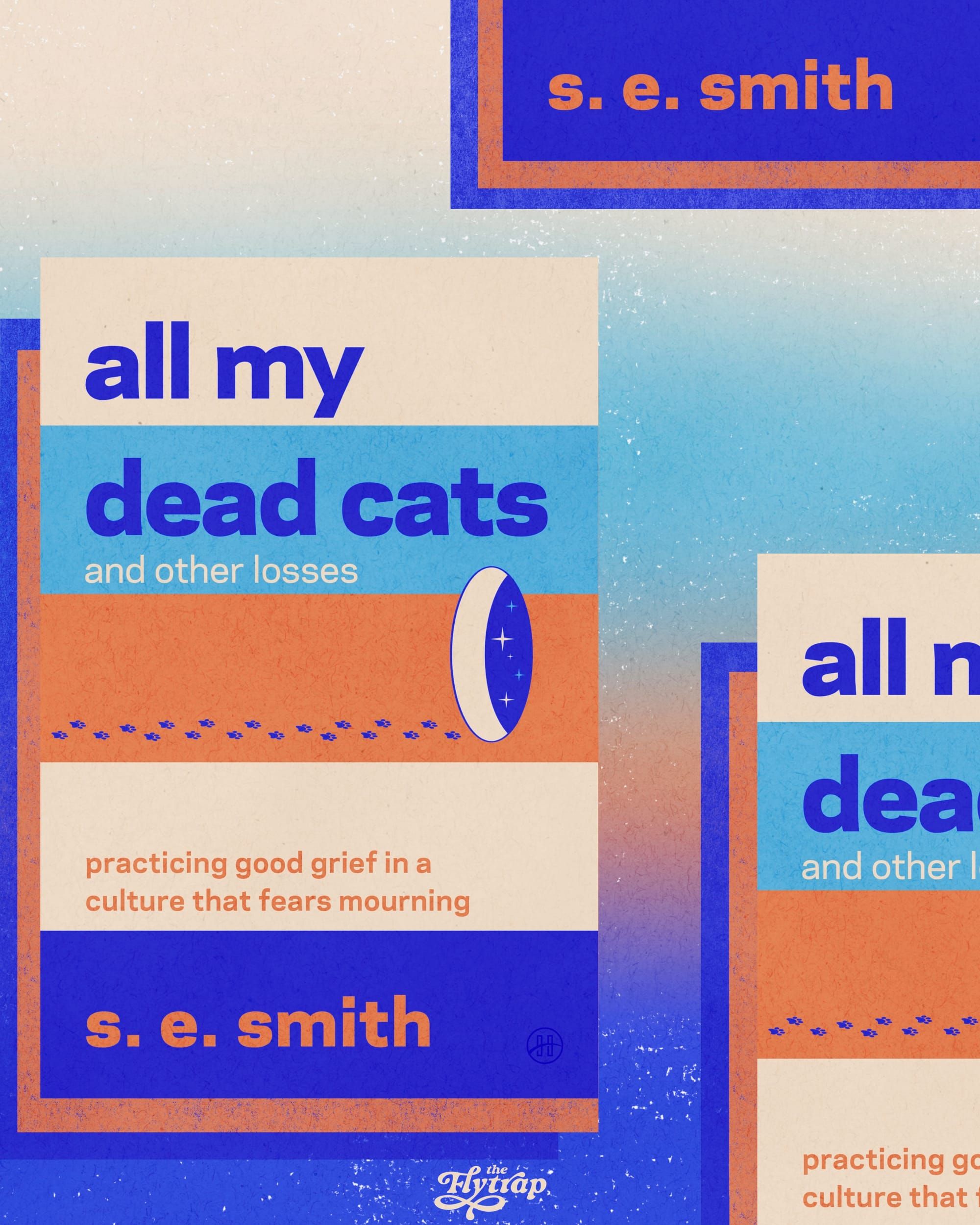
This excerpt, adapted from All My Dead Cats and Other Losses: Practicing Good Grief in a Culture That Fears Mourning by s.e. smith (HarperOne, 2026), appears by permission of the publisher.