
The WNBA Was Supposed to Give Queer Players a League of Their Own
In this excerpt from ‘The W: A History of the WNBA,’ Tamryn Spruill explores how she came to love a league shaped by athletes who refused to separate politics from sports.
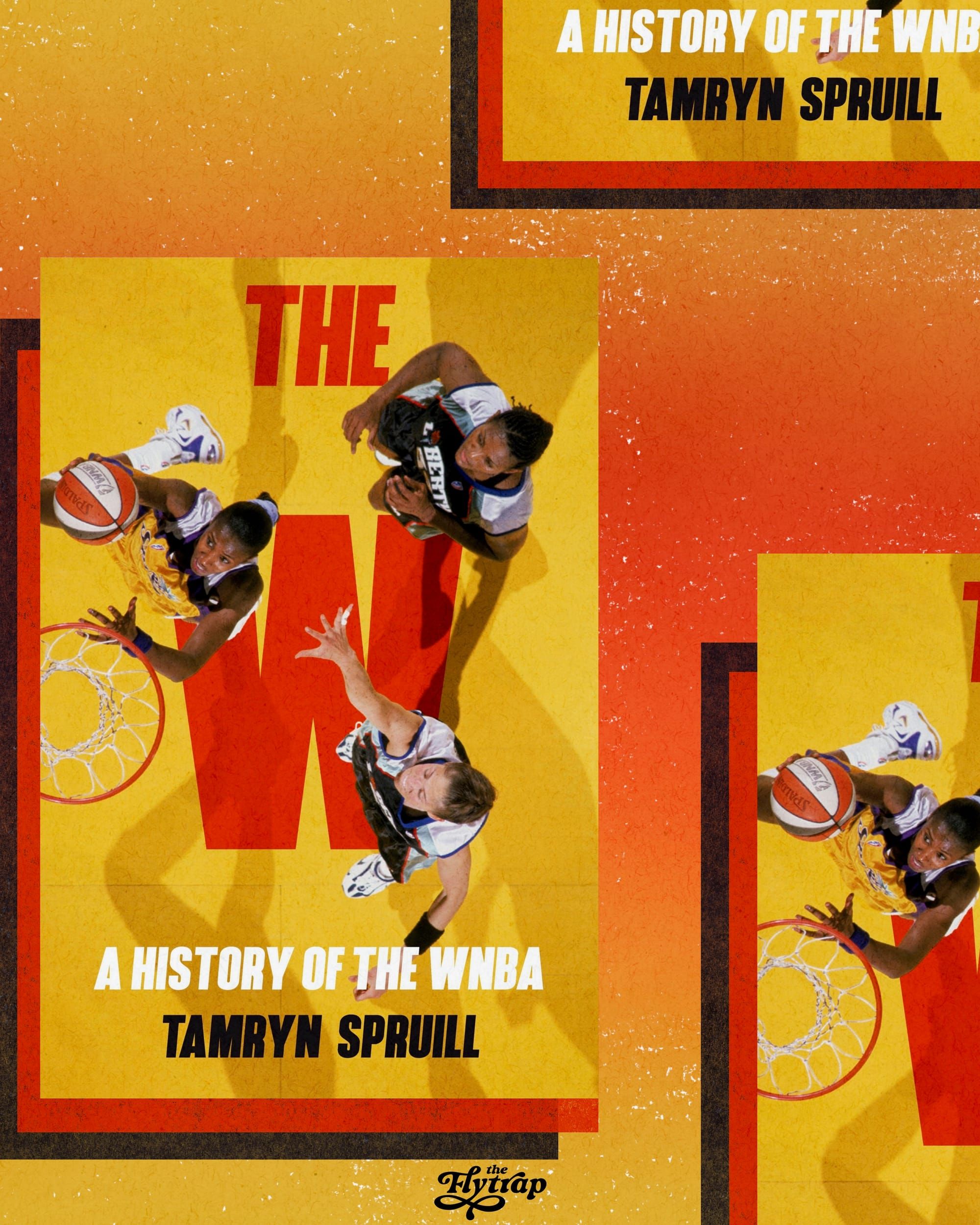
In the summer of 1996, my father was sitting on the floor of our downstairs den in his usual way—a forearm resting across an upward-bent knee. He informed me that a professional women’s basketball league was in the works. “The league will be like the NBA, but for women,” he said.
I wasn’t sure I believed him, but the possibility filled me with excitement. Only when the “We Got Next” commercials began flooding the airwaves did the arrival of the WNBA seem real; news stories suggested that I was not alone in my zeal. Female basketball players had crossed over, into mass appeal. Empowerment and possibility dominated the national conversation, but not everyone easily embraced the changing cultural tides—my father among them.
As an E-9 sergeant major in the US Army, my father was big on discipline and obedience, hierarchies and chains of command. As youngsters, my sisters and I dared not challenge the patriarch; behind his back, we discussed his domineering disrespect of the women in his life—his wife and three daughters. We tried to convince our mother to file for divorce. By fifth grade, I’d experienced enough of the traditional family structure to understand I wanted no part of it.
In my childhood home, I also learned to be the solo champion of my interests, especially those within domains assigned to boys. Discouragement of physical activity intensified as I entered puberty. All the while, my father became increasingly vocal about his unfulfilled wish of having a boy child. After years of miscarriages, my mother in the late 1960s had a sought-after son—Charlie, born premature, pink, and dead. Three live births followed, starting with my older sister in 1971. Three breathing girls did not measure up to the ghost of a stillborn son.
“If only I had a son, I could _____________” (fill in the blank with something gendered to boys). I heard these spirit-denting words often, and they enraged me. My father’s chauvinism pushed my contrarian buttons. I leaned into activities “meant for boys,” rolled my eyes at my mother’s “unladylike” labeling. I climbed trees, rode my bicycle barefoot, and baited my own fishing hooks. I accidentally drove a barb through the pad of my thumb once; I refused to cry, and generally wore cuts, bruises, scars, and scabs as badges of pride.
During the testy Los Angeles Lakers–Boston Celtics rivalry of the 1980s, my father was stuck watching with me. At first, he questioned if my budding love of the game was genuine. It was. But watching sports was often the only quality time I had with my dad. Through it, I discovered the respect that my dad had for some women. Tennessee coach Pat Summitt had earned his respect by dominating a male-centered profession. Sue Bird, the Connecticut guard—with her monstrous game in a fresh-faced, ponytailed demeanor—impressed him. But it was Diana Taurasi who got him out of his seat; her passionate, hot-headed swagger reminded him of old friends from our time living in Italy.
Generations of female basketball players now have the chance to know the achievements of their forebearers, on and off the court.
In Louisville star Angel McCoughtry, he saw my mother’s dimpled smile; game-wise, he found McCoughtry’s basketball IQ to be a marvel. Brittney Griner appeared on our radar when she began crashing boards at Baylor and blocking shots. In 2012, Griner, as a junior, led the Lady Bears to an undefeated season and the national title. The next year, she was the No. 1 pick in the 2013 WNBA Draft. In the days leading to the selection ceremony, Griner shocked the world.
The ESPN SportsCenter ticker in those days rarely showed WNBA game results or highlights of individual player accolades, but Griner’s divulgence in a Sports Illustrated interview that she is a woman who loves women did. No basketball player had come out before being drafted. Other public figures who dared to had been shunned; their careers were left in tatters. Griner had everything to lose; her disclosure drew an expected homophobic backlash. But her bravery helped others confront their own fears of living an authentic life; I was among the beneficiaries.
As the middle daughter who prioritized career and creative aspirations over spouse-seeking and baby-making, I had little in common with my immediate family. I rocked dreadlocks in the 1990s, when few women did; students in my then-conservative college town heckled me. My parents were not fans of either my hair or tattoos. When Christianity and my Southern Baptist upbringing no longer made sense to me, I embarked on a quest to learn about world religions. In my twenties, I converted to Buddhism. I didn’t fit the family I was born into and rarely felt accepted, supported, or understood. Coming out, I feared, would estrange me further or cause my disownment.
Around the time that Griner came out, I had devised a plan to end my inner angst by either coming out to my family or taking the Xanax tablets I’d been hoarding if I couldn’t muster the courage. An uncustomary call from my father disrupted my pill counting. My heart lurched when I saw his name appear on my phone; I answered in a hurry, expecting bad news. It was a relief when he told me the purpose of his call—to discuss the Griner news. My father said he’d seen the story on the SportsCenter ticker inside the South Carolina barbershop where he was getting a trim. The other men in the establishment derided Griner with homophobic slurs. My father said he excoriated them for their failure to be community exemplars.
“If she was my daughter, I would love her more,” he said he told them. “More.”
Griner’s coming out set off a ripple of life-preserving events. If my father said he’d love Griner more if she were his gay daughter, maybe he would not disown his actual flesh and blood. I stepped out in truth that day. Although I didn’t get the acceptance I was looking for in my own family, this remains a testament to the power of the WNBA—not the institution that followed its worse impulses to the brink of extinction, but the players who dragged the league away from the edge.
The WNBA is the longest-running professional women’s sports league in the United States. By that standard alone, it is deserving of coverage. But under the authority of media outlets largely run by white men, female athletes have received a raw deal. After the Phoenix Mercury in the 2014 WNBA Finals beat the Chicago Sky in a title-deciding Game 3, ESPN broadcast a video montage lacking a single postgame interview. Meager—and banal—coverage was choking the life out of the league, and it riled me into action.
The league’s current players now bear the responsibility of understanding why the WNBA, as recently as 2020, teetered on the brink of extinction.
I pivoted from my career in academia to report on the WNBA. I had in mind a twofold mission: 1) examine complex, layered issues at the heart of the league’s arrested development; and 2) amplify overlooked stories of sacrifice by the women who battled each other on the hardwood, and unjust social structures off it. “It’s hard, when you know this person doesn’t have your best interest, and they’re the person that’s in charge of you progressing,” Staley, the coach at South Carolina, told me in 2019 during a face-to-face meeting in her office on the campus. Staley listed the hierarchy (white men, Black men, white women, Black women) and addressed the challenges of striving from the bottom rung to reach one’s God-given potential.
“You’ve gotta kill ’em a little bit with kindness,” Staley said. “[Power figures] don’t really have to like you, but they do have to have a certain level of respect for you and what you do.”
Staley’s success is extraordinary. But other former players, especially the Black ones, still struggle to be taken seriously as candidates for head coaching and executive positions. As of the 2025 season, eight of the thirteen WNBA head coaches were women, four were former players, and only one of the women was Black—Noelle Quinn. There is much work to be done, and it is on the current generation of stars—many of them born in 1997, when the WNBA played its first season—to insist on improvements. The future of the WNBA must remain a priority, and it must evolve to take care of the players of the past.
You can find Flytrap posters, tees, trucker hats, and more at our merch store!
All profits in September and October from our charity bandana designed by our Art Director rommy torrico will be going to Gaza Soup Kitchen.
Sabrina Ionescu (the triple-double threat and No. 1 pick in 2020), Arike Ogunbowale (the sharpshooting No. 5 pick in 2019), Jackie Young (the No. 1 pick in 2017 and title-winner in 2022 and 2023), and other ’97ers grew up idolizing NBA players, modeling their games after theirs. With WNBA games hard to find on television, they learned from what was available to them: the NBA, which provided a de facto film study—but an incomplete education. Generations of female basketball players now have the chance to know the achievements of their forebearers, on and off the court. The league’s current players now bear the responsibility of understanding why the WNBA, as recently as 2020, teetered on the brink of extinction.
It is my hope that those who love the league today, and who are the league today, will educate themselves on the mistakes of the past and the ongoing sociopolitical factors that keep it under threat. Only this—enlightenment coupled with action—will give the league a chance to dribble the oatmeal and orange into many tomorrows.
“History, despite its wrenching pain / Cannot be unlived, but if faced / With courage, need not be lived again,” Maya Angelou wrote in “On the Pulse of Morning.” Author Norman Cousins described history as “a vast early warning system.” By covering the WNBA so sporadically, sports media produced an incomplete and inaccurate historical record. In the absence of fair and regular reporting, bad actors pumped publications and broadcasts with disparaging, falsehood-filled narratives that the public accepted as fact. The league can never again place its fate in untrustworthy hands.
This excerpt, adapted from The W: A History of the WNBA by Tamryn Spruill (Abrams Press, 2026), appears by permission of the publisher. © 2026 Tamryn Spruill
Tamryn Spruill is an award-winning independent journalist. Formerly the editor in chief of Swish Appeal, she has written for The Athletic, Harper’s BAZAAR, The New York Times, The Red Bulletin, SLAM, and elsewhere. A lifelong lover of basketball, Spruill has followed the WNBA since its inception and began reporting on it in 2014, with the aim of giving the then-neglected league meaningful coverage. She has a Master of Fine Arts in Creative Writing from Goddard College and a Bachelor of Arts in Spanish and Journalism from the University of South Carolina. As an adjunct professor, Spruill is passionate about teaching media history/studies, world literature, and creative writing. Spruill lives in Massachusetts with her wife, stepson, and two cats. She squats online in her cyberhut.