Striking Out the Stigma of Self-Publishing
From the Brontes to 'communist gay wish fulfillment,' writers taking control of their own work is having a(nother) moment. And we like it that way.

Note: Ordering books through the links in this article supports The Flytrap.
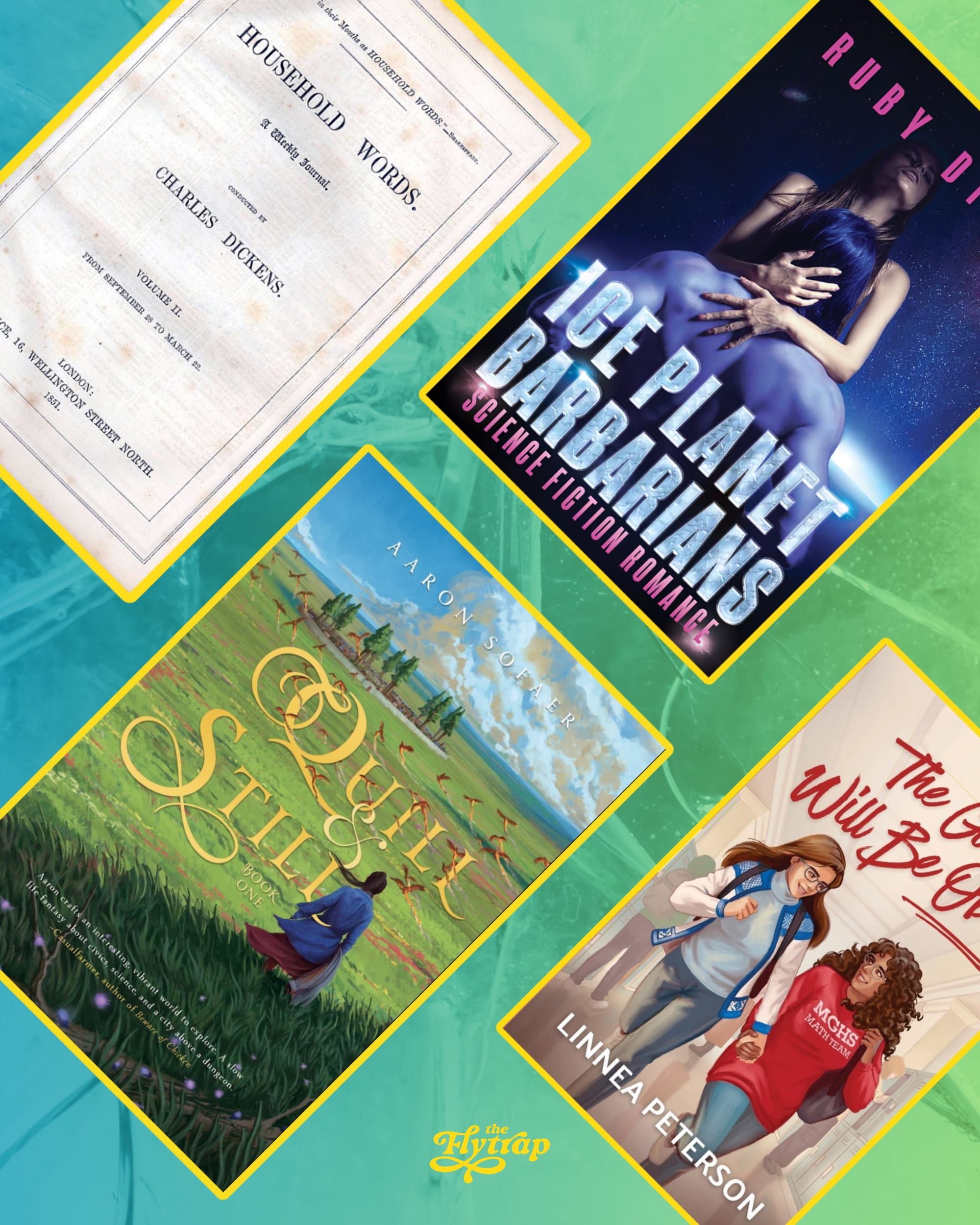
Self-publishing has always been a part of the literary world: As Juliet Barker documents in her 2021 book The Brontës, Charlotte, Emily, and Anne Brontë self-published a book of poems under the male pseudonyms Currer, Ellis, and Acton Bell, respectively, before their literary breakouts. Marcel Proust published Swann’s Way in 1913 after numerous rejections, and Charles Dickens self-published A Christmas Carol because he wanted to retain authorial and editorial control. Dickens also founded magazines such as Household Words and All the Year Round to distribute his novels in serial format, which became extremely popular in the Victorian era, foreshadowing 21st-century newsletters and websites such as Royal Road, which hosts serialized novels.
In the later part of the 20th century, attitudes about self-publishing began to shift. People considered it less prestigious than traditional publishing, because traditional publishing involves gatekeepers who ostensibly winnow out low-quality books through a selective submission, acquisition, editing, and distribution process at a publishing house. For maximum legitimacy, authors are encouraged to secure a home for their work at one of the “big five”—Penguin Random House, HarperCollins, Simon & Schuster, Hachette, and Macmillan (my book, All My Dead Cats and Other Losses, is published by HarperOne, an imprint of HarperCollins). And there’s an imagined lesser hierarchy that trickles down through small and academic presses.
But printing your own book? With no seal of approval from the industry? Without even going through a traditional editorial process? Whether people are working with a so-called “vanity press” that authors themselves pay to produce their books, or contracting with hybrid publishers that split financial risks with the author, outsiders have sometimes suggested that self-published authors aren’t “real writers." Every self-published and indie author who spoke to The Flytrap for this article noted that this was a consistent attitude, even from friends and family. In their view, self-publishing is a fallback for people who couldn’t hack it in the real world. Those who self publish are unserious hobbyists, unlike Important Writers who write Serious Things.
Self-publishing can be extremely profitable, both on its own and as a route to traditional publishing deals, for a handful of high-profile authors. When people smell money, their attitudes tend to change.
Howdy, reader! This post is paywalled, but we have good news for you: We're offering 40% off a one-year Flytrap subscription plus an exclusive merch store discount code until Thursday, September 24th to celebrate our second anniversary!