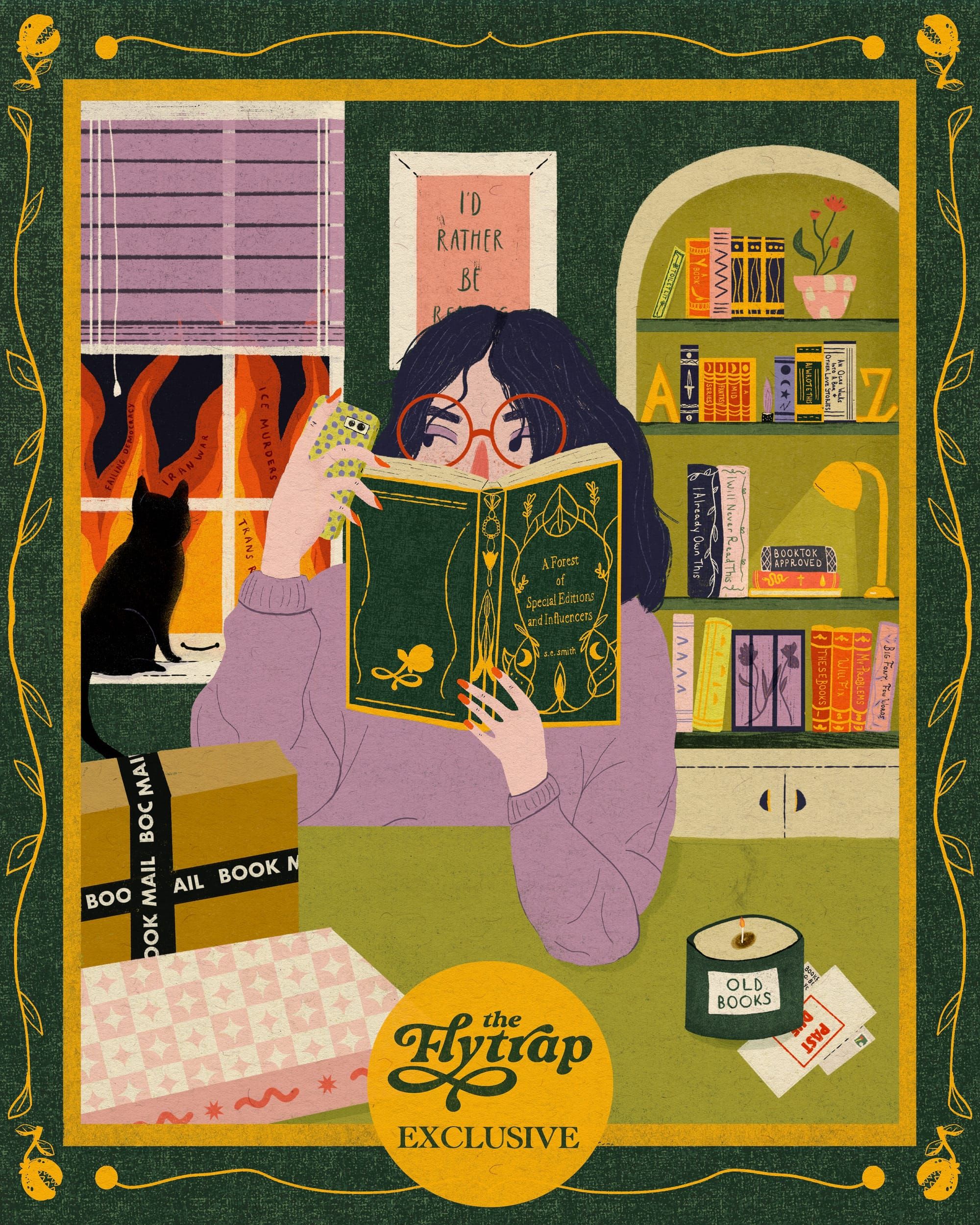
A Forest of Special Editions and Influencers
What happens when books become aesthetic objects?

Editorial note: This post contains Bookshop.org affiliate links. The Flytrap may receive a commission for products ordered via these links.
Have you read Katabasis? You should, it’s really good. R. F. Kuang is a stellar writer with incredible range, and Katabasis is a delicious take on dark academia. I had to wait several weeks for my library ebook hold to come in, but it was worth it. Not everyone likes ebooks, so there’s still a lively market for physical books. But that market isn’t just about having a physical item readers can hold in their hands. At times, that market is driven by the aesthetic of book covers.
If you want a dead tree version of Katabasis, you’ve got options. There’s the standard edition. There’s also a deluxe limited edition with extremely cool sprayed edges—or “spredges,” as an editor friend likes to call them—though it is currently backordered in many locations. A Waterstone’s exclusive edition for my U.K. comrades. Illumicrate, a very popular book crate, one among a score of subscription products that ship out a book selection and coordinating merch, had an exclusive edition, too. Another crate, Fairyloot, also had another exclusive edition. Not happy with any of these options? You can work with a re-binder like ValBinds, who initially blew up on TikTok making customized versions of her favorite books and now runs an entire business.
You can find Flytrap posters, tees, trucker hats, and more at our merch store!
Katabasis is not the only book getting this treatment: Some splashy fantasy and romantasy titles, such as This Kingdom Will Not Kill Me, Fourth Wing, Throne of Glass, and Shadow Over the Pumpkin Queen, have numerous special editions across retailers such as Target, Barnes and Noble, Books-a-Million, and Walmart; book subscription boxes; and markets such as the U.K. and U.S. Taylor Jenkins Reid just announced six special editions for The Last Days of Vic and Coco, highlighting that this isn't just about fantasy. We’re not just talking variant covers or dustjackets, which publishers have been making for a long time for select titles, such as those selected for film and television adaptations. These modern features are even more expensive and more complicated to produce. It’s like tulipomania—the short-lived Dutch speculative bubble in the 1600s that had people spending shocking amounts on tulip bulbs—all over again.
Custom endpapers cost money. Foiling on spines is finicky business. Embossing, debossing, and die-cutting are spendy. Commissioning new art, custom maps, and other design features is costly. Adding pages for bonus content complicates production. Slipcases add time and expense. But even if the cost margins are higher, publishers are investing in custom book covers, extra content, and expensive influencer mailings because they know there’s money in it.
A combination of manufactured scarcity, gotta catch ‘em all, and naked capitalism is overcrowding book shelves and draining bank accounts for the completionists who want to track down each rare variant—even if there’s nothing materially different between editions.
These special editions are evidence that publishers are confident the book will perform well, and they’re an ouroboros: Because the publisher is spending so much on advertising, promotion, and special editions, readers are more likely to be exposed to and buy the book as buzz builds. And, as Kelly Jensen notes at Book Riot, the more designs available for purchase, the more books sell, and the higher the chance of getting onto the New York Times list. While the publisher doesn’t directly benefit from the secondary market of speculation in those books, the wildly high prices highlight how hungry consumers are for those books, and further build the hype and sense of FOMO—next time, grab the special edition while you can so you don’t have to spend $600 for it on eBay.
A combination of manufactured scarcity, gotta catch ‘em all, and naked capitalism is overcrowding book shelves and draining bank accounts for the completionists who want to track down each rare variant—even if there’s nothing materially different between editions. But even that’s beginning to change, with some special editions including exclusive content that extends well beyond the occasional author Q&A, book club guide (remember those?), or preview of the author’s next book. Readers now have alternate endings, extra art, exclusive short stories set in the book’s universe, and even cut scenes.
For me, the escalation in special and exclusive editions and the surrounding ecosystem of book boxes, bookstore chain exclusives, and influencers raises questions about what happens when functional items, like books, are turned into aesthetic props. It has me thinking about the struggles across the publishing industry right now as investors sink massive marketing and acquisitions budgets into limited titles, with the pull-to-publish trend in particular going like gangbusters.
It has me thinking about the cults of personality that have always been part of the arts, including publishing, but have dramatically blown up in the social-media era—both in terms of dedicated followings for authors, and for obsessive fans of influencers (more and more of whom are turning into authors, with the TikTok book deal becoming a very big phenomenon).
It has me thinking about gender, or the way romance and some other literary genres have been disparaged as low-brow and trashy because they are primarily read by women, but are now the exact kind of books receiving this deluxe treatment.
It has me thinking about this horrible empty time we are living in where everything feels overwhelming and fake and we just want a little treat, trying to convince ourselves that we can buy ourselves out of misery if we just purchase one more thing.
It has me thinking about how all of these things are sold to us, who is doing the selling, and who is doing the buying.
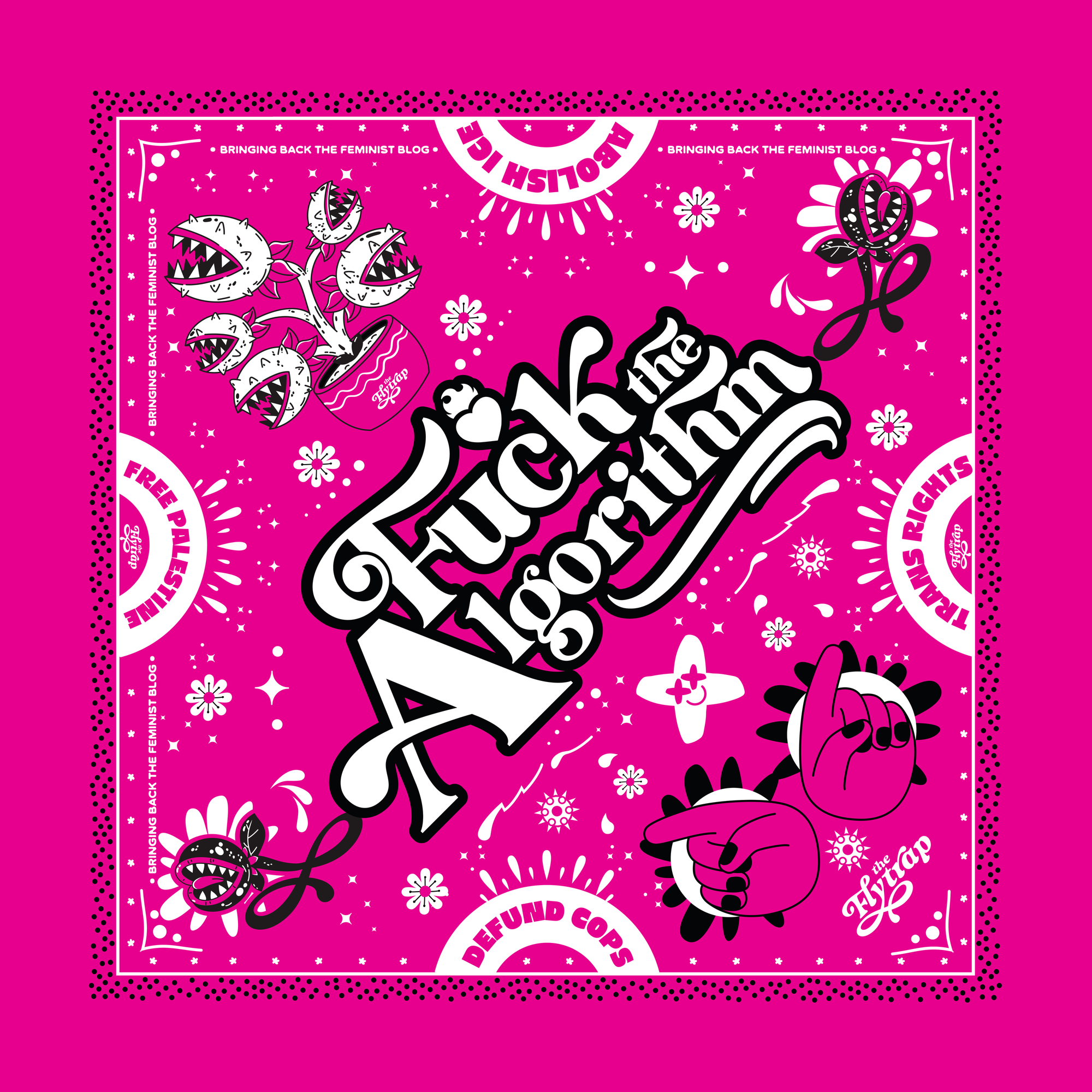
Contributing to our community is very important to us at The Flytrap.
All profits in July and Auguse from this fantastic bandana designed by our Art Director, rommy torrico, will be going to the Homeless World Cup Foundation, which supports unhoused people all over the globe with football programs.
A [Noun] of [Adjective] [Noun/s]
On #BookTok and #Bookstagram, influencer after influencer sit in a carefully-designed cozy set, surrounded by bookshelves and a few literary knickknacks, stacks of books all around them, as they hold up the latest book they’ve received from a publisher. Often, that book is PR and the influencer is being paid for it, though it’s not always disclosed as such, with influencers making big money to hype books—the same books publishers are investing big money in with huge pushes across all markets. That hype includes advertising—sorry, partnering with—purveyors of special editions, provoking longing in viewers who turn to those influencers for guidance on what they should be reading.
These books once had “featured in Oprah’s Book Club” or “instant USA Today Bestseller” plastered on their front covers to signal to readers which tastemakers were endorsing them. Now, the tastemakers are on social media, and the marketing is no longer about institutions. Instead, book publishers are focused on the people who have monetized their lives, making themselves seem personable, relatable, and aspirational. The book influencers with big followings, PR agreements, and lucrative careers on social media are selling a brand and a lifestyle—books are just another thing to hold and trade.
“‘As Seen on TikTok’ badges,” writes Brady Brickner-Wood for The New Yorker, “are stamped on books that have ostensibly been favorably marketed by content creators on the platform, or are angling to increase their potential virality. The semiotics of the badge signal a sort of hive-mind curation, a global book group that has determined that this book, of all the millions of books, is worthy of promotion.”
A number of years ago, I pissed off a huge chunk of the internet when I commented that having, and displaying, large numbers of books can be an expression of class privilege—while noting that I own a large number of books and am a reflection of the very population I was describing. This was not an indictment, just an observation, but it became quite divisive; it's worth stating that, as Andi Zeisler recently noted at Salon, people DO reserve a very specific animosity for those with large book collections that smells like, among other things, anti-intellectualism. For the record, this is not new: Medieval households also showcased their rare and expensive books to demonstrate their wealth, and we’ve been able to buy books by the foot for a long time. Yet, as New York Times-bestselling authors railed against me and I became the subject of many subskeets, the point still stood. If anything, in the time since my comment, the quest to own as many books as possible has become even more extreme.
Is a book still a book when it’s not being read? Or is it an ornament, scenery, an object, or a form of class signaling? Is a work of art still a work of art if it’s tucked up on a shelf and never taken down, those custom endpapers forever frozen between the covers, never exposed to the day, the beautifully foiled spine wrapped inside that alternate dustjacket? Is storytelling still something people take pleasure in if it’s a commodity? Or have these special editions become a signifier of an alignment with trends, membership in a fandom, and the appearance of being a reader, or, as Vogue put it, an “intellectual influencer?”
The book boxes that house these special editions ain’t cheap, and for people chasing special editions across retailers and foreign markets, it can get expensive, fast (special editions of Katabasis are going for hundreds of dollars on sites like Abebooks). Special editions feel, at times, less like an enjoyment of reading and more like the pleasure of owning, though some book collectors are also enthusiastic readers; but they’re reading ebooks or cracking open their standard edition, not befouling their deluxe editions. Special editions are designed to be admired, not to be used.
Like collectible comics, they are to be sleeved in plastic and brought out on special occasions, but never unwrapped, never touched by bare hands. There are, of course, plenty of people who are simply enthusiastic about books and love talking about them, have built up organic audiences in their corner of the internet, and bring insightful and rich criticism to literary conversations. There are followers, too, who genuinely want to engage with books, have conversations about books, and challenge each other. People have always loved books and reading, and they always will. You can collect beautiful things and enjoy their substance, too.
A [Noun] of [Noun/s] and [Noun/s]
Currently #BookTok and #Bookstagram are arguing about whether it’s ableist for authors to include words that readers might have to look up (it is not) and if readers should invest in anything beyond the dialogue (yes, we should). These arguments reflect the larger world we live in, one that prizes looks and convenience over deep engagement. In this world, people want to be perceived as doing something, rather than actually doing it. In the deeply visual media we engage with, appearances become incredibly important, sometimes overtaking substance. So do controversies and drama, ragebait and Discourse, because content creators are cynical and know that this is what translates to views, conversions, and ad revenue.
Their conversations about books turn into performances. Once an influencer establishes their shtick, their gimmick, their brand, their thing, they can get stuck with it, effectively making the same video over and over in different shirts (unless their brand is That Shirt), holding up different books. The FYP will only surface videos that echo their brand, suppressing everything else they create. Sponsors and ad partners want in on those videos rather than content that won’t be seen. Successful videos typically need to be short, snappy, use the latest trending sounds, and compulsively appeal to the biggest audiences possible.
Is a book still a book when it’s not being read? Or is it an ornament, scenery, an object, or a form of class signaling?
This is a world where people watch the first three seconds of a video, hit “like,” and scroll away, quick to move on to the next thing. It’s a world where people listen to podcasts and books on 1.5x or 2x speed to get through them, not savoring or engaging with them. It’s a world where people want AI to summarize everything, to write things for them. It’s a world where arguments about books blow up before the books are even released—and even once they are, people don't read them anyway. It’s a world where so much engagement with media is shallow, formulaic, and limiting. When did reading turn from being a pleasure, a joy, a source of intrigue, to something soulless to be performed and trudged through?
So many of the people in this space are women, as authors, content creators, and consumers, as are the publicists, editors, agents, publishers, and others involved in the production of books. Some in these feminine-coded spaces feel like they are taking something back in an industry that was once heavily male-dominated, but at times, this corner of publishing still feels a bit like a walled pink garden. By turning certain books into objects of consumption and performance for women, society has also devalued them and the genres they occupy, even though these genres have large readerships and consistently sell. That is the reason publishers keep pumping out romantasy books, romance imprints are enduringly popular, and nearly every airport bookstore has a shelf full of mysteries and thrillers.
The rise of special editions itself feeds into this, in a way: Look at all those unserious women and girls wasting money on books, seduced by those variant covers and sprayed edges and other design fads, drawn, magpie-like, to limited edition pins and a bewildering amount of unauthorized merch. Why can’t they just enjoy books like regular people? Do they really think they can buy their way out of sadness with generic comfort reads, nestled in a rabid fandom that’s all flash and no substance?
This overlooks the deeper issue, here, though: The rapid growth of limited edition books is a warning sign about more fundamental issues in the industry.
The [Noun] and the [Noun]
Arts and culture are what make us human and make our lives something bigger than trudging through toil until the day we die. Literature is a huge part of humanity’s creativity. Books and their subspecies are the keystone of this ecosystem, with authors planting deep roots that build and enrich the soil. Some subspecies have evolved to survive and bloom across the course of seasons, years, and sometimes decades. Others die after a single flowering. Readers, influencers, and agents flit between them while publishers grow tall and strong and editors and production staff build nests in their branches. Sometimes books struggle and die in the dark shadows under the leaves, or a publisher falls, a carbon sink on the forest floor that nourishes a new generation.
But something is out of balance; there are fewer publishers now, and some seem more interested in reaching for profit rather than living in harmony, putting out spindly branches that threaten to crack in the wind. Some showy, fragile special editions proliferate in patches of sun, an adventitious species that outcompetes other authors only to wither in the heat, leaving bare soil in its wake. Techbros, meanwhile, push astroturf: Why celebrate biodiversity and let all these plants and creatures hum along together when they can simply roll out plastic grass across the soil, cut the publishers down, scatter fake flowers to bewitch the birds and bees, who themselves vanish because there is only an empty approximation of the thing that once was? What remains is fake grass and flowers cracking and discoloring under the harsh sun, an ecosystem stripped bare after being exploited.
Our forest isn’t dead yet, but its keystone species are not doing well. The problem here isn’t the endless parade of special editions; it’s the fact that the lead titles often selected for this treatment increasingly feel like more of the same, chasing the formula that, with a nudge from the publisher, will blow up on social media, because that is where the money is now. Everything else is left to fend for itself.
The frustrating thing is that we know readers want more: They, along with people tired of second-screen shows; songs calculated to be used as a clip in a 30-second vertical video; and films that follow formulaic expectations, are screaming for something better. They, we, don’t want to be fed endless iterations of the same thing.
We want flowers. Real flowers. We want the weird little stragglers that grow in the shadows, not just the meticulously-cultivated blooms designed to draw our eyes. We want the happy dudes that have formed their own dense carpet of low-lying blossoms in a quiet glen, there for those who know to look for them, appreciated by those who find them. We want the scrappy ones fighting through the weeds to be seen. The ones that produce strangely-shaped seeds and bizarrely asymmetrical blooms, the ones that sometimes make us trip on their roots, the ones with very particular scents that are a love-it-or-hate-it sensory experience.
We also want the blooms that are reassuring and familiar in their sameness, with small variations in color and scent: There are hundreds of rose cultivars, and each is enjoyable in its own way. A rose can be a delightful thing. There’s nothing wrong with liking roses. There’s a reason people enjoy growing them so much, and there’s a reason gardeners form community through sharing their favorites and hybridizing them. I love a rose. I have three in my garden. Each, though, is very different: I don’t want to look out across a parade of uniform blooms and foliage, the varietals the nursery wants to push on me as the current trend. A Lady Banks is not a Poet’s Wife. A Ferdinand Pichard is not a Diablo Hawk. There’s a little something for everyone even if nurseries (and publishers) want to push everyone toward a narrow palette of colors and forms.
Katabasis, in some ways, is a peculiar choice for the exclusive edition treatment. It’s complicated and interesting and challenging, with a slower, more subtle, version of the hero’s journey and a reminder that academia is hell. There’s no smoldering sexy lead, no epic romance, and no high drama. Katabasis is is not calculated to feed the screaming hordes of the internet, the “one more book will fix me” or “I am a survivor of Maas destruction” crowd. It’s a tough book, and author, to market as an influencer because R. F. Kuang is an author with broad range. While publishers are pushing authors to produce different variations of the same story over and over again within the same genres, Kuang resists these boxes.
Yet, Harper Voyager went all in on this oddly-shaped little bloom, gave it some fertilizer, and sheltered it from the wind. Their efforts paid off: Katabasis hit the New York Times list. Like the titles carefully selected by publishers for success, the Times list is an editorial product that’s consciously curated rather than a genuine reflection of sales and interest. It is driven by the zeitgeist and marketing—like that Harper put in to Katabasis—not a literal rundown of the amount of books sold in a given week.
But Katabasis stood out amongst many of the other titles on the list, a shimmer of hope that perhaps even the Times must acknowledge that there’s something more out there for book publishers, authors, and readers who genuinely love books—not only the covers they’re housed in.
This piece was edited by Evette Dionne and copyedited by Nicole Froio.