Striking Out the Stigma of Self-Publishing
From the Brontes to 'communist gay wish fulfillment,' writers taking control of their own work is having a(nother) moment. And we like it that way.

Note: Ordering books through the links in this article supports The Flytrap.
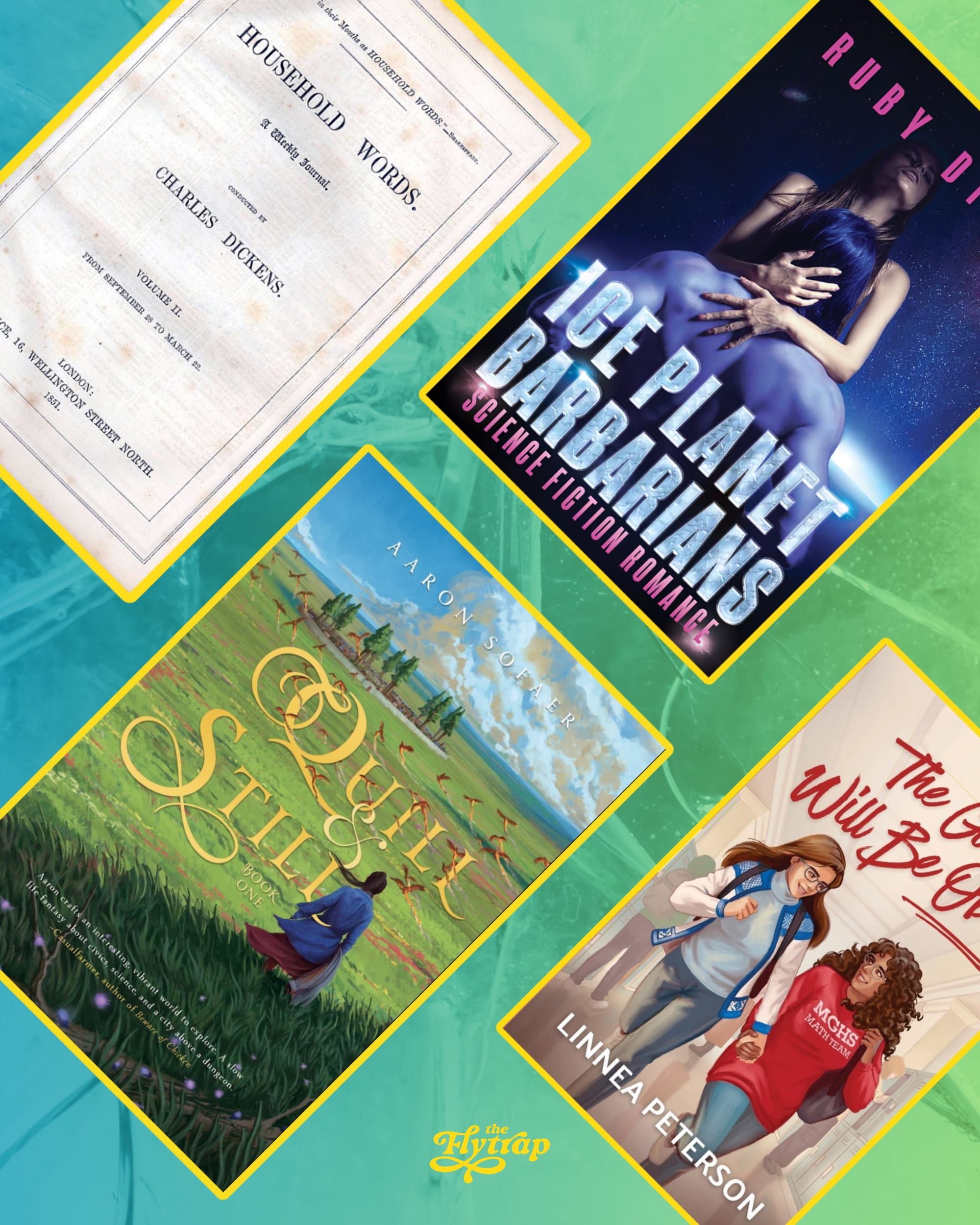
Self-publishing has always been a part of the literary world: As Juliet Barker documents in her 2021 book The Brontës, Charlotte, Emily, and Anne Brontë self-published a book of poems under the male pseudonyms Currer, Ellis, and Acton Bell, respectively, before their literary breakouts. Marcel Proust published Swann’s Way in 1913 after numerous rejections, and Charles Dickens self-published A Christmas Carol because he wanted to retain authorial and editorial control. Dickens also founded magazines such as Household Words and All the Year Round to distribute his novels in serial format, which became extremely popular in the Victorian era, foreshadowing 21st-century newsletters and websites such as Royal Road, which hosts serialized novels.
In the later part of the 20th century, attitudes about self-publishing began to shift. People considered it less prestigious than traditional publishing, because traditional publishing involves gatekeepers who ostensibly winnow out low-quality books through a selective submission, acquisition, editing, and distribution process at a publishing house. For maximum legitimacy, authors are encouraged to secure a home for their work at one of the “big five”—Penguin Random House, HarperCollins, Simon & Schuster, Hachette, and Macmillan (my book, All My Dead Cats and Other Losses, is published by HarperOne, an imprint of HarperCollins). And there’s an imagined lesser hierarchy that trickles down through small and academic presses.
But printing your own book? With no seal of approval from the industry? Without even going through a traditional editorial process? Whether people are working with a so-called “vanity press” that authors themselves pay to produce their books, or contracting with hybrid publishers that split financial risks with the author, outsiders have sometimes suggested that self-published authors aren’t “real writers." Every self-published and indie author who spoke to The Flytrap for this article noted that this was a consistent attitude, even from friends and family. In their view, self-publishing is a fallback for people who couldn’t hack it in the real world. Those who self publish are unserious hobbyists, unlike Important Writers who write Serious Things.
Self-publishing can be extremely profitable, both on its own and as a route to traditional publishing deals, for a handful of high-profile authors. When people smell money, their attitudes tend to change.
Now, the pendulum is finally beginning to swing the other way. More people are pursuing self-publishing, and they’re getting more comfortable talking about it, because they’re less likely to encounter judgmental attitudes. One of the reasons why: Outsiders have finally noticed that self-publishing can be extremely profitable, both on its own and as a route to traditional publishing deals, for a handful of high-profile authors. When people smell money, their attitudes tend to change. Culture shifts are also changing the way people think about publishing, such as concerns about the state of traditional publishing, where after a brief interest in marginalized writers and stories in the 2010s, publishing houses seem to be slinking back under a rock, leading some to wonder if taking charge of their own work is a better bet.
Contrary to what naysayers think, self-publishing is a part of the industry, and it is rapidly growing, expanding by 48% between 2024 and 2026. And focusing on profits overlooks the many reasons people may actively pursue this path to seeing their work in print, hearing it in their ears, and sharing it with others. The narrow understanding of self-publishing in the general public—and from some authors—doesn’t reflect the reality of why people opt to self- or hybrid-publish, focusing on the idea that every author has the same goals of a big five contract, a spot on the New York Times list, and an Apple TV adaptation.
Deriding self-publishing as unimportant and irrelevant until it’s profitable leaves out a huge, fascinating, and complicated sector of the publishing industry.
All About the Benjamins
About that unserious hobby. Some certainly hope that self-publishing will be a stepping stone that leads to traditional publishing contracts, whether editors see a base of potential readers and commission original projects, reprint self-published books, or both. Ruby Dixon’s Ice Planet Barbarians, for example, was originally self-published in 2015 before Berkeley picked it up in 2021. The series went viral on #BookTok, and she has the New York Times bestseller bragging rights to go with it. Matt Dinniman’s wildly successful Dungeon Crawler Carl books, a litRPG series that began on Royal Road before moving to Act Books in 2024, with a pending adaptation on Peacock, has also demonstrated the power of the pull-to-publish contract.
You can find Flytrap posters, tees, trucker hats, and more at our merch store!
All profits in September and October from our charity bandana designed by our Art Director rommy torrico will be going to Gaza Soup Kitchen.
Contemporary self-publishing involves a lot of romance and fantasy authors, many of whom are women—another reason that people tend to deride self-publishing as an unserious world of “genre fiction.” Some self-published authors bring in six- and sometimes seven-figure incomes, thanks to extremely loyal fans and intricate business plans. Some publish under a variety of pen names to tailor their work and personas for various markets and audiences. They’re also maintaining an active and responsive social media presence, publishing newsletters to keep their readers in the loop, and keeping an eye on performance indicators, just like a traditional publishing house.
Self-publishing books is a conscious choice, and it’s a lot of work. An independent author isn’t just a writer: They are also an editor, a production department, a marketer, a publicist, an accountant, an artist, and so much more, filling all the roles at a traditional publishing house or working with contractors for parts of the work they can’t or don’t want to do.
This issue is also practical; some indie authors worry that they won’t receive the support they historically expected from big five houses, but even that expectation is shifting. “I have friends who are trad authors, and they also don’t get a ton of marketing help anymore on their books,” said indie author RJ Zielonka. “Obviously trad authors get their books in more stores, but they still have to do a lot of the marketing themselves,” which raises questions for some indie authors about why they want to give up profits and editorial control if they’re not being properly marketed and promoted.
While traditional publishers have more reach, which allows them to get their books stocked in more places, self-published authors no longer have to ship their books from their basements. It’s much easier to distribute self-published books than it used to be, thanks to print and ebook distribution platforms like Ingram Spark. Amazon’s Kindle Direct Publishing is another option for self-publishing. Amazon allows self-published authors to enroll in its Kindle Direct Publishing Select, which gives them access to the company’s Kindle Unlimited program, where subscribers pay a fee for unlimited access to digital titles, including audiobooks. But Kindle Direct Publishing comes with a catch: The program requires authors to distribute digital editions exclusively through them, which is one reason many traditional publishers don’t participate.
Increased visibility as well as a greater understanding that good stories can come from more than just the big five has also sparked more interest from bookstores, especially independent bookstores, which stock books by local authors and host events for them. USA Today bestselling author Jeffe Kennedy, also known as Jennifer K. Lambert, started in nonfiction and journalism. As a novelist, she’s been writing romantasy since before it was cool (when she sold her first novel to Carina Press, Harlequin’s digital-first imprint, in 2007, they marketed it as “fantasy romance”).
Deriding self-publishing as unimportant and irrelevant until it’s profitable leaves out a huge, fascinating, and complicated sector of the publishing industry.
She later published erotica with independent publishers Ellora’s Cave and Lucid. Lambert told The Flytrap that when her Lucid rights reverted to her after two years, she thought, “Heck, I might as well dip my toes into self publishing.” It was the start of an incredibly successful fiction career that includes a robust mix of self-published novels and traditional publishing deals. “In 2016, I got downsized from my day job, and I thought, ‘Here’s a good time to try writing full-time.’ I knew how much money I made from [my traditional publishing deals] and knew it wasn’t enough to live on,” she said. “My self-pubbed books were doing okay, so that was when I started creating some self-published series.”
Today, Lambert publishes widely across platforms including Amazon, Kobo, Google Play, Barnes & Noble, and Apple Books (with the help of a third party platform, Draft2Digital). She also has audiobooks distributed on platforms such an INaudio and Spotify, with “wonderful” audiobook narrator, Deborah Balm. Balm herself has a following—Lambert told The Flytrap that some of her readers found her via Balm, a common experience for both traditional and self-published authors as the audiobook market grows and listeners connect with certain audiobook narrators.
Many business-minded writers like Lambert split their work between self- and traditionally-published routes, depending on the project and their target audience. Romance author Kit Rocha (the pen name of collaborators Donna Herren and Bree Bridges) has a robust catalogue of self- and trad-published books. And Chuck Tingle is famous for pounding readers in the butt with “Tinglers,” his large and ever-growing self-published body of work, but he also has a multi-book contract with Nightfire, an imprint of Macmillan, that’s included Fabulous Bodies, Lucky Day, Bury Your Gays, and Camp Damascus. Tingle and Rocha clearly aren’t struggling to sell their books and turning to self-publishing as a fallback, or thinking of one distribution format as better than the other. They simply know the value of a diverse business strategy.
Lambert warns that self-publishing can be subject to its own bubbles as trends, such as the explosive growth in romantasy, come and go. “Everybody’s numbers are down in self-publishing,” she said. “And there’s so much AI-generated slop on Amazon that discovery is down, although readers are pretty discerning. ... We’ve had this conversation many times over the years about the self-publishing gold rush being over, but how much of that is just the pendulum?”
But what if self-publishing is not (just, or even!) about it for the money?
For the Love of the Game
Self-publishing is neither a path of last resort nor a primarily mercenary decision. Some self-published authors don’t want to go the trad-pub route, even when it’s available, because it doesn’t align with what they want to do. Like Dickens, for example, some authors prefer to retain authorial and editorial control of their work. That control can include room to experiment and explore without hard deadlines, a ruthless production schedule, or the pressures of needing to write for a given market. That includes weird little stories, unpopular genres, unconventional storytelling, and other choices that traditional publishers don’t take chances on.
When author Linnea Peterson looked at the contract they turned down from a traditional publisher for their book, The Girls Will Be Okay, they realized that “this will give the vast majority of the financial control and creative control over the future of the story to people who are not offering me much in return in terms of editing or marketing.” That experience helped Peterson “believe in myself and the story” and to “consider self-publishing” so they could tell the story they wanted to tell.
For marginalized authors and those writing to their lived experience like Peterson, worries about editorial pressure are very real. Despite publishing’s brief turn to uplifting those writers in the 2010s and early 2020s, publishing is still heavily occupied by white men, especially in senior positions; as is often the case, a tiny slice of visibility led those with privilege to cry foul about how they were being overrun by diversity hires. And even in the heyday of the market for what came to be known generically as “diverse books,” editors and agents sometimes pushed writers to change the race, gender, orientation, faith, and other characteristics of their protagonists, while Black authors found themselves pigeonholed in segregated sections of the bookstore.
As is common with other careers in the arts, publishing is treated as a ‘passion job,’ with the belief that the work is the reward, while workers, like those at HarperCollins, would like to be able to eat and pay rent.
Authors also found themselves sometimes fighting with publishers over cover designs that didn’t reflect the reality of their books. Now, some writers, who asked to remain anonymous to protect their publishing relationships, told The Flytrap that this kind of editorial pressure is again on the rise, forcing them to make difficult choices. Authors and agents in children's literature in particular are reporting a crabwalk back from diverse books.
Author Sam Miller, who has been traditionally published with both Simon & Schuster and HarperCollins, is currently serializing his novel Jupiter Ruins Everything on Substack. He told The Flytrap that “the particular shitshow in publishing right now is definitely a backlash against the abundance of previously marginalized voices that we started to see in 2010s and 2020s. ...Radical queer horny queer stories are not as easy to sell as they were when I started selling them.”
Miller’s first book, the Nebula award-winning The Art of Starving (2019), “was on submission for like a week before we got an offer.” More recently, Red Star Hustle (2025), written with Mary Robinette Kowal, was on submission for 18 months before being acquired by Saga, an imprint of Simon & Schuster. Indie authors and editors who spoke with The Flytrap shared this frustration: The seeming culture shift that led to a flowering market for stories from marginalized writers is, it turns out, yet another publishing trend, and now it’s cooling.
Many are also worried about the role of big five publishers in our fascist landscape: Four out of five run rightwing imprints that publish people antithetical to their values, including Sentinel (Penguin Random House), Threshold Editions (Simon & Schuster), Basic Liberty (Hachette), and Broadside Books (HarperCollins). And Macmillan’s St. Martin’s Press publishes a broad mix of titles, including those by conservative blowhards like Bill O’Reilly. Not everyone can be a Roxane Gay: In 2017, she pulled a book contract from Simon & Schuster after Threshold Editions cut a deal with Milo Yiannopolous.
That’s another reason some authors self-publish: Self-publishers and independent presses have also forged a very different literary culture. “Is it possible to make art while also treating my fellow artists the way I would like to be treated, or is it impossible in our capitalist landscape?” asked Nivair H. Gabriel, co-publisher of Scattered Light Press, a new “incredibly small-scale experiment” that revolves around more collaboration between writers, artists, and editors. “I hear about how we can’t afford to pay freelancers a fair rate, can’t pay them on time...is that really true? Is it possible to make art according to our values?”
Gabriel began her career in editorial positions in traditional publishing settings, spending several years in that sector of the industry. She felt frustrated by the frequent claims that since publishing is a “zero-margin business,” it can be used to abridge workers’ rights. In 2022 and 2023, striking HarperCollins workers who were members of United Auto Workers Local 2110 highlighted poor working conditions in publishing, including low pay and sometimes hostile conditions such as racism and sexism. Gabriel said she only was able to get into publishing, taking a series of low-paid and unpaid internships, because of her support from her parents. As is common with other careers in the arts, publishing is treated as a “passion job,” with the belief that the work is the reward, while workers, like those at HarperCollins, would like to be able to eat and pay rent.
People unfamiliar with publishing may think that a book deal includes a large upfront payment (an “advance”) and, once a book is published, the author immediately starts earning a cut of every sale (royalties). In reality, authors don’t receive royalty payments until the publisher has recouped the cost of the advance, a process known as “earning out.” Depending on sales and the size of the advance, many authors spend months or years waiting to earn out, if they ever do, while the publisher can make a profit much earlier.
According to The Publishing Calculator, a book with a $30,000 advance would need to sell tens of thousands of copies. While publishing is notoriously secretive about numbers, editors and agents who spoke with The Flytrap said many books sell in the low thousands. Gabriel is thinking differently about this structure, upending norms the industry has accepted as the only way to run a publishing house.
Gabriel is considering something else, too: “Established houses don’t work with first-time artists. It’s too big a risk,” she said. “Something I enjoyed about working with small publishers [earlier in my career] was the opportunity to nurture people in their early careers and give them a big break or two,” something she’s very consciously continuing at Scattered Light Press by creating space for emerging artists and writers. “Of course,” she said wryly, recalling her experiences in traditional publishing “then a publisher with more money would snap them up.”
Building Solidarity and Finding Family
That sense of creating opportunity was important for Lee Arden, who runs Sheer Spite Press, a Canadian small press that prints “useful, generous, personal, political, heart-filled” books and zines. “I started Sheer Spite Press in 2023 because I was looking at arts grants applications, and realized that self-published work does not count toward a lot of opportunities like grants and artist residencies,” they told The Flytrap. “I’d been informally helping people make and sell their zines for a long time, but I realized if I called that ‘running a small press,’ I could launder legitimacy for them and their work and help them access those types of opportunities. It worked almost immediately: The first author I published got a $25,000 grant to write her next book.”
“Other small publishers have been incredibly kind with advice, resources, mentorship, and pep talks,” Arden continued, which is a very different vibe from the world of traditional publishing. And Arden takes joy doing and experimenting, rather than thinking about bottom lines. “I am surrounded by people who make things for the joy of it, and to share with friends and use as a vehicle to meet new people,” they said. Arden’s strategy to help other writers reflects a larger rich culture in self-publishing, with indie authors building community on websites, Discords, group chats, and anywhere they can carve out space. Writing for and with each other, these spaces are not competitive and participants don’t see writing and success as zero-sum games.
“A guy gave me a one-star review for ‘communist gay wish fulfillment.’ Yeah, it kind of is, thanks!”
Web serialist Aaron Sofaer, the indie author of Quill and Still, told The Flytrap that there’s a lively online community of people who enjoy progression fantasy, for example—books steeped in character development, particularly characters who get more powerful over time, from wizards and paladins to beyond. “Whether cozy, grimdark, cheerful...this is an enthusiast community as much as it is an author space,” Sofaer said, and it shows in the way readers show up for the writers they love, some of whom are serializing on platforms like Patreon and Substack, while others stick to sites such as Royal Road and Wattpad.
It is also, she notes, an extremely diverse space where authors feel like they have space to play and deeply connect with their audiences, even when those audiences are very niche. “I write litRPG,” Sofaer said when I asked her about the stigma that clings to self-publishing. “I am already at apex cringe.”
“A guy gave me a one-star review for ‘communist gay wish fulfillment,’” she added. “Yeah, it kind of is, thanks!”
That sense of community—writing as a shared project—is something else that those who disparage self-publishing may not understand. Not everyone wants to write commercially successful books for a general audience. Some want to write for and within a community of like-minded readers and authors. This is not a precedent. Romance and fantasy have long been shared communities like this. So has literary fiction, which turns up its nose at “genre fiction” (like romance and fantasy), and sometimes thinks that popularity is a marker of poor quality.
Social media has been a game changer for self-published writers, providing incredible reach that helps them find those audiences—fans of mysteries and thrillers, fantasy and science fiction, romance, and, yes, literary fiction, too. In those book-loving communities, many readers are more focused on the stories than the logo on their spines. Those readers happily read a mix of self- and traditionally-published books, finding stories wherever they are and catapulting their beloved authors to fame. Indie authors told The Flytrap that this shift in attitudes makes them feel more confident when it comes to disclosing that they self-publish—like Lambert, they bring their audience with them wherever they go.
That sense of writing for an audience you love echoes a long history in other writing spaces, particularly zines and the poetry community. For people who create zines, the shared DIY community ethos is an essential part of their values—the self-publishing is part of the point, and so is creating distribution avenues that bypass mainstream routes. Similarly, poetry has a rich tradition of self-published chapbooks or collections from small presses, something some readers might consider a niche interest.
Many poets write because of their love for the form and a desire to connect with other poetry lovers, well aware that they’re unlikely to break into a major market—that’s not the point of their work. This history of community is an essential part of the art. “I think the amazing thing about self-publishing is it brings more human written stories to the world,” Zielonka, the indie author, said. “If this allows more people the freedom to create art that they love, then I think it’s only a good thing.”
This doesn’t mean that self-publishing is without its problems and inner disputes, especially with the rise of generative AI and other artificial intelligence tools, which have upended so many corners of the arts. Some self-published authors, for example, use AI-generated covers, arguing that they cannot afford to pay traditional artists, while others are strongly opposed to the practice. Similarly, not all authors hire or work with audiobook narrators—some opt to use artificial intelligence to distribute their audiobooks.
These uses of artificial intelligence very much conflict with an ethos of building community, creating art from a place of joy and curiosity, and resisting the pressures of capitalism. Not every self-publishing community is a welcoming or safe place, and jealousy, resentment, a surge of AI slop, and other sources of conflict come up in self-publishing as they do everywhere else. While arguments, flying accusations, writers leveraging pity marketing in lies about book bans to sell their books, predatory presses, and interpersonal conflicts might be written off as niche drama, these are issues in every corner of society, and they are things we all need to think about solving together.
In a world of capitalist grindset, where we’re supposed to monetize everything about our lives and turn our hobbies into our jobs, I hope that the increased profile of self-publishing doesn’t normalize yet another way to hustle. Instead, I hope the increase in visibility and interest in the self-publishing becomes something else: A light in the darkness for the art, culture, and people building community and creating the things they want to make because they have intrinsic value—not because everything in life needs to be cynically gameified, chasing “number go up” and beating the competition.
I hope that self-publishing remains a place of opportunity and choices—one where people can be career authors supporting themselves with their work, and one where people can write for joy, model another way to be in community with each other, and experiment with anti-capitalism in ways that bear fruit. In a moment where the arts are being devalued while also being overtaken by AI slop, and people who refuse to bow to the hegemony of the tech industry are dismissed, these communities of resistance are essential, and they will endure.
This piece was edited by Evette Dionne and copyedited by Andrea Grimes