
Ain't We Women, Too?
For many incarcerated women, the state is their abuser, but the gender-based violence we experience behind bars goes ignored.
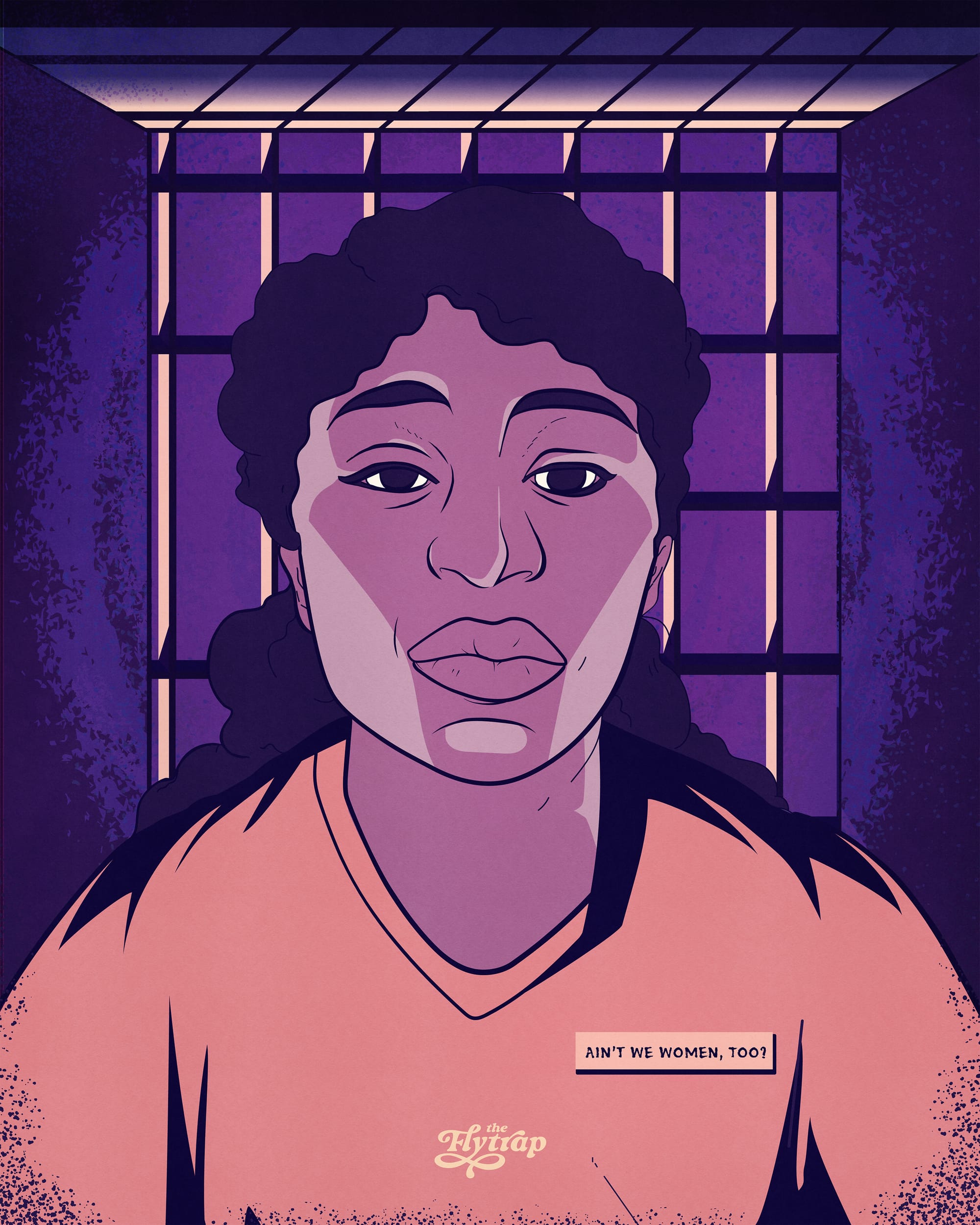
Does your partner:
☐ Control where you go and who you see?
☐ Monitor your communications and movements?
☐ Threaten you with separation from your children?
☐ Use their authority over you to demand sexual favors?
☐ Touch you without consent when you're vulnerable or naked?
☐ Deny you medical care as punishment?
☐ Isolate you from support systems when you complain?
☐ Tell you no one will believe you if you report the abuse?
☐ Make you feel like you have no choice but to comply?
If you checked even one box, domestic violence organizations will tell you that you are experiencing intimate partner violence. They'll offer you connections to organizations, access to shelters, help with safety planning, and even legal assistance or help filing a restraining order. They'll tell you that you deserve safety, dignity, and freedom from abuse.
Unless you're in prison. Then they'll tell you nothing at all.
I'm writing this from inside a women's prison, where every single behavior indicating intimate partner violence happens daily. Not from intimate partners, but from the mostly male staff paid by the state to "supervise" us. In my case, there’s a corrections officer who watches me shower. A guard who promises to help with my parole if I "cooperate." Let’s not forget the lieutenant who puts me in solitary when I file a grievance, and the warden who tells investigators I'm lying because I'm an “inmate” and inmates always lie.
Attorney and organizer Andrea Ritchie, author of Invisible No More: Police Violence Against Black Women and Women of Color, has spent decades documenting how systems that purport to protect women are actually sites of gendered violence. She argues that the criminal legal system doesn't interrupt gender violence, but rather extends it, concentrates it, and hides it behind prison walls where it disappears from public view. We are some of society's most vulnerable women. We have no ability to leave our abusers. We cannot access a hotline to call. We cannot seek a restraining order against the person who holds the keys to our cell. We cannot flee to a shelter. We cannot ask our families for help without our calls being recorded. We cannot hire attorneys without money we cannot earn. We cannot go to the police because the police are our abusers.
Professor Beth Richie, whose groundbreaking work, Arrested Justice: Black Women, Violence, and America's Prison Nation, examines the convergence of gender violence and mass incarceration, emphasizing that women who experience violence in their intimate relationships are often funneled into carceral systems where they then experience state-sanctioned violence. According to the Survivor Justice Initiative, up to 95% of women incarcerated in American prisons have experienced domestic or sexual violence at some point in their lifetime. The government’s own data shows that widespread sexual abuse of women continues to plague prisons.
For women in prison, one abuser is replaced with another. The U.S. calls this “justice.”
The exclusion of incarcerated women from protection has nothing to do with crime or justice. It's about power and expendability. Incarcerated women are disproportionately poor, Black, Indigenous, and Latina. We're the women society has always found easiest to ignore and abandon.
Who has permission to enact violence?
Let me tell you what it's like to live in state-sanctioned, gender-based violence.
In prison, we wake up when male guards tell us to. We wear what they tell us to wear. We eat what they give us, when they decide to give it. We go where they permit, speak when they allow, and exist under their constant surveillance. Our bodies belong to the state. Our movements are controlled. Our communications are monitored. They have the power to deny or delay our medical care, and our complaints go ignored or punished.
And like survivors on the outside, we learn to comply. We smile at guards who make sexual comments because angering them means losing phone privileges, being written up, or getting sent to solitary. We don't report assaults because we don’t want retaliation. We don't fight back because fighting back means more time. We intuitively learn the survival skills that domestic violence organizations inform the public about: appeasement, hypervigilance, strategic submission. We read our abusers' moods. We make ourselves small. We avoid triggering their anger. We protect ourselves by surrendering autonomy. We become perfectly obedient victims of intimate partner violence, except the violence is legal and the abusers wear badges.
It only makes it worse that we have been abandoned by advocates on the outside.
Movements supporting survivors have every tool at their disposal to help us. They have lawyers, advocates, funding, political access, and media platforms. They have successfully lobbied for laws, changed policies, and shifted public consciousness. They know how to fight systems that enable abuse. They just choose not to fight for us.
In the context of feminist movements, this should sound familiar. White suffragists explicitly excluded Black women, arguing that Black women's inclusion would hurt their cause. Black women were effectively told to wait their turn. To be patient. To understand that the movement couldn't take on everything at once. But later never came, so Black women built their own movement.
Now the anti-violence movement repeats the same betrayal. In 2022, Black people made up 12% of the total population, yet they accounted for 26% of people in jail and Black women continue to be incarcerated at 1.6x the rate of white women. But movements supporting survivors have decided that incarcerated women are too controversial, complicated, and unsympathetic to support.
Professor Leigh Goodmark, author of Decriminalizing Domestic Violence, articulates that the system doesn't want to eliminate violence against women. Rather, the system wants to determine who has permission to enact that violence. When the state does it, we call it corrections. The system needs us to accept this violence as a normal consequence of our incarceration. Because if we recognized it as abuse, if we named it as intimate partner violence enacted by the state, the entire facade of the criminal legal system as “public safety” would collapse.
Don’t miss the latest episode of Cancel Me, Daddy, a Flytrap Media Production. Katelyn and Christine interview New York Times columnist Jamelle Bouie about police forces crushing free speech and how to cancel ICE.
Gender-Based Violence Behind Bars
There are many recent examples of what state-sanctioned gender-based violence looks like in practice.
For example, the women’s Federal Correctional Institution (FCI) in Dublin, California, was known to have a “rape club.” After a years-long investigation beginning in 2021, a total of 10 men—including the prison’s warden and chaplain—have been charged for sexually abusing incarcerated women.
The abuse at FCI Dublin wasn’t a case of just a few bad apples. According to the Department of Justice, the abuse was systemic, known to supervisors, and ignored by oversight agencies. Women repeatedly reported sexual assault. They filed grievances. They told inspectors. Nothing happened until journalists and advocates forced public attention years later.
The same pattern played out at Alabama’s Julia Tutwiler Prison for Women, where in 2014 the Department of Justice exposed how the facility’s sexual abuse by staff was among the worst of any facility anywhere in the nation. At Florida’s Lowell Correctional Institution, dozens of staff members were arrested for sexual abuse. The list goes on and on—and minors in juvenile detention are not spared.
This abuse isn't new. It's been happening since women's prisons were created. Male staff have always had unfettered access to women's bodies, and women in custody have no power to stop them. Part of the problem is that incarcerated women are not covered by laws created to protect survivors.
The Violence Against Women Act (VAWA), first passed in 1994, revolutionized the response to domestic violence. The federal law provides funding and resources to federal, tribal, state, and local groups supporting survivors of domestic violence, sexual assault, dating violence, and stalking.
But VAWA has done almost nothing for incarcerated women.
Do you love The Flytrap’s art from amazing freelance artists and Art Director rommy torrico? This week’s art is up at our merch store!
Want more writing by our freelancers? Check out “What Black Homes Remember” by Justin A. Davis!
VAWA funneled billions of dollars into the criminal legal system to address gender-based violence outside prison while completely ignoring gender-based violence experienced by incarcerated women. It funded police and prosecutors to arrest abusers while the same agencies overseeing this work employed guards who sexually assault incarcerated women. It provided housing assistance for survivors fleeing violence while offering no protection for women trapped in violent prisons. While VAWA was reauthorized in 2022 and expanded to include women in federal prisons, a majority of women incarcerated in the U.S. are held in local jails and state prisons.
Beth Richie's research documents what she calls criminalized survivors: women who experienced intimate partner violence and were then prosecuted for defending themselves, for crimes committed under coercion, or for circumstances connected to their abuse. These women are forced to move from one system of violence into another.
Criminalized survivors represent the complete failure of the carceral approach to gender-based violence. But still, many argue that incarcerated women are different; that we broke the law; that we're in prison for a reason; and that protecting “criminals” from abuse will somehow encourage more crime or disrespect victims.
These arguments are morally bankrupt and deliberately misleading. Not only are most incarcerated women also survivors, even if you have committed a serious crime or harmed others, your punishment is the loss of liberty. It is not sexual assault, and it does not grant prison guards permission to abuse their power. And it is certainly not authorization for the state to enact violence against you. The ability to stop the abuse you experience should not be a privilege contingent on perfect behavior. But for incarcerated women, our past actions and convictions somehow make us unworthy of even basic protections.
When we accept that certain women can be abused because of their past actions, we fundamentally undermine the belief that gender-based violence is wrong. It also means we’re not actually opposed to violence against women. We're just opposed to violence against the women we consider deserving of protection. Our exclusion from protection has nothing to do with crime or justice. It's about power and expendability. Incarcerated women are disproportionately poor, Black, Indigenous, and Latina. We're the women society has always found easiest to ignore and abandon.
The work of law professor Leigh Goodmark emphasizes that carceral solutions require us to ignore incarcerated women. Acknowledging that prisons are sites of gender-based violence would undermine the narrative that criminalization keeps women safe.
When we tolerate sexual assault in women's prisons, we signal that the state can commit violence against people without consequences. When we ignore the abuse of incarcerated women, we establish that certain populations are outside the realm of human rights. When we accept that imprisoned women have no protection from predatory staff, we are also excusing state violence against immigrants and anyone deemed "criminal," "illegal," or "other." The connection is direct and intentional. Mass incarceration and immigrant detention are one in the same, and these systems rely on dehumanization. Both require public compliance through fear. Both normalize violence as a tool of state control.
Sojourner Truth demanded to know why a movement that claimed to fight for women would exclude her. "Ain't I a woman?" she asked. I'm now asking the same question.
The goal is to make us all precomply, and to make us obedient because we are scared. State forces have conditioned society to accept increasing levels of state-sanctioned violence by first targeting the most vulnerable and then expanding the population in its crosshairs.
This is likely why so many white Americans are shocked to see federal immigration agents gun down white American citizens in Minneapolis, even though federal agents shot and killed a Mexican immigrant in Chicago weeks prior. Incarcerated women were the canary in the coal mine, but society accepted the violence we experience. Women's organizations ignored it and politicians permitted it, making it clear to the state that it could expand its violence with impunity.
I have been thinking a lot about the abolitionist Sojourner Truth, who spoke at a women's rights convention in 1851 and argued for equal rights for Black women, demolishing the idea that women's rights could be parceled out based on race. She demanded to know why a movement that claimed to fight for women would exclude her. "Ain't I a woman?" she asked.
I'm now asking the same question.
When a corrections officer sexually assaults me, ain't that intimate partner violence? When a guard uses his authority to coerce me, ain't that abuse of power? When the state denies me protection from violence, ain't I a woman who deserves safety? When I comply out of fear, when I'm silenced by threats, when I'm told no one will believe me, when I'm isolated from support, ain't I experiencing domestic violence?
The violence we experience inside is not a different or separate kind of violence. It is gender-based violence, and it's enabled by your silence. So let me ask again: Ain't I a woman? And if I am, then where are you?
This piece was edited by Tina Vasquez and copyedited by Nicole Froio.
Kwaneta Harris is a former nurse, business owner, and expat, now an incarcerated journalist. To hear more from Kwaneta, you can follow her on Bluesky and Instagram, or subscribe to her Substack.