I Saw My Own Search for Sunlight in “Heated Rivalry”
'Heated Rivalry' dares to ask: Why should queer athletes be forced to choose between their identity and their sport?
I first encountered the buzz around Heated Rivalry on Bluesky from my cishet women friends who were gleefully and obsessively skeeting about the show, which at that time had been running on HBO Max for four weeks. They were taken in at first by the hotness of the two lead actors, Hudson Williams and Connor Storrie, who play professional hockey players Shane Hollander and Ilya Rozanov, respectively. And then they were taken in by the steamy sex scenes between the two, and then the gay yearning of it all.
At first blush, this show should have been a must see for me. I’m a former athlete and queer myself, and I’m also into hot men. But after I came out as a trans woman who is attracted to men, society constantly implored me to “just be a gay man.” But that’s just not how any of this works.
Since then, I’ve been reluctant to get into male/male romance stories. What if I reinforce the transphobic view of what many people think trans women should be?
Then there’s the thorny issue that Heated Rivalry is not really subtle about its main characters referencing two real-life NHL superstars, Russian Alexander Ovechkin and Canadian Sydney Crosby, both of whom are presumably cishet. The similarities are too obvious to ignore. The ethics of writing what is essentially a gay fanfic about two real life cishet men is murky.
On the other hand, I thought the M/M rom com Red, White, and Royal Blue had a bit of charm and was kind of cute, so I decided to give Heated Rivalry a shot.
I was hooked almost immediately.
If Connor Storrie’s performance (and general hotness) drew me in, it was the way the show portrayed the tension between organized athletics and the queer closet that made me fall for it deeper than I’d ever imagined possible with a M/M show.
Storrie’s character Rozanov quickly jumped off the screen for me. Has a man ever looked so good with a hockey mullet before? I doubt it. “You will not be so nice when we beat you,” chirps Rozanov in the opening scene after meeting Williams’ Hollander. Instantly I was transported back to my youth and high school sporting days.
Back then, I was more like Hollander, a deeply closeted and quieter bottom who obsessively prepared for every practice, every game. Players like Rozanov, brash and cocky shit talkers with the ability to back it all up, drove me mad, both on the field and off. I loathed these loudmouths, but also, if I’m being honest, sometimes late at night as I relived the annoying moments playing against these types of guys, my mind would wander into more bedroom-related scenarios.
There’s a scene in episode 2 with the two leads alone in a hotel room just after Rozanov wins the league’s Most Valuable Player award. The two had made a bet over who would win the award, with the loser having to do whatever the winner wanted. With Rozanov in a chair and Hollander on the bed performing a strip show, Rozanov asks, “Do you want to know how it feels?... Holding the Cup?” Several times throughout the show Rozanov, with his thick Russian accent, emphasizes the P sound as a sexy flirtation.
In hockey, there’s a tradition that players do not touch the Stanley Cup (in the show it’s referred to simply as “the Cup”) until they win it. It is considered a jinx to touch it before you’ve won it yourself.
Given that Rozanov had won the cup and Hollander never had, Rozanov’s taunt was one of the hottest things I’ve ever seen in a show. The power dynamics made the scene memorable to me. Here’s this arrogant top, at the height of his career, lording over winning a championship that his bottom hadn’t achieved yet. Yet it’s playful, and Hollander shuts it down by taking off his underwear, stopping Ilya in his tracks.
It was everything that ever crept into the dark corners of my adolescent mind as I thought about my arrogant opponents. I’ve never once admitted this thought to anyone before, such was the depths of my closet both as a trans woman and as an AMAB person attracted to men.
Don’t miss the latest episode of Cancel Me, Daddy, a Flytrap Media Production. Katelyn and Christine interview New York Times columnist Jamelle Bouie about police forces crushing free speech and how to cancel ICE.
If Connor Storrie’s performance (and general hotness) drew me in, it was the way the show portrayed the tension between organized athletics and the queer closet that made me fall for it deeper than I’d ever imagined possible with a M/M show.
I think it’s tricky in 2026 to portray a compelling closet-to-coming out story. The closet differs for everyone. Coming out experiences vary widely. In film, the clichés have been done to death: the unaccepting parents, the unaccepting community, the inherent violence of it all.
Heated Rivalry avoids these clichés. While the romance starts off hot, the drama and yearning morph the show into a slow burn. The initial thrill of the sneaking, fleeting hookups, eventually gives way to gay pining and sadness for the life these two young men are forced to navigate. Without spoiling anything, there’s a second pivotal gay relationship featuring another pro hockey player in the show. That relationship includes an older player who finally can’t take the closet anymore and decides to do something about it.
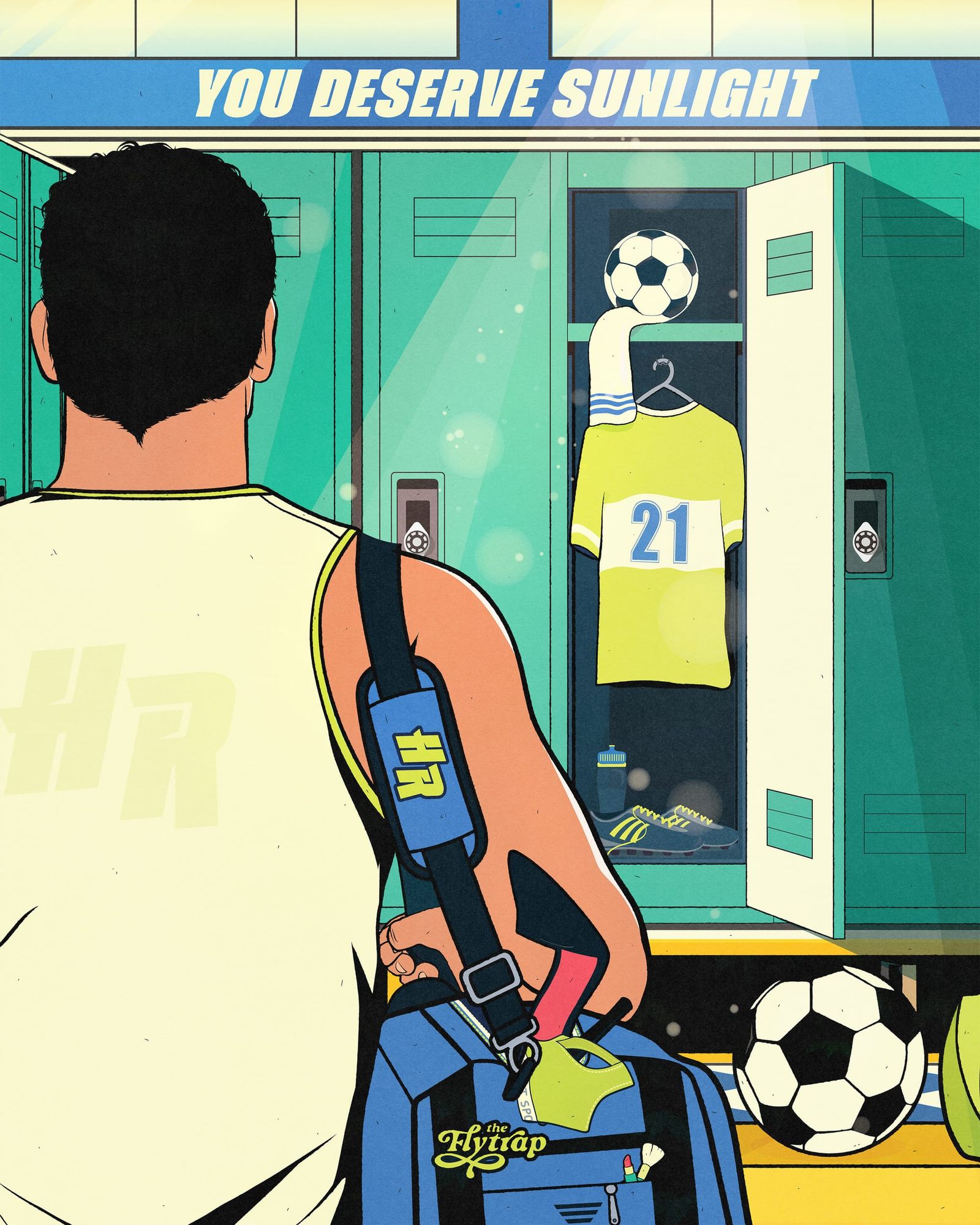
The sex may be hot, but this story is ultimately about sharing the burden of secrecy and the closet, until later on in the series when the two choose sunlight.
You can easily see both Hollander and Rozanov ending up like this other player, but they have each other. Together, the two players share their experience in the closet. Shane has endorsements and the love of the Asian-Canadian community on the line, Ilya has Russia, the ur-nation of homophobia. If Rozanov ever comes out, he likely could never return to his eastern European home.
But their relationship carries them through. The sex may be hot, but this story is ultimately about sharing the burden of secrecy and the closet, until later on in the series when the two choose sunlight.
Now, as I said before, I am neither a gay man nor a professional athlete, so my closeted athlete experience was very different from that of the two main characters. Nevertheless, their stories struck a familiar chord for me. I played multiple sports in high school and soccer in college. Like Hollander and Rozanov, there were parts of my personal life that I not only couldn’t share with my teammates and family, but that I had to actively hide from them.
Do you love The Flytrap’s art from amazing freelance artists and Art Director rommy torrico? This week’s art is up at our merch store!
Want more media criticism from Kate? Check out “Virginity Is Fake” and grab a stylish poster of the American Pie-inspired art too!
The field or the court was my escape. On the field, it was just me, the ball, and my opponents, and I was free of all the gender shit that clogged my brain the rest of the day.
This is why my heart breaks for the young trans athletes who have been run out of sports by authorities. I can’t imagine growing up in a more accepting time when coming out as a young trans person would have been possible, but asking me to abandon the only truly safe place I had ever found in the closet in order to live the life I knew I was supposed to lead would have literally killed me.
It’s an impossible choice for any queer athlete to be forced to choose between their identity and their sport. But Heated Rivalry dares to ask: “Why not both?”
The first season of the show doesn’t resolve this question, but this is seemingly the overall theme of the series. In an age when shatteringly few male professional athletes are out as gay, and when sports like hockey continue to often be openly homophobic, Heated Rivalry feels like a balm for the queer athlete’s soul.
This piece was edited by Chrissy Stroop and copyedited by Evette Dionne.