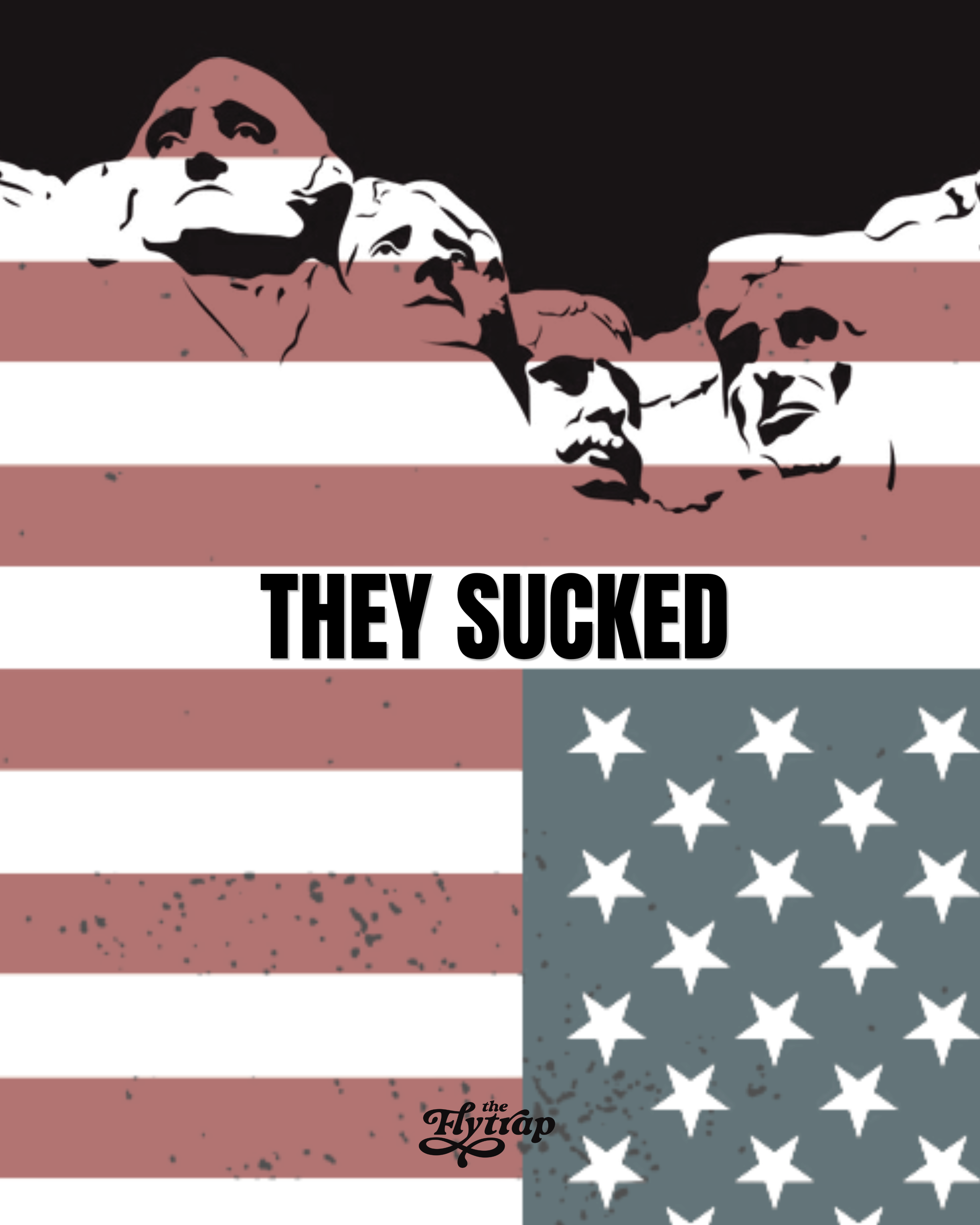
The Founding Fathers Sucked
In honor of America’s 250 birthday, we should stop lionizing them.

Editorial note: This post contains Bookshop.org affiliate links. The Flytrap may receive a commission for products ordered via these links.
The United States of America is quirky place—sometimes in a good way, often in a bad one. In the United States, you can still find the occasional operational mid-century roadside attraction, like the mermaid shows of Weeki Wachee Springs State Park, located in an unincorporated part of Florida some 60 miles north of Tampa. The attraction offers white-coded 1960s style spectacle in a place with a Seminole name (meaning “little spring” or “winding river,” according to the park’s website). If you go—which, I must admit, I have—and attend the standard mermaid show, you’ll sit in a viewing gallery where you’ll be treated to a display of admittedly impressive athleticism, along with a hefty dose of lily-white nostalgia mixed with the fantastical, as nostalgia always is in one way or another.
The underground gallery features a large window into a natural spring, where women wearing mermaid tails perform without surfacing, breathing as necessary through hoses with pumps on the end that release air, an apparatus that seems not to have been updated since the attraction’s midcentury heyday. They perform to music and a voiceover that describes the history of the tourist attraction, highlighting the amazing feat of eating apples underwater.
The show concludes with—I should have seen it coming, but I didn’t—an underwater ballet routine set to Lee Greenwood’s intolerable 1984 country hit “God Bless the USA.” Many of the audience members—I don’t remember seeing a single BIPOC person among them when I went—stand and place their right hands over their hearts as if this schlocky jingoistic trash is the goddamn national anthem. As the song crescendos toward its conclusion, the mermaids unfurl a massive, nylon(?) weighted American flag. It’s tawdry, it’s tacky, and the audience eats it up.
In the Civil War, the Union won the war but lost the peace.
It brought back memories.
I am a 1980 baby and a product of evangelical Christian schools. I had to say three pledges a day in elementary school—to the American flag, the Christian flag, and the Bible, in that order. Our talent shows ended with an audience sing-along of “God Bless the USA.” Here in America, we may not be free to afford healthcare, but at least “we” know “we’re” free to indoctrinate kids into right-wing faith and fill their heads with “Lost Cause” nonsense about how Confederate Generals Robert E. Lee and Stonewall Jackson were honorable Christian heroes.
Drawn by the allure of a mermaid performance and my problematic love-hate relationship with Americana, I went to Weeki Wachee—a name that, again, recalls the presence of Indigenous people who were forcibly removed from their unceded land—in 2018. It was particularly surreal to experience the show while living under a fascist Republican president whose own favorite former president is Andrew fucking Jackson.
This same repulsive buffoon, this dunderhead dictator, is of course also known for defending “beautiful” statues of Confederate leaders. Even though Donald Trump is an insurrectionist and therefore theoretically barred from holding “any office, civil or military,” by the Fourteenth Amendment to the U.S. Constitution—the second of the three Reconstruction Amendments ratified between 1865 and 1870, in the aftermath of the Civil War—he is now president again.
On January 6, 2021, a Christian flag was brought into the breached Capitol along with other abhorrent banners including “blue lives matter” and Confederate battle flags. For Christian nationalists and their fellow travelers, all three can sit comfortably with each other and with the American flag because in the Civil War, the Union won the war but lost the peace. And the “spirit” of the Confederacy, if you will, keeps winning the peace over, and over, and over, “rising again” in vicious backlash against civil rights gains. January 6 was a crystallization of one such moment, a moment that we are still living through.
Back in the White House, Trump has been abusing his power to the benefit of insurrectionists who were convicted for the crimes they committed that day. And the ideological movement behind Trump calls not only for the elimination of the Fourteenth Amendment, which grants birthright citizenship, but also for overturning the Nineteenth Amendment, because women voting is inconvenient for the “anti-woke,” anti-DEI assholes who are currently in charge at the federal level.
You can find Flytrap posters, tees, trucker hats, and more at our merch store!
All profits in May and June from our charity bandana designed by our Art Director, rommy torrico, will go to Red Canary Song, a collective of migrant massage workers, sex workers, and supporters of the Asian diaspora.
The Constitution Itself is Fundamentally Inequitable
Most Americans don’t want any of this shit. But what most Americans want has never mattered to American power—not when the founding fathers crafted the Constitution, and not in any generation since. As the 250th anniversary of the adoption of the Declaration of Independence by the Second Continental Congress draws near, I think it’s high time more of us started questioning whether an equitable democratic society is remotely possible under the system bequeathed to us by Virginian slaveholders like Thomas Jefferson and George Washington, and the northern compromisers like Benjamin Franklin (who enslaved people before the revolutionary era and was just as deep in the dirty land speculation game as Washington and Jefferson).
Now, I love a semiquincentennial as much as the next person—mostly because it gives me an excuse to say “semiquincentennial”—but when it comes to celebrations, I will have to sit this one out, along with the artists originally slated to perform at the National Mall and several U.S. states who have pulled out of the America250 event.
The United States is in a reactionary period of actively getting worse, with human and civil rights on the chopping block. It’s a disgrace, and a cycle we just can’t seem to break. When it comes to the federal power, we are forced to endure a situation in which, essentially, land votes rather than people. The Electoral College, a nonsensical invention of the founding fathers, decides the outcome of presidential races—all too often in favor of right-wing Republicans who lose the popular vote. Equal representation by state in the Senate is at least as unfair, as it allows right-wing, rural states with low population density to hold equal power to densely populated states. As there are more of the former and fewer of the latter, once again, white right-wing Christians have an unfair baked-in advantage.
Given structural issues such as this—along with partisan gerrymandering, a complete lack of any mechanism for holding Supreme Court justices with lifetime appointments (a terrible idea in themselves) accountable for malfeasance, and our inability (and too often unwillingness) to bring criminal presidents to justice, not to mention the nearly impossibly high supermajoritarian threshold for amending the Constitution—one can make a compelling case that the U.S. Constitution has failed at fostering a healthy, functional democracy. Of course, we shouldn’t be particularly surprised about this, since it was never intended to do so.
The original Constitution directly addresses slavery five times, despite the fact that it never uses the words “slave” and “slavery.” Many of us will be familiar with the three-fifths compromise (Article I, Section 2), in which enslaved people are conveniently filed under “all other persons.” Some of us will also recall that the Constitution allowed the importation of African slaves (“such persons”) to continue until 1808 (Article I, Section 9). But a provision that is far more rarely recalled than it should be is the Constitution’s fugitive slave clause (Article IV, Section 2): “No Person held to Service or Labour in one State, under the Laws thereof, escaping into another, shall, in Consequence of any Law or Regulation therein, be discharged from such Service or Labour, but shall be delivered up on Claim of the Party to whom such Service or Labour may be due.”
From the very beginning of its current incarnation, then, the United States established separate and unequal systems of “law and order,” one for white citizens, and one for the Americans of African descent that, even if free, Chief Justice Roger Taney ruled not to be citizens at all in the infamous 1857 Dred Scott case. To be sure, the Thirteenth Amendment abolished slavery and involuntary servitude (“except as a punishment for crime whereof the party shall have been duly convicted”) and rendered all such antebellum jurisprudence null and void. Nevertheless, the separate and unequal system of law and order, including the deliberate criminalization of African American communities, has continued in varying ways and to varying degrees up to the present.
Nothing has stopped unreconstructed white America from “rising again” multiple times to reinscribe white supremacy into the national fabric. We are living through such times now; the current Supreme Court has eviscerated the 1965 Voting Rights Act that put an end to Jim Crow tactics used to prevent African Americans from voting.
Despite all this, even American liberals can’t seem to help themselves from buying into pernicious notions like “national greatness” and “American exceptionalism.” The willing blindness the political class and the punditocracy hold toward the ever-urgent need for decolonization, reparations, and basic universal access to housing, healthcare, and education is deeply depressing.
The Declaration is often cited as a key example of the Enlightenment ideals espoused, often hypocritically, by the founding fathers. Even those who recognize the hypocrisy, like many prominent Democrats, often refer to the Declaration as setting very special aspirational ideals, as if the country’s leadership over centuries should get credit simply for ostensible good intentions, or cite the Declaration explicitly as an example of “American exceptionalism,” when this notion of national supremacy is in itself corrosive of democracy.
We don’t owe the founders any special deference in figuring out how to pursue a more fair, equitable, and democratic future, whether from within or outside the current system.
Like hero worship of the founding fathers, the rhetoric of exceptionalism and “national greatness” should have no place in a healthy, democratic country, and therefore should be eschewed by any supposedly democratic party. But our feckless Democratic Party leaders can’t seem to help themselves from letting the fascist Republicans frame national discourse. Often they actually seem to like the same frames.
As a transgender woman, and thus a member of a demographic whose rights and representation are being directly rolled back by the current federal government—as they have been by many state governments for more than a decade—I am tired of seeing the same part of the Declaration quoted over and over again like holy scripture, which allows key contexts and realities to be waved away:
We hold these truths to be self-evident, that all men are created equal; that they are endowed by their Creator with certain unalienable rights; that among these are life, liberty, and the pursuit of happiness.
If “all men,” let alone all people, have never been equal in the United States, how long is it reasonable to wait before we conclude the fault must lie in the system itself—the same system designed and implemented by the wealthy white founding fathers who drafted, adopted, and signed the Declaration of Independence?
Frankly, 250 years since the Declaration—or, if you prefer, 237 years since the current Constitution went into effect—seems like more than enough time for the United States to have “realized its aspiration” toward the equality of all, if it ever had such an aspiration. And if our founding documents were not, in fact, crafted with any such high aspirational ideal in mind (spoiler alert: they weren’t)? If the supposed promissory note provided by the Declaration can never be cashed in? Then it seems to me we don’t owe the founders any special deference in figuring out how to pursue a more fair, equitable, and democratic future, whether from within or outside the current system.
If we continue treating the founders and founding documents like religious icons to be venerated, we will never be able to delegitimize the power of the unreconstructed. However we approach the road ahead, we need to look forward, not backward to “great men” and “heroes” who... weren’t.
This piece was edited by Andrea Grimes and copyedited by s.e. smith.