
Housewife Luxury Will Never Be Quiet
Get your half-baked class analysis out of my face
NOTE FROM THE FLYTRAP FOUNDERS: If you’re a paid subscriber and you’re having trouble viewing today’s piece, check your spam filter! We’ve heard from a number of folks who are seeing our emails go to the junkbox, so be sure to add us to your safe-senders list. If you’re still unable to view our content after checking that out, please holler at us at info@theflytrapmedia.com and we’ll get you sorted out.
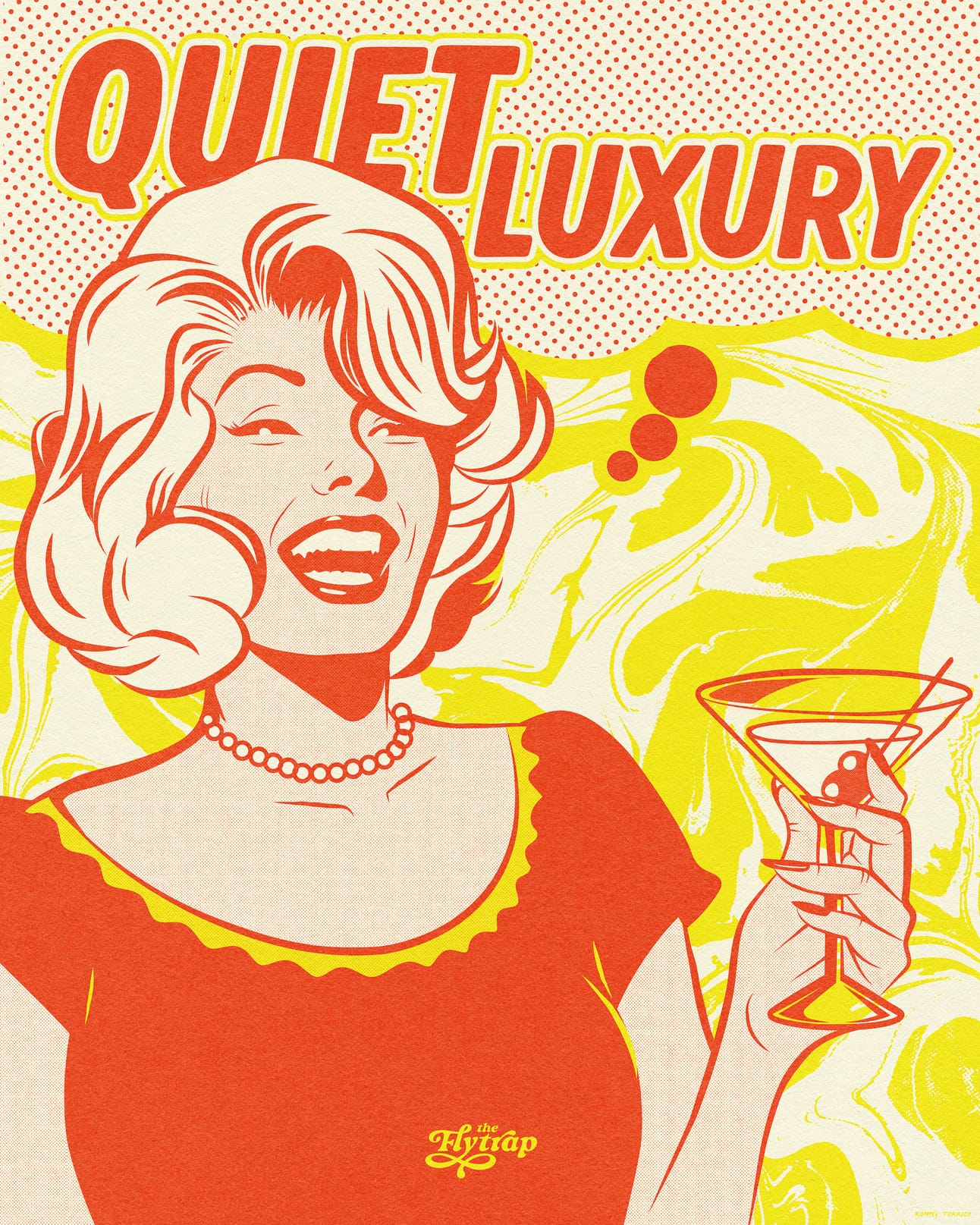
Picture a Housewife. Not a “housewife,” but a capital-H Housewife. Whether she’s NeNe Leakes, Teresa Giudice, Lisa Vanderpump, Luann de Lesseps or any other woman under the umbrella of the Andy Cohen Extended Television Universe, you probably have a few adjectives that come to mind when you conjure her image. “Loud,” “flashy,” “campy.” Maybe “tacky” and “drunk,” if you’re not feeling charitable. She yells at her fellow cast members. She occasionally throws drinks, bread, or prosthetic limbs. She accuses her friends’ husbands of infidelity and storms out of restaurants with hair extensions and camera crews trailing behind her. She is the creation of 18 years and counting of the Bravo TV juggernaut. But most importantly, she’s very rich, bitch, and she wants to make sure you know it.
In the last few years, there’s been a steady stream of online trend pieces discussing and dissecting the concepts of “quiet luxury” and “stealth wealth,” driven largely by the aesthetics of Succession and celebrities like Gwyneth Paltrow. (I would argue that Paltrow’s existence as Hollywood’s premier actress-turned-lifestyle-influencer would negate any claims to quiet or stealth, but this isn’t a column about Our Lady of Goop.) What started as a Gen Z social media discussion soon bloomed into a larger conversation taken up by legacy media like the Associated Press, Vogue, and Glamour. And inevitably, that discussion has trickled into a few corners of the “Real Housewives” fandom, including the r/BravoRealHousewives subreddit.
There have always been criticisms of the conspicuous consumption of the Real Housewives. In 2008, Hanh Nguyen of Zap2It took note of the “orgy of excessive spending” — what a delightful turn of phrase! — in the first season of Real Housewives of Atlanta. During that season, the exorbitant prices of cast members’ purchases were regularly displayed during on-screen shopping sprees: $3,000 on a few dresses here, $850 on shoes there, $68,000 on a cream-colored Cadillac Escalade driven off the lot moments later. As a cultural phenomenon born of the mid-2000s pre-recession reality TV glut, “Real Housewives” was a matter of “right place, right time.”
On paper, the economy was booming. Almost anyone could get a mortgage to buy their McMansion-sized piece of the American Dream. Shows like Lifestyles of the Rich and Famous and MTV Cribs gave viewers a taste of how the 1% live. But it wasn’t often that we got to see “normal” rich people on TV, which is to say “people with a lot of money but without an IMDB profile or a separate Wikipedia page dedicated to their discography.” Bravo offered us a window into that world, beginning with Real Housewives of Orange County in 2006. Franchises based in New York City, Atlanta and New Jersey followed in short order, each offering their own local flavor of blingy excess.
❝ Obliviousness and a penchant for destroying relationships are what make the Housewives entertaining.
As the label-heavy maximalism of the Bush era gave way to the Great Recession and the Obama years, Americans’ class consciousness rose. It crested and retreated in waves that mirrored the Occupy Wall Street protests of 2011, Bernie Sanders’ Democratic primary campaign in 2015 and 2016, and the COVID-19 pandemic that has caused all manner of economic chaos in our current decade. But the Real Housewives remained largely insulated. They carried on with their contractually-mandated cast vacations, their Mercedes G Wagons and their massive (yet often bland) homes. Meanwhile, the fans’ tastes shifted, sometimes in strange ways.
A search of the terms “quiet luxury” and “stealth wealth” within the BravoRealHousewives subreddit returns recent threads about how viewers don’t enjoy the flagrant displays of wealth the way they used to and (confoundingly) how Beverly Hills isn’t living up to its supposed reputation as a bastion of subdued elegance. Nevermind the fact that for millions of us raised on a steady diet of late-80s to mid-00s pop culture, “Beverly Hills” and “Rodeo Drive” were synonymous with luxury shopping. As a kid, before I knew anything about California besides where to find it on a map, I knew that Rodeo Drive was where people went to spend a lot of money. It was Los Angeles' answer to Fifth Avenue in Manhattan. If I, an 8-year-old from the Atlanta suburbs whose idea of “fancy” was dinner at Steak and Ale, was aware of it, then where was the quiet part of this luxury? Is the stealth wealth in the room with us? Or is it in the back room at the Hermès store with the secret stash of ostrich leather Birkin bags?
Critiques of wealth and unfettered capitalism in the Housewives ecosystem aren’t unfounded (see Ngyuen’s commentary above), but I do question the expectations fans have of these shows. This is a TV subgenre known for day drinking, sprinter van fights, and brunches that create more problems than they solve. Removing or toning down their decadence would be creating an entirely different show. It’s like expecting shows aimed at preschool kids to do away with the bright colors and saccharine musical earworms that are the hallmarks of PBS Kids and Nick Jr. What exactly is it that they want? It seems that it’s more the way these women choose to display their purported wealth that’s a turn-off rather than its existence at all. And that’s certainly… a take.
These fans claim to yearn for more subdued displays of affluence like we see in Succession, with its color grading that evokes the constant foreboding of an overcast day, its Loro Piana baseball caps, and its endless supply of pantsuits in oatmeal, camel, and navy. Yawn. I, for one, have no interest in seeing 21st century WASP-y aesthetics trotted out on my screen week after week. If I wanted to see people who look like they wash down their cornflakes with gin and tonics, I’d be rewatching Mad Men. Give me the sisterhood of the traveling Mugler bodysuit. Give me the CHA and NEL earrings. Give me a child’s first birthday party with 12 cakes.
Effective class consciousness requires self-awareness — acknowledgment of oneself as a member of the proletariat. It also requires solidarity, that is: Standing with other exploited workers against the capitalist class. The former is a character trait that has always been in short supply in the Bravo-verse. If anything, self-awareness is antithetical to a Housewife being good at her job! Those who do demonstrate it are often accused of being “self-produced.” Someone like Lisa Barlow wouldn’t be nearly as entertaining if she realized how out-of-touch her meltdown about a $60,000 ring made her sound to plebes like me. And the latter is effectively impossible when, even outside of their status as employees or contractors of Bravo, many of the cast members are — at minimum — part of the petite bourgeoisie.
❝ The revolution will not be televised by NBCUniversal!
Obliviousness and a penchant for destroying relationships are what make the Housewives entertaining. It’s what makes the low stakes of claiming someone “smells like hospital” or not being on a birthday party guest list or snide comments about a white refrigerator into cultural touchstones. If that no longer resonates with you as a viewer, that’s fine. It’s perfectly acceptable, even laudable, to outgrow a media property as your politics evolve. (I’m looking at you, Harry Potter fans who still put money in J.K. Rowling’s TERF-y pockets.) But if your argument is that these women should be less flamboyant because you find such displays garish or offensive, perhaps consider that you’ve lost the plot. Don’t expect these women to stop serving up what they’re good at. The revolution will not be televised by NBCUniversal! The first shot in the war on late-stage capitalism will not be fired by the likes of Larsa Pippen or Heather Gay. To be a Housewife is to be fundamentally incapable of subtlety and self-reflection. If one believes that “money talks and wealth whispers,” then Housewives across franchises will continue doing what they’ve done best for the better part of two decades: screaming. As they should.
This piece was edited by Nicole Froio and copy edited by Evette Dionne.