Quitting Men Isn't a Political Strategy
White women’s individualistic calls to disavow men — while invoking the 4B movement in South Korea — do nothing to achieve collective liberation from patriarchy.

The Flytrap is a Bookshop.org affiliate. If you buy a book we mention or recommend in the post below, we may earn a small commission.
In the days following the re-election of Donald Trump as president of the United States, mostly white and presumably middle class American women took to the internet to spread the word of a movement they just learned of and decided to join – despite obvious language and cultural barriers. The 4B movement, some TikTok users parroted, was a movement to boycott men and all the labor women do for them.
Originally conceptualized in South Korea, 4B has four rules: biyeonae (no dating men), bihon (no marrying men), bisekseu (no sex with men), and bichulsan (no childbirth). After the revelation that more than half of men under 30 voted for Trump, women’s decision to quit men as a protest to men’s allegiance to a Trumpian status quo — the kind of status quo that subordinates women — seems like an appropriate, if reactionary, response. Curiously, the social media posts disavowing men are mostly coming from white women, another demographic that has historically supported Republican candidates at the polls, an inclination that unfortunately continued in 2024.
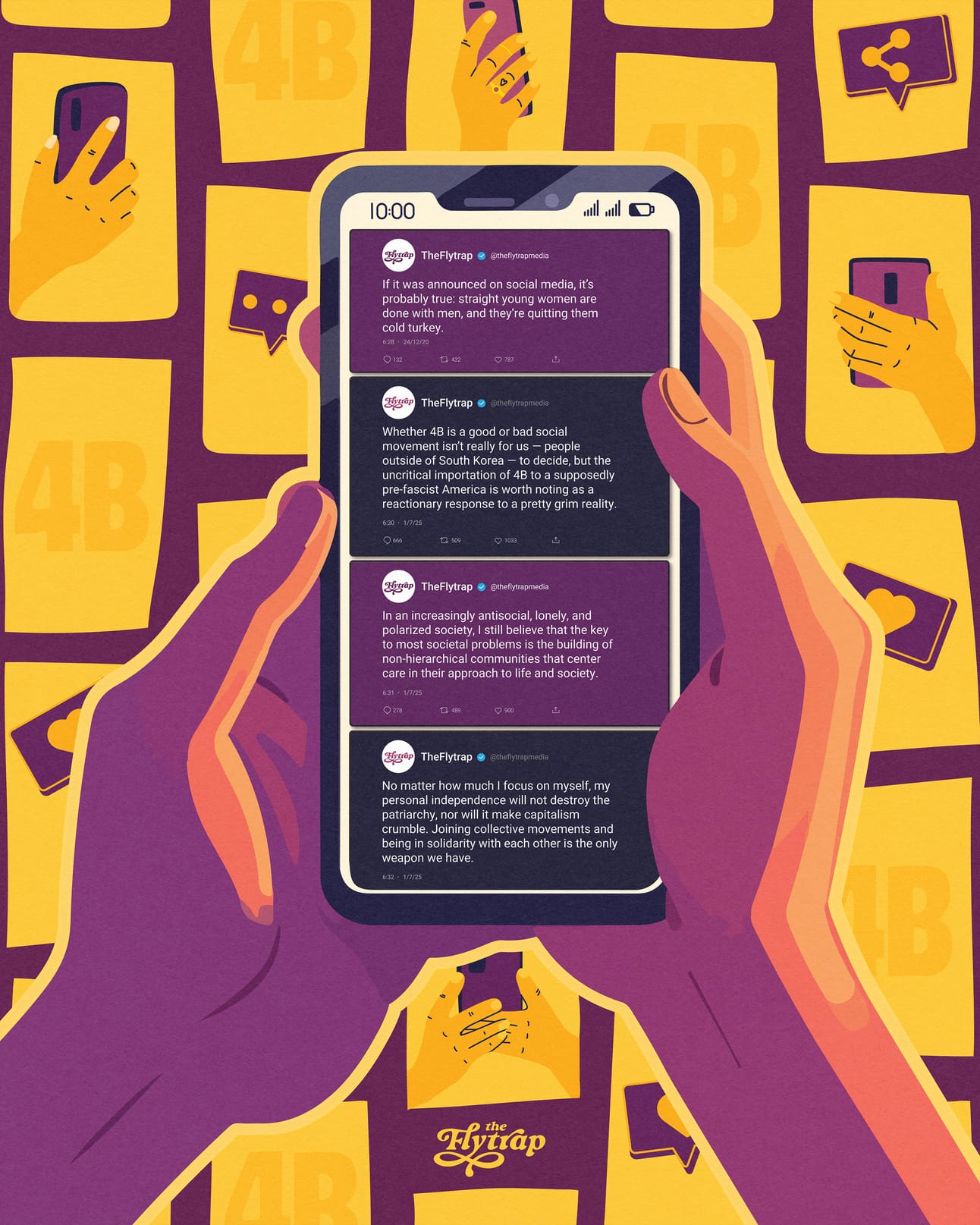
If it was announced on social media, it’s probably true: straight young women are done with men, and they’re quitting them cold turkey. Following these passionate announcements, the digital media machine rushed to explain the 4B movement to the public. Many of the reports had an orientalizing angle, framing gendered oppression in South Korea as something that happens uniquely elsewhere. The coverage has also framed the social media trend as a fringe movement that comes across as extremist to the median reader. How scandalous that women would do this in South Korea – women must really suffer under gender oppression there. The journalistic narrative is that, because of Trump, Americans will now get a taste of what it is like to be a woman in a global south country. To quote The Guardian, the 4B movement is “pushing against a deeply unequal society,” which seems to imply this isn't the case right now in the United States of Fascism.
The imperialistic tone of “gender is an issue over there” has always irritated me. What is true is that 4B was born out of South Korea’s unique social context. All countries have, more or less, a unique social context where a gender order operates as a system of oppression, and it has become tiring to watch Western media (and now, American TikTokers) narrate these inequalities as something that only happens in less evolved countries.
In an effort to understand the movement within its context, without the specter of Trumpian fascism and U.S.exceptionalism, I reached out to Seoul, South Korea-based scholar Euisol Jeong, who wrote about the 4B movement for the Journal of Gender Studies.
In broad strokes, 4B was born in the digital forums of Megalia, a digital feminist movement that began in 2015 when South Korean women publicly shared complaints about their male partners, eventually arriving at larger critiques of toxic masculinity. The South Korean government’s release of a map tracking women of childbearing age by city district and region in an attempt to increase birth rates in 2016 further fuelled the discourse on Megalian forums. “In response, Megalian participants protested and introduced slogans such as biyeonae and bisekseu, rejecting the instrumentalisation of women's bodies,” Jeong explained. “These slogans became the foundation of the 4B ideology.” Broadly, adherents refused to do the reproductive labor that benefits men in society.
The 4B movement critiques a South Korean society that refuses to provide possibilities of a future for women who do not want to build a nuclear family. Single South Korean women, Jeong said, face discrimination in seeking housing, work, societal stigma, sexual harassment and gendered violence. 4B is critical of both patriarchy and the pro-natalist state, grounding itself in the refusal of reproductive labor in an effort to prioritize individual women’s career growth and financial independence.
In a feature about the movement for The Cut, Anna Louie Sussman wrote that 4B participants believe that “Korean men are essentially beyond redemption, and Korean culture, on the whole, is hopelessly patriarchal — often downright misogynistic.” Sussman describes Korean women purposefully cutting their hair short, rejecting make-up, working a lot to earn enough money to have their own place or simply living with their parents to avoid having to pay rent, as well as having an interest in finance and growing women’s financial power — a difficult feat when the gender wage gap is one of the widest in the world at more than 30%. “Their interest in finance is both about the pressing matter of living an economically viable life today and the longer-term possibility that women practicing 4B at scale will eventually weaken the patriarchy,” wrote Sussman.
The imperialistic tone of ‘gender is an issue over there’ has always irritated me.
But the movement also has its critics, both in South Korea and abroad. Its emphasis on self-betterment and building an individual life — as well as an emphasis on economic growth — has drawn criticism that the movement is essentially neoliberal and in alignment to another oppressor of women: capitalism and the fact we must labor to survive. 4B ideology has also been criticised for its very evident biological essentialism — Jeong told me that “4B does not directly address queerness or transness” because it centers the treatment of cis women in South Korean society. South Korean feminists and American commentators alike have dubbed the movement transphobic and exclusionary. The centering of a binary gender system has — much like in Western feminist movements — resulted in a fringe trans-exclusionary feminism.
“It took a regressive turn,” explained UCLA gender studies assistant professor Ju Hui Judy to the publication Them. “Women calling for an end to the violence against women were then starting to really police the boundaries of who can participate in those protests. You can see how [4B] keeps going this way when you stick to, and when you reproduce, and when you reinforce the gender binary, this inevitably harms trans and queer folks.”
Whether 4B is a good or bad social movement isn’t really for us — people outside of South Korea — to decide, but the uncritical importation of 4B to a supposedly pre-fascist America is worth noting as a reactionary response to a pretty grim reality. There is an imperialist turn where Americans fetishize global south feminism(s) as inherently more radical and efficient than any kind of homegrown feminism. In reality, global south feminisms also have internal fractures and disagreements that sometimes make these movements not as liberatory as they seem. This turn tends to reinforce the narrative that gender is only a problem elsewhere and only when the latest Republican demagogue is (or about to be) in power.
Feminist white ladies in America have a tendency to reinvent global south feminisms when their own methods have failed, often misunderstanding or purposefully ignoring the original contexts these movements were created in. Reactionary and ineffective sex strikes that center protest on an individual’s withholding of sexuality, rather than collective action to retake reproductive autonomy, is a cyclical plea within the American feminist sphere. In 2019, actress Alyssa Milano urged women not to have sex with cis men to protest an abortion ban in Georgia. In 2022, the overturning of Roe v. Wade caused protesters to call for a sex strike reminiscent of the Greek play “Lysistrata,” which has been famously misunderstood by American feminists since at least 2010. We’ve been here before, and the effectiveness of these strikes are pretty much impossible to quantify because they are conceptualized individualistically and on the fly, mostly out of fear. People will post about what they’re pledging to do online, there will be two or three days of discourse about it, and then it fizzles out.
Feminist white ladies in America have a tendency to reinvent global south feminisms when their own methods have failed, often misunderstanding or purposefully ignoring the original contexts these movements were created in.
Ultimately, the importation of the 4B ideology at this particular juncture reminds me of that weird period post the 2016 election of Trump when white liberal feminists pushed the idea that Black women would save us all — with their organizing, with their votes, with their beliefs — thus encouraging a dehumanizing deification of Black women as infallible saviors whose politics are inherently Good™. When all else fails, nice feminist ladies will look to women of color for solutions, as if women of color are more enlightened by our oppression; as if we have acquired superhuman resilience that we must share. Within this framing, the context of women of color’s oppression has completely collapsed into leading white feminists out of American fascism — a Sisiphyan task, to say the least — rather than liberating all women of all kinds from oppression.
On Feminist Discernment
I’ve been thinking about discernment since 2018, when I realized that some of the liberatory language I learned when I discovered feminism and social justice was used by people pretending to be progressive activists to grift people out of money. The guilt of privileged people can be a powerful tool for bogus fundraising. The term “resistance grifters” has certainly come to mind in the weeks after Trump was re-elected, as I watched “social justice” influencers shift their narratives from regular fundraising to sudden promises of “community building” and unbounded support for marginalized people. Which ones? How will they be supported? Specificity is generally avoided in these posts. Gender, race, disability, ethnicity — all of these categories can now be used to wield social capital and validation for cruel, antisocial behavior. This is being done both by (alleged) allies of social justice movements and by people who actually inhabit those categories. The usage of identity to leverage individual social capital is a symptom of the hyper-individualization of collective struggles that should be addressed collectively.
Jeong says 4B operates like an ideology for individual women, rather than a traditional social movement. The rapid rise of 4B on American social media felt like an extension of this hyper-individualization, from the accelerated pace in which it gained online attention to the inherently punitive goals of the alleged movement. In the videos I reviewed, there were no mentions of organizing collectively to actually achieve liberation from patriarchy. Rather, there were influencers talking about how women have always had this power within us, how all we have to do is decenter men from our lives and our success will follow. Focus on yourself, we are told.
Don’t get me wrong, I am a fan of decentering men from women’s lives, and I have done it wherever possible. But singularly identifying men as our oppressors is only a part of why gender matters in the world — we are also heavily oppressed by capitalism, in a myriad of gendered ways which are seldom recognized by singular feminist discourses that do not consider class as a framework for oppression. This is where the idea of feminist discernment comes in, an idea I have previously applied in the context of girlboss feminism and how it doesn’t quite empower us, but drives us into the arms of capital production in exchange for (our desperately needed) economic independence. We also have to reckon with the objective fact that the mainstreaming of feminism has resulted in its instrumentalization — whether by the Democrats to raise campaign funds in the name of feminist representation or its weaponization to further drive the populational divide between liberal and conservative. Hell, this is exactly why I wanted to start The Flytrap Media — feminism has become another reactionary discourse on the internet, and I wanted to disrupt this process.
While I’ve been thinking about feminist discernment, feminist author Sophie Lewis’ new book Enemy Feminisms: Terfs, Policewomen, and Girlbosses Against Liberation argues that segments of feminism have always flirted with and sometimes aligned with white supremacy, imperialism, and capitalism. Instead of disavowing realities such as the eugenicist origins of Planned Parenthood or the imperialist and racist arguments of Susan B. Anthony on how women’s suffrage could serve to expand colonial powers as “not real feminism,” Lewis argues that these ideologies should be understood as a part of the feminist movement. According to Lewis, calling a movement or an ideology “feminist” shouldn’t automatically be understood as “good politics,” as there are kinds of feminisms that leave many marginalized populations behind — or worse, actually oppress them. I spoke to Lewis over video call after she posted a thread about hetero fatalism and 4B, where she put her argument in historical context. Citing emerging reactionary digital communities of young women in which using men for economical gain is encouraged, as well as the separatist fringe of the American feminist movement of the 1970s that precoursed the trans-exclusionary feminists of today, Lewis cautions against these fascistic fractures of the feminist movement precisely because of the current historical moment.
“We are in a moment of mass disillusionment with liberal feminism, and we have been here before,” Lewis said. “We're seeing various kinds of discursive exodus from the scene of what used to be called postfeminism, that are coming from an impulse towards edginess or radicality or nihilism or separatism. What I want people to understand is that separatism is an impulse that [historically] emerged from defeat. It wasn't originally what the radical women's movement thought was emancipatory.”
Singularly identifying men as our oppressors is only a part of why gender matters in the world — we are also heavily oppressed by capitalism, in a myriad of gendered ways which are seldom recognized by singular feminist discourses that do not consider class as a framework for oppression.
My own disillusionment with liberal feminism started before this election cycle, but my revulsion for what liberal feminism currently stands for became unavoidable as I watched the Kamala Harris campaign and its supporters ignore pleas for a ceasefire in Gaza, while insisting that it is feminist to have a Black woman at the helm of the world’s most destructive empire. As I reported on the reproductive rights movement’s fractures over the genocide of Palestinians, I wondered how women who declared themselves feminists could turn a blind eye to the war crimes being committed in real time, war crimes committed against women and children that many of us witnessed on social media.
The importation of 4B as a radical global south uprising in response to a change in presidential fortunes felt ludicrous to me because there is a gendered emergency in the global south right now — one that is being caused directly by the U.S. empire’s fascistic and colonial approach to the Middle East, in Gaza, Lebanon, and Syria. In the Democratic Republic of Congo, the rush for cobalt mining for the manufacturing of technology in the U.S. has resulted in the displacement of Congolese people. As always, women’s reproductive rights in these countries are the first to fall away under the brutality of U.S.-backed wars.
How can we make sure that our feminism is for the liberation of all people rather than just a few white, middle class women?
Feminist discernment is how I identify who my comrades actually are. After spending five years in a women’s studies department in the U.K., I know that not all feminist women think colonialism was bad; that some feminist women are racist; that some feminist women are exclusionary and openly transphobic. Mentally, I used to say that these feminisms were “not real feminism,” but it has become increasingly clear that they are to some, and ideologies grounded in the reality of women’s subjugation have the potential to be fascist. So, how can we make sure that our feminism is for the liberation of all people rather than just a few white, middle class women? How can we avoid impulses like the importation of the 4B movement in response to an increasing reality of feminist defeat?
Don’t Let Go of Each Other
In an increasingly antisocial, lonely, and polarized society, I still believe that the key to most societal problems is the building of non-hierarchical communities that center care in their approach to life and society. At the risk of sounding earnest, I still believe in the potential for people to build a better world, to be better to themselves and each other, to live in harmony. I believe this dream is feminist, that my ability to hold onto the hard truths of the world while also declaring that we can and will make things better stems from my ideals as a feminist who rejects hierarchy and instead, looks for the utopia of the collective.
Lewis also views collective approaches to gender oppression as more useful experiments in feminist liberation than fatalism or nihilism. “I'm more interested in projects like Mommunes, when many moms live together and raise children together,” Lewis said. Personally, I am a longtime admirer of Mães de Manguinhos (Mothers of Manguinhos), a project where mothers of police violence victims come together to care for each other and protest for justice, collectively recognizing how the policing of race violates Black mothers’ reproductive rights. In the U.S., Food Not Bombs has fed food-insecure Americans while emphasizing the connection between military investment and American hunger for over 35 years, transforming the reproductive work of making food into a life-saving project.
These collective projects have demonstrable results that hyper-individualizing ideologies and “movements” do not produce. Building a utopian future for everyone requires that we don’t give up on each other. I’m not telling you to go out of your way to change men into leftists or to deradicalize them, but I am saying that a nihilistic brand of feminism is not necessarily good politics. I deeply resent that, as a woman, I am called to organize against my own subjugation. When I shared this resentment with Lewis, she echoed my frustration. But, pragmatically, I cannot live my life ignoring 50% of the population. No matter how much I focus on myself, my personal independence will not destroy the patriarchy, nor will it make capitalism crumble. Joining collective movements and being in solidarity with each other is the only weapon we have. Coming together to build something different, while believing that we are the answer to this fucked up world, is all we can do.
So let’s do it.
This piece was edited by s.e. smith and copyedited by Tina Vasquez