
Queer Joy! at the Bra Store
How the lingerie boutique where I worked as a bra fitter became an intimate space for shared queerness.
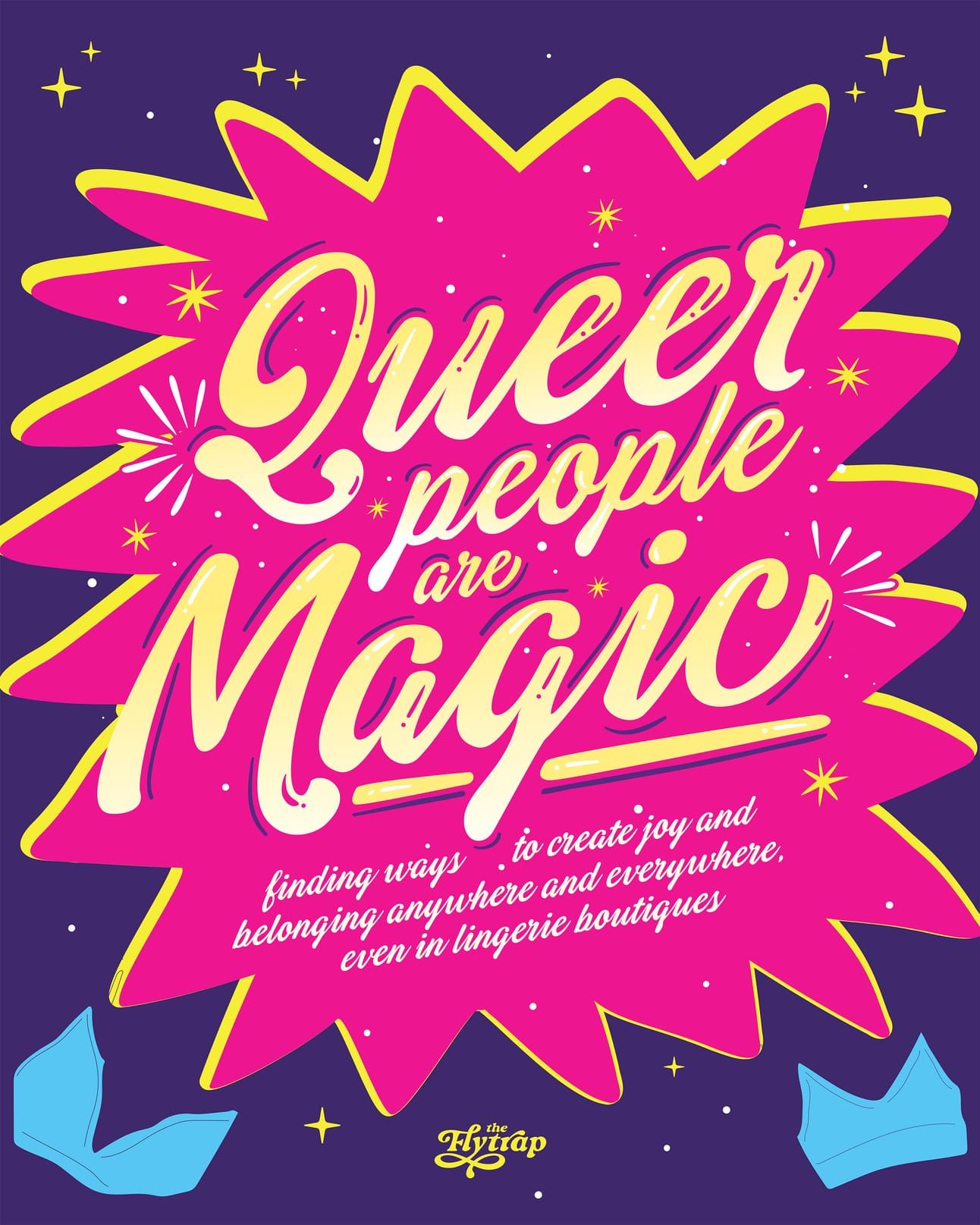
Note from The Flyteam: The Flytrap merch store is now open! Buy a poster or a sticker of the art below or get dripped out in the latest Flytrap merch. Every purchase helps keep The Flytrap running and unfucking your techno-fascist algorithm.
My male boss and his assistant, a woman about 40 years my senior, sat me down at the private Evangelical Christian college library where I worked and studied in my early 20s. My multiple dress code infractions, most of which applied to the visible cleavage that rose over the necklines of my t-shirts, were a stumbling block for men, they told me. How could any man maintain pure thoughts and a clean conscience with such ample flesh on display! As a library employee, it was my responsibility to set a good example for the rest of the student body.
"Well, then," I said, taking a deep breath and standing up, "I guess I'm not a library employee anymore."
I walked out before I could hear their response. I wondered what they would have said if I countered with what was really going through my mind, voicing a truth about myself I'd only just started being comfortable sharing with my nearest and dearest of friends:
"Well, I'm a lesbian, so I don't really care much what ideas men have about me."
Back at my dorm, I researched bra-fitting boutiques, found one in a town I'd be visiting the next month, and made an appointment.
A friend with a similar history of dress code infractions had gotten a bra fitting the semester prior, and I'd seen what a huge difference it’d made in how her clothes lay. We'd bonded over our parallel experiences and discussed where they diverged in how differently the teachers approached the topic with each of us. I'm white, and the teachers adopted the tone of gentle guidance, telling me I’d been doing something wrong without realizing it. She was Black, and her infractions had been met with harsher, more scolding words, the racialized hypersexualization of her body a constant undercurrent.
I was sick of being singled out for the sin of having my body's shape. I couldn't erase past infractions. I would never gain back the respect I'd lost for the adults who had humiliated me. But I could prevent the awful conversations from continuing to happen and be more comfortable in my own skin at the same time.
A good bra is a marvel of engineering: a wearable suspension bridge strong enough to support the weight of breasts but light enough to not add any extra weight or bulk for the wearer. Bras can be made to do this for a seemingly infinite range of sizes. Due to capitalism and its inherent racism and fatphobia, in the United States we've decided that only a few sizes actually count.
It is cheaper for brands to make limited size ranges, according to writer and lingerie expert Cora Harrington’s groundbreaking Black- and queer-led blog The Lingerie Addict. In the early 2000s, most U.S. big box retailers and department stores seemed to follow Victoria's Secret's lead and topped out their cup sizes at a DD. Every time my mom and I found a store that carried bras, we would scour the racks together, looking for anything above a D-cup.
As soon as my mother realized I was in the early stages of puberty, she handed me two books: American Girl’s classic The Care and Keeping of You, and James Dobson's Preparing for Adolescence. While the former was truly helpful, if due for an update, the latter taught me that all boys are uncontrollably horny and that it was my job to hide my body from them to avoid sexual assault. Sexual temptation was a sin, and girls were the sinners.
Three years after reading these books, I'd already outgrown the bras available to me at Walmart and JCPenney. I was homeschooled until I was 13, and when I started going to public school, students made comments to my face about how I had some of the largest boobs of any girl in eighth grade. My mother's friends started giving me gentle talks about how best to hide my body.
Age 13 is also when I realized I liked girls. I met a girl whose smile made me feel like magic. I stopped worrying about the sin of my body and started worrying more about the sin of my heart. I told myself I was bisexual and that I would still marry a man and have a Godly marriage when I grew up.
Despite having been steeped in Evangelical homophobia, I was astonished by how casually homophobic slurs were thrown around by my fellow middle-schoolers. "Gay" was the go-to slur for anything and everything. There weren't any out queer students, but rumors abounded, often with comments about how the school shouldn't let gay and lesbian students use the locker rooms and bathrooms.
Think Regina George in Mean Girls, talking about why she stopped being friends with Janice Ian (DYKE!): "I couldn't have a lesbian at my [pool] party. There were going to be girls there in their bathing suits. I mean, right? She was a lesbian!"
This framing of queer people surrounded me during the years I began realizing I was queer people. Combined with what I'd been taught about men's overwhelming lust for any woman who wasn't dressed modestly, I worried my own desire was predatory. Would I still be invited to slumber parties if people knew who I really was? Would my female friends trust me not to assault them if we changed clothes together in the locker room? This fear, more than anything else, kept me closeted through the start of college.
2009 wasn't just the year I finally got a bra that fit. It was also the year I realized I was a lesbian. I wasn't going to find the perfect man for me. I started coming out to family and friends. Much to my surprise, almost everyone was supportive, even if that support took the form of breaking out into Katy Perry's I Kissed a Girl, a song that seemed inescapable that summer.
I kissed a girl, just to try it. I hope my boyfriend won't mind it.
In the most beautifully relieving (if sometimes annoying) way possible, nothing changed about my most important friendships. My current roommates weren't weird around me, and my female friends didn't care that I'd seen them in their bathing suits countless times.
This framing of queer people surrounded me during the years I began realizing I was queer people. Combined with what I'd been taught about men's overwhelming lust for any woman who wasn't dressed modestly, I worried my own desire was predatory.
My first bra fitting was a queer event. I flew to Boston to spend a weekend with a girl I had met on LiveJournal. I had an enormous crush on her. She took me to the mall for the appointment I'd made after quitting my job at the library.
My fitter was a woman close in age to the woman who had chastised me for tempting men. I took off my shirt. She took a long look at me and came back with a bra for me to try on.
It fit. Perfectly.
That bra was followed by at least a dozen more, each one just as perfect as the first. After all the hours I'd spent searching for a bra that fit, this woman had found an abundance in five minutes.
I walked out with two bras. As if my fitter had waved a magic wand, my breasts were lifted without being squished up to my collarbones and my t-shirt necklines stayed in place rather than dragging lower and lower as the day went on. I'd known in theory how much a correctly fitting bra could change the fit of your clothes, but looking in the mirror, I was astonished by how much smaller my breasts looked, even as I was wearing a larger cup size.
With the “problem” of my ever-present cleavage solved, I didn't suddenly adhere to strict modesty standards. I didn't return to the campus library and ask for my job back. I didn't apologize to my professors for my multiple dress code infractions. I didn't beg for forgiveness from every man who had been exposed to the sight of my cleavage. I didn't restart my attempts to pray the gay away.
The problem had never been my body or my queerness. The problem had always been that the support I needed had never been available to me.
Over a decade later, I was looking for work after spending almost four years as a stay-at-home parent through the pandemic. I'd worked in public libraries after leaving school, and planned to go back to them once I was ready to work again. But when I saw that a bra boutique was hiring a team to open a new location, I thought of that magic wand. I applied.
When I was called back for an interview, I mentioned my wife early and often. My fear of being predatory had changed to my fear of being perceived as predatory. I wasn't going to let fear interfere with this job. I knew I would be good at it.
No one in the hiring process blinked an eye at mentions of my wife. My sexuality never came up as a potential problem. And the day I started, I realized I had no reason to worry.
As it turns out, almost all of the other fitters I'd be working with were queer, too.
If a retail location is open, but doesn't have the constant noise of background music pumping through speakers, does it really exist? My coworkers and I filled our days with a steady blend of genres and eras—classic blues and country, disco and power ballads, 90s/00s pop, post-punk revival and indie sleaze, and current radio hits.
The problem had never been my body or my queerness. The problem had always been that the support I needed had never been available to me.
Queerness bled through all of our playlists. We filled them with artists who were hailed as queer icons, who were closeted in their time but outed after their deaths, and artists who were openly queer and whose songs were explicitly so.
I loved how the music influenced our client interactions.
On a disco-heavy day: "I haven't heard this song in forever! It used to be my favorite to dance to."
As indie sleaze filled the background: "Oh my god, this store sounds like my old iPod."
When a classic love ballad started playing: "This was my first dance at my wedding!"
These moments opened up conversations that charged the fitting rooms with laughter and tears. Bra fittings are intimate spaces. Listening to stories about clients' lives and telling stories about our own often revealed the joys of shared queerness. My fellow fitters and I fed that intimacy as we helped clients try on bra after bra until they found what they loved.
My favorite was a woman who drove down from Memphis. She seemed nervous from the beginning, unsure of what she wanted or if she was in the right place. Bra fitting had become a superpower for me by this point. We didn't use measuring tape. After scanning my eyes over a torso along with asking a few questions and permission for a quick squeeze around the ribcage, I would bring someone the right size on the first try more often than not.
After guiding the Memphis woman through this ritual, I offered her a variety of options, hoping she'd know what she wanted when she put one on and fell in love. As she cycled through bras, we talked about her trip to Atlanta and what else she planned to do here. She mentioned how much packing for travel stressed her out.
"Oh, my wife is the same way,” I said. “I'm more of a throw-things-in-a-bag-and-hope-for-the-best packer, but my wife always has checklists and organizational systems for what we bring."
She turned to me suddenly, her eyes wide, face shocked. For half a second Regina George reared her head and I thought she was going to be angry at me for mentioning having a wife, upset that a lesbian was seeing her half-nude, touching her breasts and shoulders to adjust bras as she tried them on.
Then she said, "My wife is exactly like you."
She relaxed after that. We laughed about our wives, and our similarities and differences. By the end of the fitting she'd fallen in love with two bras—one a smooth beige t-shirt bra, and the other a lacy black demi-cup. She couldn't pick between the two, and decided to enlist her wife's help. As we walked to the front of the store where her wife was waiting, Chappell Roan's "Super Graphic Ultra Modern Girl" started playing. When the client relayed her current pickle of practical vs. pretty to her wife, her wife responded, "Honey, Chappell is playing. It's a sign. Get them both. For her."
So she did.
We'd been playing Chappell Roan in the store since we'd opened. In 2022, before the release of The Rise and Fall of a Midwest Princess, and the tour with Olivia Rodrigo that made her a household name, she was one of our most played artists. "Pink Pony Club," "Love Me Anyway," and "My Kink Is Karma" all got heavy airtime. It was such a joy to see more and more clients recognizing her music and getting excited about hearing it in our store.
"We're a lingerie boutique run by queers," I always wanted to respond. "Of course we're playing Chappell Roan." And Billie Eilish, too.
“I could eat that girl for lunch,” Eilish sings, celebrating same-sex attraction as something worshipful and delicious—“a craving, not a crush.”
When I first heard “Lunch,” I was reminded of Katy Perry singing “it felt so wrong, it felt so right, don’t mean I'm in love tonight” in her song treating same-sex attraction as something naughty, a silly phase, a game to play before going back to her boyfriend. Where Perry sings about queerness as a guilty pleasure, Eilish sings about it as something holy.
Bra fittings are intimate spaces. Listening to stories about clients' lives and telling stories about our own often revealed the joys of shared queerness. My fellow fitters and I fed that intimacy as we helped clients try on bra after bra until they found what they loved.
Our fitting rooms transformed from intimate to holy on the days when the background songs synced with and celebrated our clients’ queerness.
I treasured first bra fittings more than anything else. An early-blooming 11-year-old girl was incredibly shy. She barely spoke a word through the fitting, but she had a rainbow of neon colors woven throughout her dozens of braids. I brought her our most color-saturated bras. Her face lit up. I looked for that smile with each bra she tried on, and tossed anything that didn't spark it. She left with a hot pink bra that matched her hair, and another with glittery stars that matched her bright eyes.
Another day a trans woman, a referral from one of my regular clients, came in saying she was ready to be fit for her first "real bras." My coworker Madison Anne took the fitting, and soon joy emanated from the fitting room as she determined the woman's size and began bringing her options to try on. I found myself smiling the whole time. I had to laugh every time she found one she loved, her exclamations of "I'm an adult! I am allowed to buy myself nice things!" ringing through the store.
She found several nice things, left with a few, and wishlisted the others. As she was checking out, another woman, a friend-of-a-friend, walked in. They struck up an excited conversation and made plans to meet up for coffee that afternoon. It was a beautiful ending to a beautiful fitting.
For most of their existence, bras have existed in a hyper-feminine space in society, thanks to their marketing. Brands like Victoria's Secret focus on telling consumers their bras will make them sexier, more beautiful, more feminine versions of themselves. This means that for those who need bras but have complicated relationships with femininity and womanhood, bra shopping can be a fraught experience.
Is a plunge bra sexier than a demi cup or a sports bra in the eye of the beholder? What if “sex,” in its many forms, isn’t part of a person’s sexuality, as The Lingerie Addict covered in a 2020 post about asexual Black model Yasmin Benoit? Soon after I started the job, my default response to clients who said they were looking for "something sexy" became, "What does sexy mean to you?"
For some it meant bold and strappy; for others, soft and floral. What one client declared the sexiest bra they'd ever tried on, another would disparage the same garment as "a grandma bra." What one person found boring, another would find glamorous. Sex, like beauty, is in the eye of the beholder. Some relished the idea that a bra they thought was sexy was also practical for everyday wear. For others, wearing anything they deemed "sexy" wasn't something for which they were prepared, even if I knew it would solve all the problems they'd come to the store to fix.
There is a bit of a chicken/egg problem with lingerie and sexuality: many bras are lacy because lace is actually a practical material. High quality lace and embroidered tulle can hold incredible amounts of weight while maintaining their shape for a long time and providing lightweight breathability. Because much lingerie is made with these materials, we associate them with the hypersexual femininity they're drenched in through marketing.
This meant that it was sometimes difficult getting people into what I knew would be the best bra for them. Even many cishet women felt a lacy bra was too girly for them, but once they put it on, moved around in it, and saw how it looked under their clothes, they realized, "Oh. This actually is what I'm looking for."
Queer people are magic, finding ways to create joy and belonging anywhere and everywhere, even in lingerie boutiques.
This isn't to say that everyone needs to run out and buy the frilliest bra they can find. Sometimes God gives her largest of naturals to her butchiest of dykes. Some of my favorite fittings happened when femme queers who shopped with us dragged in their partners who thought they were too butch for a lingerie boutique. The femmes insisted we would have something their doubtful partners would love.
For some, I stuck to bra-sized sports bras that provided better support than the XS–XL sized ones they came in wearing. For others, I pulled out options that used lace and tulle, but with designs and patterns that weren't floral. I never struck out—the femmes always left feeling smug about being right while the butches and studs left amazed that they found something they loved.
There was one specific sports bra I came to refer to as the "binder-lite." It became my go-to for trans and masc clients who weren't quite ready for a binder, but wanted something that gave more compression than what they were used to. I discovered its power when a client walked in using crutches and asking for something wireless but supportive. They seemed tired, worn down, and as we started the fitting, I noticed their fingers bending back in an all-too-familiar manner.
"Any chance you have Ehlers-Danlos Syndrome?" I asked.
They looked at me in surprise, and when I bent my left-hand fingers backwards and waved my right-hand fingers around to show off my ring-splints, they laughed.
“Yeah, I think so. I'm in the process of getting diagnosed. I also just came out as non-binary. So. There's a lot going on right now."
I raised my hand for a high-five. "I'm a lesbian! Hell yeah, disabled queers."
We chatted about our shared disability as I helped them try on bras, and when they finally tried on The One, I knew immediately it would be going home with them. Some of the tension EDS causes leaked from their shoulders, which were now no longer dragged down by their breasts. They stood a bit straighter. "Yeah," they said, a deep sigh of relief passing through their smile, "This is good."
There are so many more moments of queer joy I could write about—the older lesbian I flirted with by telling her about a brand's upcoming Robert Mapplethorpe collection, the number of times I mentioned my wife in fittings with women who then got excited and said, "I have two moms!" I will treasure my time spent as a bra fitter for the rest of my life.
I knew it would come to an end, though, when I saw my boss' signature on a petition condemning Jonathan Glazer for speaking in defense of Palestine at the Oscars. I made my exit plan, enrolled in grad school, and began counting down the days until I could work in libraries again. The shop closed in January, a week before the DOGE-induced mass layoffs began sweeping across the country and impacting Atlanta’s economy.
Even as I look forward to working in libraries again, I miss the tiny queer haven we created in the middle of Atlanta. Queer people are magic, finding ways to create joy and belonging anywhere and everywhere, even in lingerie boutiques.
I once took a call from a man who had gynecomastia, excessive male breast tissue. He told me he had a life-long fear of surgery, and couldn't bring himself to undergo a breast reduction. Instead, he'd decided to embrace it and get really into luxury lingerie. He wasn't local, but he had questions about some bras he’d seen online. I answered his questions and I wished him well, telling him that I hoped he found somewhere he could comfortably shop for bras and get his questions answered in person.
I think about him often. I don't know much about him other than what I learned through that phone call. But he reminds me of the ways in which a better world for queer people is a better world for everyone. I'm eternally honored to have spent three years giving the support I'd once needed to others through queer joy at the bra store.
This piece was edited by Christine Grimaldi and copyedited by Nicole Froio.
Rebecca Mott lives in Atlanta with her wife, son, black lab, rescue cat, and boa constrictor. After a decade of library work and three years of bra-fitting, Rebecca is currently working on her Master's in Library Sciences at LSU. She believes in the power of both libraries and lingerie to change lives. Follow her on Bluesky and Instagram.