
Pushing Through The Pain
What the sports world can learn from the kink community
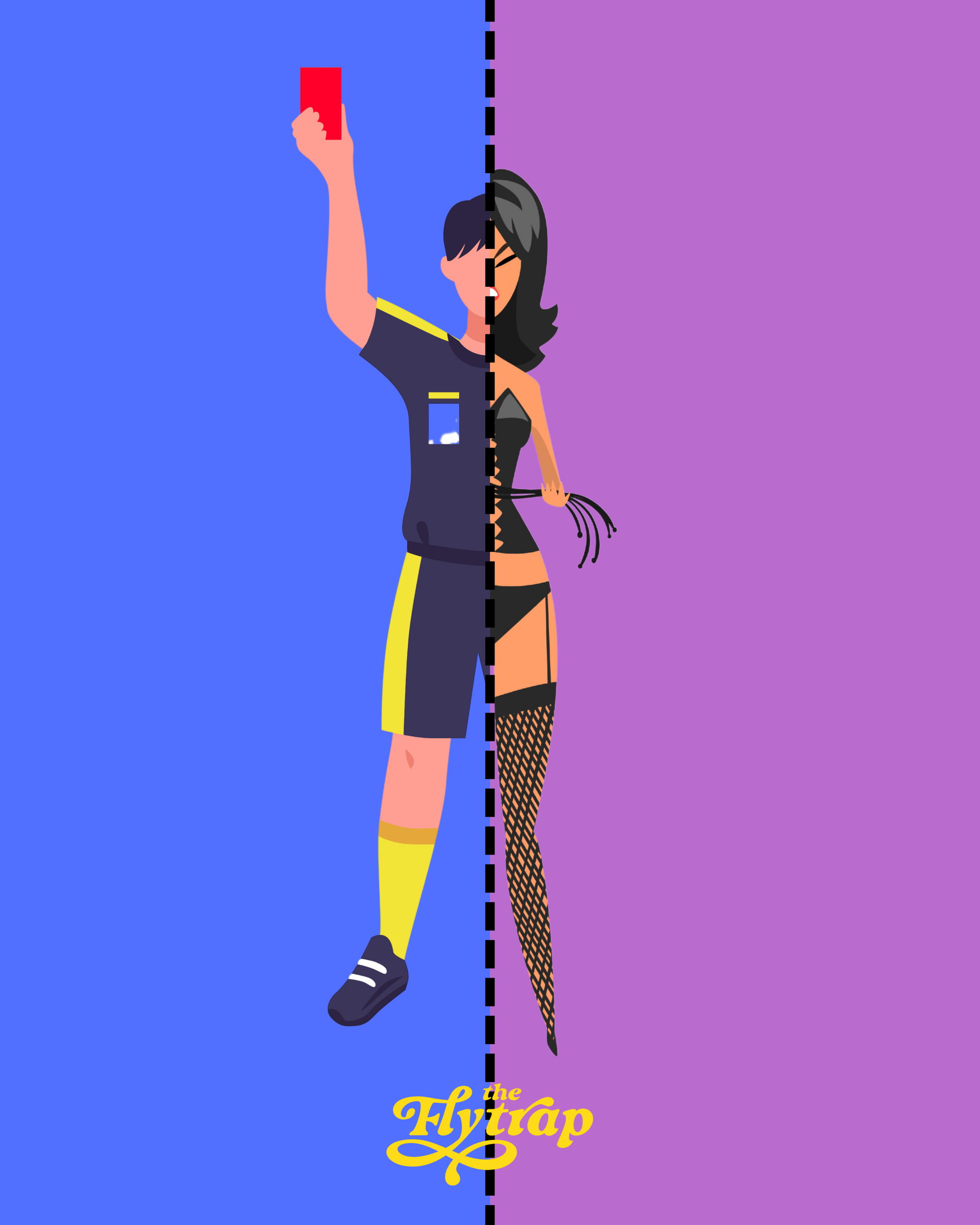
As a teenager, Charlie, (who requested that The Flytrap use a pseudonym) played basketball. Over the years, through different teams and coaches, they noticed they preferred certain kinds of feedback: “I respond well to my coaches being harsh and negging me.” But not all of their teammates handled that kind of coaching like Charlie did; receiving negative comments from a coach could make some of them crumble emotionally. It would have the opposite effect that the coach wanted. Players would give up rather than try harder.
After playing basketball at university, Charlie left the sport. As an adult, they returned through coaching a local women’s team. In learning to be the best leader they could, they found themselves leaning on another kind of training—the lessons they’d learned as a Dungeon Master in their local kink scene.
“I think having that awareness of how consent and boundaries are or should be established continuously, on an ongoing basis, has made me more aware of how others might interpret me based on the power dynamic of coach/player,” Charlie says. “I’m trying to be more up front about that so that it doesn't have negative effects on people or make them feel unable to say if they don't like something about how a session is run.”
While the BDSM world has language and norms to have these kinds of conversations, the sports world largely doesn’t. How does one bring the lessons learned in kinky spaces onto the sporting field?
Acknowledging parallels between sadomasochistic sex and sport is not new. In Hurts So Good: The Science and Culture of Pain on Purpose, journalist Leigh Cowart interviews a variety of people who participate in voluntary masochistic activities, from BDSM practitioners to ballet dancers and ultramarathoners. Meanwhile, sociology professor Jill D. Weinberg opens her book Consensual Violence with the image of someone being choked, and then broadens to two different scenes—the MMA ring and a BDSM dungeon—to make the point that the same act has very different societal responses depending on where it takes place.
Athletes put their bodies on the line in ways that can have permanent consequences. They push themselves to physical and mental limits that can result in impact far after a game or practice ends. They navigate relationships with coaches and teammates that involve collaboration and partnerships that require trust and communication. All of these things are also facets of the BDSM world. In many ways, kink communities are way ahead of the sports world when it comes to knowing how to talk about these things and care for people who willingly engage in these acts.
If talking about sex, especially kinky sex, were less taboo, the sporting world could learn from the BDSM community in myriad ways, particularly around consent, negotiation of physical and psychological boundaries, and aftercare. But, as Cowart found, many athletes bristled at the idea of being associated with the concept of masochism.
“I think there's some squeamishness around sex and being associated with sexual deviance, so there is this kind of ambient pearl clutching around sexual masochistic tendencies,” Cowart says. “I also think that certain types of athleticism get draped in a kind of dignity that precludes looking deeper into the motivation for the pain because it feels like it's about achievement more than it is about self-reflection. I don't think those things are opposed at all. I think they actually go very well together. There's always an opportunity to look inward and ask why.”
When athletes distance themselves from any sort of connection to “deviance,” it means there can't be a knowledge exchange about topics like consent, which is the cornerstone of any BDSM encounter.
“When I started doing this PhD, I never thought I'd read so much BDSM,” says James Shepherd, an academic associate at Nottingham Trent University who focuses on consent in combat sports. “I don't really know anyone in that community, but the BDSM game has a better grasp on these concepts than we do; they’re ahead of us on this stuff.”
When researchers Christopher R. Matthews and Alex Channon wanted to explore how consent functioned in combat sporting spaces; there was so little previous research on the topic that their study “dr[e]w on insights from sex research to theorise consent as a communicative social practice.” They found a culture of implied consent in sport: the participant tacitly accepts potential harm or consequences of athletic activity just by stepping into a ring or onto a field. Sometimes, like in many martial arts gyms, athletes may be asked to sign a waiver saying they understand the risk they’re taking on when they enter the ring.
But Shepherd says that isn’t good enough.
Consent is an evolving practice that requires ongoing check-ins between all parties involved, whether that’s coach-to-athlete, or teammate-to-teammate.
“How do we inform people of the long-term risks, whether it be hip issues from dance or brain injury from contact sports?” Shepherd asks. While people often say they are consciously choosing to take a risk with their body, it’s hard to make an informed choice unless you can fully understand potential consequences.
Not only that, consent can change based on context. Shepherd gives the example of a fighter known for taking cheap shots or targeting areas on an opponent’s body they know are injured; perhaps someone may not want to spar with that fighter, but would be happy to spar with someone else. Are there cheerleaders who are comfortable being lifted by one base but not another? Dancers who might feel comfortable rehearsing full-out routines today but not tomorrow? Consent is an evolving practice that requires ongoing check-ins between all parties involved, whether that’s coach-to-athlete, or teammate-to-teammate.
The built-in power imbalance between coach and athlete is almost never explicitly acknowledged. “You are in a position where you're fundamentally entrusting some aspect of your bodily sovereignty to someone else who's going to push you through something that touches your limit,” Cowart explains of the player-coach dynamic.
In a kink context, “power exchange” is a consensual practice that usually involves a Dominant party and a submissive party, in which the participants negotiate a dynamic that gives one party authority and control over another. The key to that exchange is, of course, consent; either party can revoke consent and end the exchange at any point during the scene or relationship.
In sport, the facets of that athlete/coach relationship and the inherent power exchange it involves are rarely negotiated. “Sport has such a hierarchy of the coaches being these all knowing people and your sporting career is in their hands,” Shepherd says. “That feels like you couldn't possibly go to them [with your training concerns].”
What would it look like for a coaching relationship to include consent and negotiation?
Coaches could ask their players how they like to be motivated: do they prefer tough love and a firm hand that pushes them when they want to quit, or does positive feedback and encouragement work better? Maybe they develop a code word or non-verbal signal that an athlete is reaching their limit and needs to stop, break, or rest. Or perhaps prior to a practice or training session, a coach checks in to see how an athlete’s body is feeling that day and whether they think they want to train at 20%, 50%, or 80%.
There is a common trope where the coaches push athletes beyond their limits, where athletes play through the pain to show how committed and tough they are. This is almost always framed positively. We celebrate athletes like Donovan McNabb playing the 2002 Super Bowl on a broken ankle, Michael Jordan playing through the flu, or Kerri Strug doing a second vault on a severely injured ankle at the 1996 Olympics. The capitalist framework in elite sport, where athlete bodies are tools for profit, even trickles down even to the youth level. When an athlete feels like they will be punished or let down their team if they sit out when injured, the decision to continue is no longer a fully consensual process.
In the BDSM community, pushing through pain is often the point. The difference is that the person experiencing the pain is in complete control
An example of this happened recently when United States men’s national soccer team player Christian Pulisic asked to be taken out of a World Cup game against Belgium in the knockout round of the tournament. After the team lost, Pulisic was highly criticized for this decision, even after it was revealed that he had suffered a microfracture in his leg. Former U.S. national women’s team member Sydney Leroux even declared that he should have just “tape[d] it up,” citing the fact that she had played through broken ribs, broken ankles, and the postpartum period.
In the BDSM community, pushing through pain is often the point. The difference is that the person experiencing the pain is in complete control, has carefully negotiated the circumstances around it beforehand, and always has a safe word. There’s always an escape hatch from the scene if the pain becomes too much, or if they change their mind about wanting to continue.
“As a Dungeon Master at events, my job is to make people run through what they're going to do so it's clear what's been consented to, and I engage in plenty of negotiations of my own,” says Charlie, the basketball coach. “I think players and coaches using a similar model to have a clear discussion about their expectations of each other would be really good, but I've not seen it happen much.”
Contributing to our community is very important to us at The Flytrap.
All profits in July and August from this fantastic bandana designed by our Art Director, rommy torrico, will be going to the Homeless World Cup Foundation, which supports unhoused people all over the globe with football programs.
“We are very aware we are masochists,” Meg Leach tells The Flytrap. Leach is an ultramarathoner, running races well over the 26.2 miles of a marathon. “My longest race is only 32 miles,” they say somewhat sheepishly, as if 32 miles is a distance that could ever be qualified with “only.”
For Leach, one of the most beautiful parts of being in community with other ultramarathoners is the way they take care of each other. “Throughout my friend’s 100-mile race, I will bandage her feet,” they explain. “I have taken a handful of lube and shoved it down the back of her bra because she was chafing under her pack. That is real intimacy.”
That care doesn’t stop after the running does. “After my friend finishes a 100-mile race, the aftercare is such an important part,” Leach says. So important, in fact, that the aftercare is considered part of the race—the same way aftercare in BDSM is considered a necessary part of a scene.
In BDSM, aftercare involves tending to someone emotionally and physically following an intense scene. When people engage in D/s play, it can be intense physically—especially if there is pain play involved—and emotionally. Participants on the receiving end may experience something called “sub drop” as the endorphins and adrenaline generated during sadomasochistic play plummet when the scene is over (“Dom drop” or “event drop” are also experienced by other participants not in the submissive role, and some researchers use “x-drop” to encapsulate all of these experiences). It can cause intense emotional reactions like crying, temporary depression, or physical exhaustion.
People who engage in masochistic sexual activity may also need to care for wounds or injuries incurred during play, whether bruising or gashes from a flogger or whip, or cuts from piercing or needle play.
The same kind of experience is common after intense athletic performance. After a marathon or ultramarathon, where runners push themselves to the brink and experience the phenomenon known as a “runner’s high,” they can crash afterwards on top of dealing with endurance injuries like missing toenails and bleeding blisters.
Physical recovery time is often built in for athletes, but emotional recovery time is just as important. Leach says ultramarathonning would not be possible without the care of the community. They cite examples of fellow runners forming meal trains for a week after someone has completed a 100+ mile race and community members who help bandage blistered feet, feed pets, and water plants so the runner doesn’t have to walk more than absolutely necessary.
“I have helped a friend take a shower after her race,” Leach says. “Even if I'm not there, I'll be texting her like, ‘Do not go for a walk today. I know you want to get outside, but you are not allowed to walk for a week.’” It takes someone a while to recover from running 100 miles. The presence of a friend or teammate adds an element that goes beyond just physical recovery, providing emotional support as well.
“I think that for children in sports, a lot of that aftercare gets sequestered under ‘parenting,’” where physical recovery care happens at home and is the responsibility of parents, rather than a coach or team, Leach reflects. In adulthood, it is up to the community around the athlete to step in and ensure that their teammates are taken care of.
“There are conversations I’d like to have, informed by my DM background, that I don’t know how to broach,” Charlie says. “It’s quite easy to ask in a broad sense, ‘How would you like to be coached’ or ‘Am I being too harsh,’ but more specific questions like, ‘Do you prefer it if poor performance has consequences like having to do sprints’ or figuring out how to make space for players to say they are motivated by harshness or jokes, feels difficult.”
Changing the language we use can bridge the gap between kink-adjacent practices and sports by removing some of the taboo. “I believe in taking a more sensation-based approach like, ‘how are we using sensation-seeking to benefit our lives?’ And people who are high sensation-seeking—sexual or non-sexual—how do you have that as a practice while still keeping your body safe?” Cowart says. “Some of the existing language around it is already so kink-flavored that people might have a hard time seeing how it applies to them until you phrase it differently.”
This piece was edited by s.e. smith and copyedited by Katelyn Burns.