A Woman of a Certain Age
Chrissy Stroop reflects on what aging means to her as a trans woman—and what it says about liberation for aged and aging people.

Note from The Flyteam: The Flytrap merch store is now open! Get dripped out in the latest Flytrap merch here!
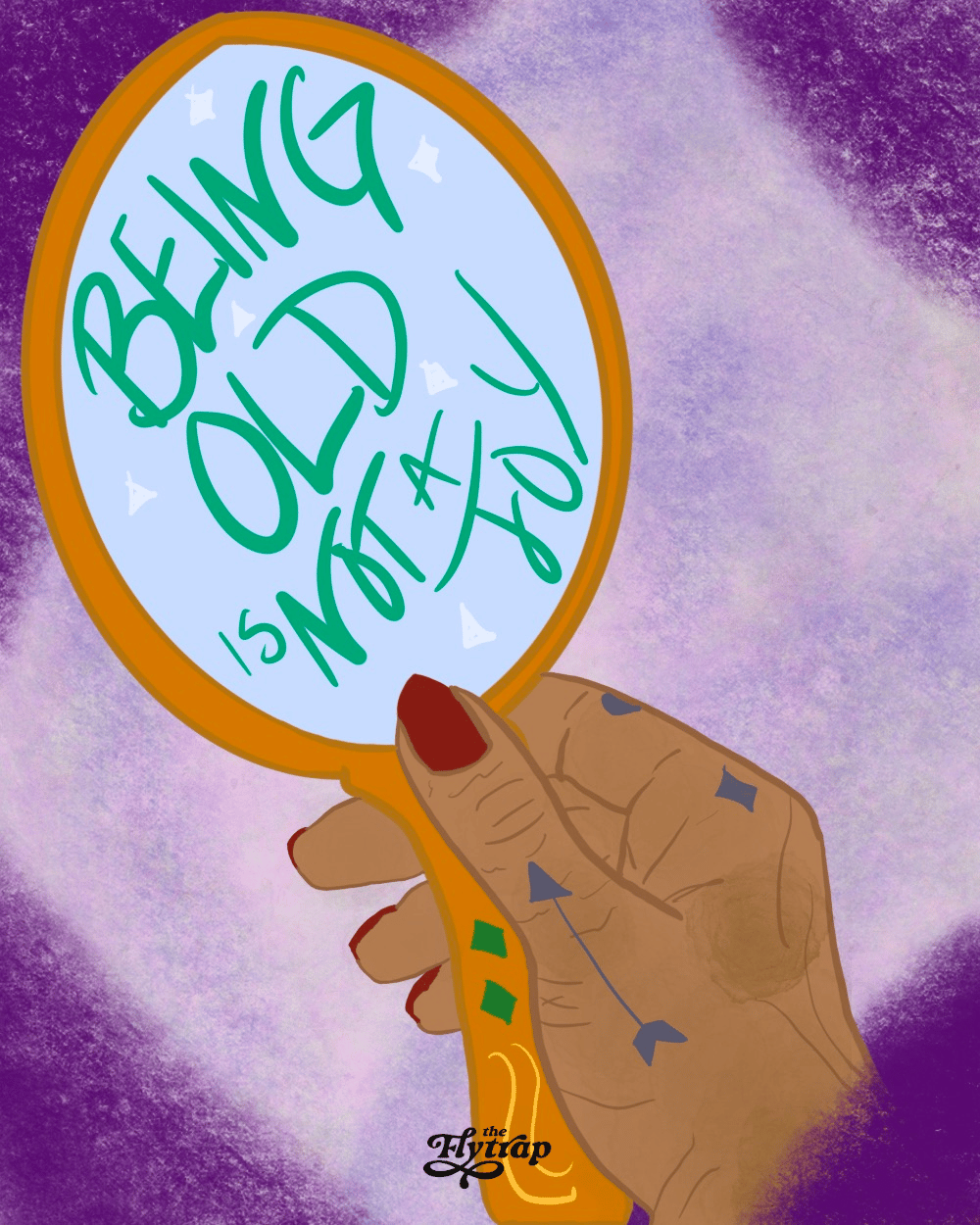
“Старость не радость,” which translates to “Being old is not a joy,” is one of the first colloquial, everyday Russian sayings that stuck with me when I first began spending significant periods of time in Russia. Often uttered with a sigh of resignation, the simple phrase probably stayed with me because I heard it so often, primarily from middle-aged and aging Russian women. Women like the host mothers I lived with in the provincial city of Vladimir in my early to mid-20s, when I taught English for a year at an institution called the American Home and returned for a summer of intensive Russian study after my first year of grad school at Stanford. I always felt empathy for the people who uttered this phrase in conversation, but as a younger adult I lacked the experience to fully understand where they were coming from.
Now that, as of last month, I’m 45, “старость не радость” resonates differently in all its brutal Slavic bluntness: no frills, no sugarcoating, no optimism. Aging does not bring happiness. That’s the way it is.
But does it really have to be all bad?
As an American transgender woman staring down the complexities of aging as femme, fat, queer, and divorced, I want to hope for better, and to uplift and celebrate alternative models for growing older like thе 55-and-up LGBTQ cohousing community Tina Vasquez examined for The Flytrap during Pride Month. The members of that community are committed to taking care of each other as well as they can for as long as they can, circumventing the social isolation that age can bring as well as potential mistreatment and queerphobic discrimination in nursing homes. A better society could implement social structures that facilitate this experience for seniors of all races, economic backgrounds, genders, and orientations, in addition to encouraging respect for the experience and knowledge that elderly individuals accumulate over their long lives.
While age will catch up with us all—we will experience physical decline and ultimately death—what scares me is not really the prospect of dying as opposed to the prospect of living in pain, isolation, and irrelevance. It isn’t cheap to buy your way into a good senior living community, and I have very little saved for retirement. I’m also aging in an increasingly authoritarian capitalist hellscape, where the federal government is moving to strip the elderly, impoverished, and disabled of the few state supports that are available, in addition to attacking LGBTQ Americans—especially trans ones like myself.
At the end of the day, that’s why I get scared when I notice the lines on my face, the gray hairs, and that “unusually large freckle” on the back of my right hand that might in fact be my first age spot.
Please bear with me; this article won’t be all doom and gloom. But to skip straight to hope would strike me—someone who has never really been able to muster much optimism but fights for a better world anyway—as disingenuous. With next to no faith in humanity, you might call me a doomer, but somehow I’m also still stubborn as fuck.
In any case, the sociology of aging in western societies bears out that old age brings with it a decline in social status (and in certain outcomes related to health and wellbeing that aren’t inherently part of aging). This is particularly true for women. For decades now, the scholarly literature has addressed issues of “double jeopardy,” regarding older women as opposed to older men, and “multiple jeopardy,” or what scholars and feminists today more frequently refer to as intersectionality. That is, the relevant scholarly literature has long since observed that the stigma and worse social outcomes that affect older individuals in western societies don’t occur in isolation from other social identities.
For example, as Vasquez noted in her reporting, “LGBTQ elders are twice as likely as the general population to live alone and experience social isolation.” Furthermore, in patriarchal societies, men’s status tends to be tied more to achievement than appearance, while it’s the opposite for women. Women thus face worse stigmatization from aging, leading for example to what seems to be a significantly worse risk for ageist discrimination in the workplace.
Aging is hard on all women: cis, trans, queer, straight, fat, thin, white, Black. Sure, it’s harder on some of us than others, but it is never easy. Some men who go gray get to be “silver foxes,” maybe even “the most interesting man in the world.” Aging men at work—at least to a point—often get typed as “experienced,” a status for which they can be valued. Older women, by contrast, are more likely to be seen as “incompetent” at work regardless of their actual job skills and mental acuity.
And when it comes to Hollywood? Well, an 80-something-year-old Harrison Ford gets to look his age and still be an action star. Older female stars, by contrast, are largely only valued for “how young they look in comparison to their actual age,” as Nicole Froio put it.
Meanwhile, older men who surround themselves with much younger women get to be “playboys”—an innocent-sounding epithet that somehow leaves them with agency but no blame. But women who seek out the company of younger men are labeled “cougars,” and conventionally attractive aging women are labeled “MILFs.” In other words, aging women are broadly perceived either as predators or as objects of desire lacking agency of their own, if their sexuality is acknowledged at all.
This isn’t merely a conservative problem, either. Even on the Left, there are many who blithely ignore not just the racist, misogynistic, and transmisogynistic statements of popular Marxist intellectual Slavoj Žižek, but also the fact that he is married to a conventionally attractive woman a full three decades his junior.
I still lament the girlhood I never had.
As a transgender woman who already has chronic pain from years of intense anxiety and insomnia caused by religious trauma from my evangelical upbringing, it’s hard to look forward to growing older. Particularly since, as someone who only began transitioning at age 39, I never got to experience living as a young, attractive woman.
Instead, I’ve experienced an awkward transition, partially interrupted by the pandemic and still limited by the constraints of financial precarity. At this point, I’m happy with some aspects of my feminization but frustrated with other elements of my body. I’m also still in the process of grieving the past that could have been if things had been different.
I know that growing up socialized and perceived as a girl in a patriarchal society is no picnic, to say the least. As a child born in 1980 and mostly raised in suburbia, recognizing my gender may also have taken me a long time even if I hadn’t grown up a right-wing Christian. But I still lament the girlhood I never had. My found sister sometimes tries to help me with this by giving me “girly” presents, like Disney-themed lip gloss sets, for birthdays and holidays. And I appreciate the gesture, though it doesn’t change the past.
I’ve now arrived at a place where I’m recognized as a woman in public often enough, particularly if I put on makeup and dress femme, though being somewhat butch by nature, that’s not always the style I pick. That being said, I do want to be read as a woman, and it’s still novel enough that I appreciate it when I am. I just wish it could have happened when I was younger.
I’ve come to be frequently recognized as a woman only in time to be deemed “a woman of a certain age” by the classic male gaze. We’ve all internalized it to some degree. To the extent that I look my age, I’m considered unfuckable and “past my expiration date,” which means both “unattractive” and “can probably no longer have children,” which is the other thing patriarchy-brained men value in women. (Of course, as a trans woman, I’ve never had the ability to give birth.)
I might be tempted to shrug and say “I’m rarely interested in dating or fucking men anyway.” And that’s true enough. I’ve always been much more frequently attracted to women than men, and I think that’s part of why it took me so long to figure out my gender. I’ve also largely shied away from putting myself out there through these years of transition, though I’d like to try dating again even though the prospect is intimidating.
In any case, I can’t hide from myself the fact that I am self-conscious about my age and appearance, both of which make it more difficult for me as a woman and a queer person to achieve financial security, professional recognition, and robust mental health.
The federal government of the United States is working to erase my legal existence, and that’s inevitably on my mind even as I have to keep reminding myself that I need to get on the ball and schedule my first mammogram.
If I had tens of thousands of dollars to spare, I would absolutely spend some of that money on cosmetic procedures, even while a part of me would blame myself not only for playing patriarchy’s game, but also for pursuing the unsustainable individual solutions that capitalism promises are the only path to improving our lives. Of course, this is entirely theoretical; currently I can’t even afford to continue with the electrolysis sessions I need to ultimately rid myself of my obnoxiously tenacious facial hair, a long-term process I do not consider merely cosmetic because my facial hair is a serious source of dysphoria.
In addition, my transition has taken place in a time of increasing hostility to trans folks. Under aspiring dictator Donald Trump, the federal government of the United States is working to erase my legal existence, and that’s inevitably on my mind even as I have to keep reminding myself that I need to get on the ball and schedule my first mammogram. The situation is, in short, not great, and if you find that to be an understatement, well, let me assure you that you’re not wrong and remind you that my native idiom is Midwestern.
At an event a few years ago, I shared a panel with a younger trans woman. We were asked if, given the chance, we would choose to be cisgender. I admitted it: Yes, I would take that deal in a heartbeat. Hell, I’m even an open enough book to admit here that sometimes I fantasize about being a conventionally attractive suburban soccer mom who doesn’t have to worry about financial security, whose whole world is husband and kids and domesticity and holidays, and the PTA and spa days and maybe volunteering for a cause or two. Someone with the (quiet?) luxury of shrugging off anything “political.”
Don’t worry (too much). I know that this is pure fantasy and that if I could in fact switch places with such a person, I would not. But if I could wave a magic wand and make myself into a cisgender woman, I would do it and never look back.
The younger trans woman on that conference panel, though? She emphatically asserted that she did not wish to be cis. She reveled in trans joy. I have experienced trans joy myself, and some gender euphoria through second puberty: How could I forget my (cringe in retrospect) “posting pics of my titties to Twitter” phase? But I’d readily trade these experiences in for cis privilege. I sort of marveled at that younger woman’s attitude at the time, wondering if perhaps it was a generational thing. When I think back on it now, I’m still a little awed, and maybe I even envy her defiant optimism a little. At the very least, it reminds me that a better world is possible.
The conditions of brutal capitalism, cisheteropatriarchy, and bizarro authoritarianism we currently live under in the United States make life hard. Our inhumane realities make life particularly rough for those of us who have one or more marginalized identities, and I think we often forget that age is one of the identities that confers privilege or stigma. Of course, the funny thing about that identity is that if we live long enough, all of us will experience both the privileged status of youth and the marginalized status of old age.
Together, capitalism and patriarchy prescribe a simple script to aging women: Do whatever it takes, buy every product or service you can afford and some you can’t, to stay thin and young-looking, to remain conventionally attractive. That way, you will avoid the worst of the stigma. Keep on spending and running on that hamster wheel; that’s how you “win.”
Under the circumstances, I don’t blame any of us for buying expensive skin creams or getting Botox injections. That being said, we must never forget that capitalism and patriarchy are games in which no one ever wins—least of all women, transgender and cisgender alike. Ultimately, the way forward is to fight for a social and cultural revolution that brings equity.
In the absence of mainstream social structures that uplift and support us, we build our own affirming communities and our narrative counterpublics from which to uphold each other while attacking structural inequality and the narratives that support it. We need to tell better stories, model better communities, change minds, and then maybe, just maybe, we’ll have a chance to build a better society when the current order collapses under its own weight.
Our liberation will not be complete unless it includes the aged and aging.
There’s one thing I’ll say for many marginalized communities, and certainly the queer community. We already value our elders a good deal more than mainstream western societies value elders in general. I’m still scared of becoming an elder, but even so, it’s a comforting thought. I also know that I’m a much more interesting and insightful person at 45 than I was at 25. Experience brings a sophistication that young people simply have not had time to acquire. I’ve accumulated the years, and was lucky enough to have the opportunities, to pursue advanced degrees and live in multiple cities and even countries. I’m also a trained historian, which lends me a certain understanding of how societies change over long periods of time. That being said, living through decades of history as an adult brings a different kind of subjective perspective that enriches my understanding in ways purely academic study cannot.
Aging may not be joy. Still, despite the eventual inevitability of death, aging does have its benefits, if we can look away from our worries about leaving a legacy and our fears of physical decline and social stigmatization long enough to appreciate the gifts that aging confers. In a better world, in which we’d all have the structural support we need to age gracefully, this would be much easier to do.
As we work toward that world, let’s remember to appreciate and learn from the experiences of the older members of our communities. Our liberation will not be complete unless it includes the aged and aging.
This piece was edited by Nicole Froio and copy edited by Christine Grimaldi.

“So…who are we canceling today?”
Subscribe to Cancel Me, Daddy, a Flytrap Media production, for the answer! Co-hosts, friends, and former Capitol Hill journalists Katelyn Burns and Christine Grimaldi discuss the latest developments in media and politics, providing thoughtful analysis and verbal shitposting you won’t find anywhere else. New episodes drop every other Thursday on YouTube and wherever you get your podcasts.
Excommunicated! Deposed! Executed! Dropping this Thursday, August 14, Katelyn and Christine time travel through medieval cancellations with Dr. Eleanor Janega on the latest episode of the pod. Need a good laugh? It's a convo on the lighter side that skewers Braveheart propaganda to tell the real story of Edward I and Isabella, and brings fellow cancellers on a wild ride through England and France with “femme fatale” Eleanor of Aquitaine. Justice for Anne Boleyn! (Merch Me, Daddy—order your Anne B. crop tops and stickers in the store!) Subscribe and stream on our YouTube channel! Listen via Apple or Spotify.