The Robin Hood of For-Profit Education
Matriculating into the University of Phoenix under my dad’s name was a way to repay him for all of his hard work, but in the end I could only take him so far.
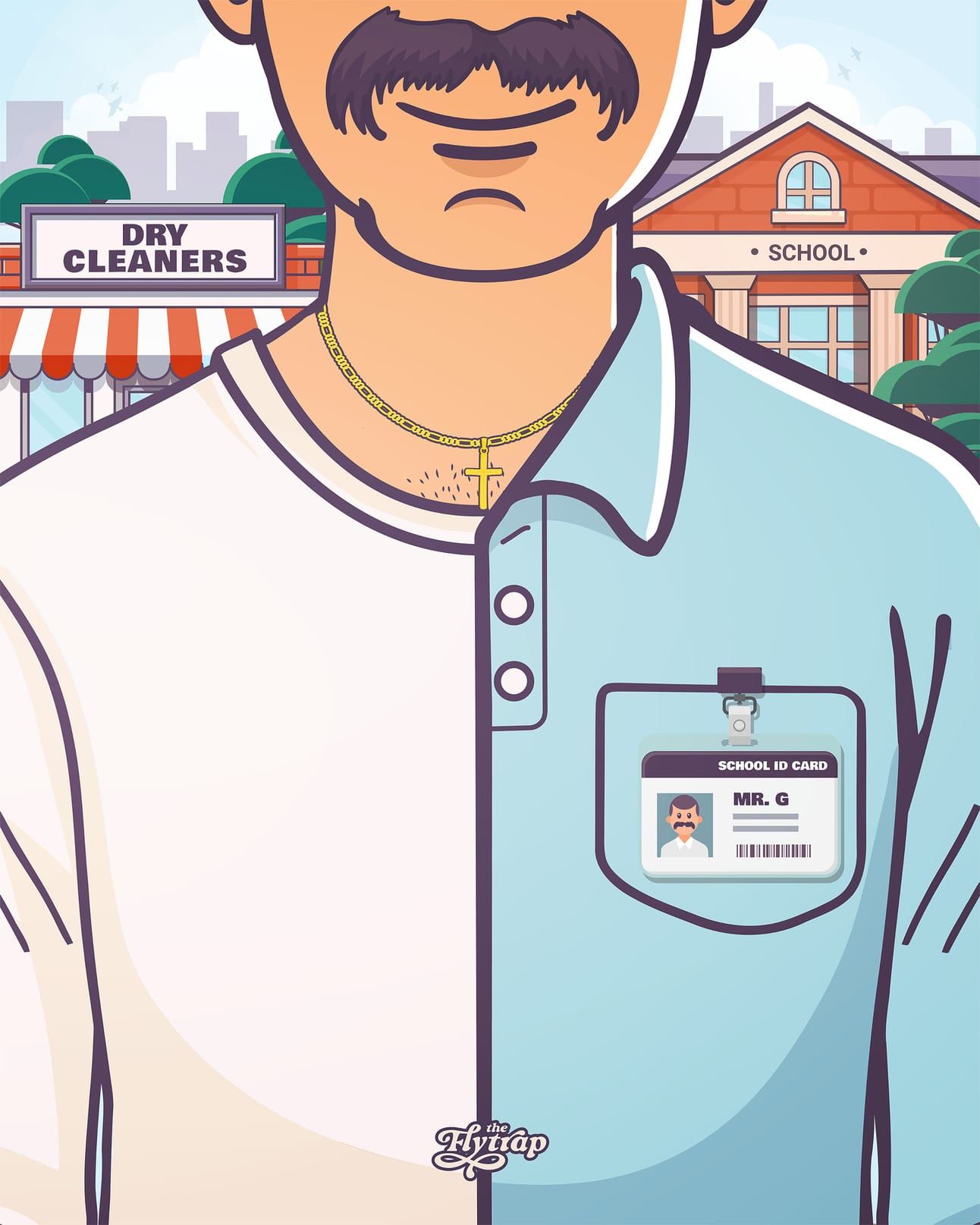
The Flytrap merch store is now open! Buy a poster of the art for this piece or get dripped out in the latest Flytrap merch.
I. The Teacher
No one had ever called my father “mister” anything in a professional setting until he taught dry cleaning at a vocational high school in mid-aughts suburban New Jersey. ”Tommy!” to my mother and his more demanding customers then transformed into “Mr. G” with the speed of Clark Kent ripping his button-down open to reveal the Superman logo.
Off came the Costco T-shirts and jorts that stuck to Dad as he worked in the back of his dry cleaning business, starching white collars for many bridge-and-tunnel finance bros living the family life in the suburbs and the high life in the city. Mr. G’s new Costco polo shirts unbuttoned to reveal every goomba’s favorite coat of arms: a 14-karat gold figaro chain with a crucifix that glinted against chest hair that turned a little more gray with every passing year.
The school offered a wide range of vocational and technical programs, among them carpentry, culinary arts, automotive services, and hexating, ventilation, and air conditioning (HVAC). Dry cleaning was not popular with students, nor a priority for school administration. The higher-ups treated dry cleaning like low-skilled labor, albeit labor on which they nevertheless depended for school banquet tablecloths and their own personal items of clothing.
Ever bite into an in-season strawberry that bled onto your lapel? Thank your migrant farmworkers for handpicking your unblemished fruit and your local dry cleaner for removing the stain it left behind.
Dad lacked the self-awareness to identify such social and racial inequities. He did not understand how he contributed to their disproportionate impact on people who didn’t look like him or share the same immigration status, and the interconnectedness of the struggle. This duality is the nature of whiteness. I was nurtured with it.
Circa 2005, I used to call my father “Atticus Finch without the social consciousness.” Of course, this was before author Harper Lee revised her fan-favorite character, based on her father. To Kill a Mockingbird’s white savior became Go Set a Watchman’s more accurate, virulent racist, disappointing a generation of white liberal fans who named their sons “Atticus.”
Mr. G was good with the kids, a mix of white, Latine, and Black students. He gave them tough love, but he wasn’t a hardass. He taught them a skill, even as he encouraged them to dream bigger than dry cleaning. And he didn’t withhold bathroom breaks, nor stop students from using the bathroom that aligned with their gender identity. “Sure,” was his attitude as early as 2005.
Dad said he wanted everyone to have rights, as long as they didn’t have any more rights than him. (Gay marriage? Yes. A “gay tax” that he’d be charged to fund their weddings? No, and I have no idea where he got that idea.)
Mr. G cleared the lowest bar: tolerance. Everyone was welcome at our house, in his store, and in the class. Only when he stopped to think did he start to sound like the conservative radio talk show hosts that played in my maternal uncles’ cars.
Dad said he wanted everyone to have rights, as long as they didn’t have any more rights than him. (Gay marriage? Yes. A “gay tax” that he’d be charged to fund their weddings? No, and I have no idea where he got that idea.)
I found this charmingly offensive at the time. The notion was so ridiculous, I would egg him on instead of shut him down, perpetuating the harm. We both had a lot to learn about who was starting from where.
Moving away from that very particular Northeast brand of casual bigotry, the kind that nice white liberals deny in their blue state, woke me the fuck up to my role in it. A decade into his second stint at high school, my dad seemed to be vaulting over the tolerance bar, even if he couldn’t quite grasp affirmation. I was happy he ran with a crowd of diverse teenagers and union teachers (albeit primarily white teachers) who seemed to teach him more than his daughter’s lectures.
Dad’s class sizes unfortunately remained low. Every year, he worried the school would shut down his shop. He tried to earn his keep by dry cleaning the winter coat donations.
In 2015, Mr. G’s principal approached him with a Godfather-esque offer he couldn’t refuse.
“You would be great for this supervisor gig,” the principal said, according to Dad, and which I relayed to my friend Sarah on Gchat. The supervisor would travel to community work sites that employed students in exchange for school credit in their trade. For example, some local HVAC businesses let students apply their classroom lessons to real-life repairs.
The supervisor would make sure the teenagers were at their work sites instead of elsewhere, typically the nearest mall or Wawa parking lots lining the iconic Route 9 of Bruce Springsteen’s “Born to Run.”
The supervisor job’s prerequisites included a pair of continuing education classes toward a certificate in school counseling through the University of Phoenix, the for-profit college that advertised during daytime television and mostly offered classes online.
“Continuing education” was a generous term for a 63-year-old baby boomer who’d largely skipped the beginning, too.
In the early 1970s Brooklyn, New York enclaves that revolved around Sunday sauce, Italian Americans were often a generation behind in sending their first- and second-gen kids to college. Dad had had a child prodigy of a cousin who could sit down at the piano and play any song while the other boys played masculinity-coded stickball in the streets. Cousin Tony graduated from Harvard—heard of it?
But the neighborhood Tommys—Dad included—wore out their hands on manual labor long before Tony retired to his well-earned portfolios and his own masculinity-coded motorcycle.
Other paesans from the neighborhood attended trade school and forged decades-long, lucrative careers as electricians and plumbers. Dad could paint, caulk, or nail anything that needed painting, caulking, or nailing. But he was self-taught.
But the neighborhood Tommys—Dad included—wore out their hands on manual labor long before Tony retired to his well-earned portfolios and his own masculinity-coded motorcycle.
II. The Dry Cleaner
Dad only did three semesters at Kingsborough Community College, treating it like the clink instead of higher education. He escaped into the familiar Bay Ridge streets that achieved sudden fame through the 1977 blockbuster Saturday Night Fever, which portrays the dark side of disco fever thanks to fabulist British rock critic Nik Cohn, who fabricated the source material for New York magazine.
The platformed stride of a young John Travolta as Tony Manero, the stand-in for the article’s so-called “Vincent,” nevertheless captured the dagger-collar bravado of a young Tommy Grimaldi as himself. My mother, another 2001 Odyssey Disco club queen, introduced him to the dry-cleaning business in the 1980s.
It was when Tommy trimmed his handlebar mustache into the type of fringe that today’s literary fuckbois and indie rock drummers can only sprout in their skinny jean dreams.
It was also when I was born.
For the next 16 years I watched Dad, in the role of “Tommy!” the small business owner, pay for his share of the operation with stores on Staten Island and later, in New Jersey, in sweat equity.
Any customer-facing business is a real bitch. Mom catered to the front of the house, handling finance bros’ eggshell egos with the same precision Dad dedicated to spotting yolk, ketchup, and grease stains from their morning BEC on the BQE to lower Manhattan. With her Marisa Tomei cadence—think wives and goomars—Mom schmoozed about their kids, their jobs, their pain-in-the-ass in-laws, and even their childhood dreams, which certainly didn’t include this coffee-splattered silk floral tie.
If Mom couldn’t tawk them off the ledge, Dad would come out and shove them over it.
The third co-owner financed much of the business. He was a spectral presence: rarely seen but always felt.
For the next 16 years I watched Dad, in the role of “Tommy!” the small business owner, pay for his share of the operation with stores on Staten Island and later, in New Jersey, in sweat equity.
Dad fired up the store’s hot water tank in the predawn mist that forecasted rising humidity throughout his 12-hour day. Dry cleaners are microclimates, breaking record highs with bursts of steam from the boiler-powered presser machines. Dad’s business partner glistened by choice at the Jersey Shore.
Seven rent-free years living with my paternal grandmother, Nanny, in her tight Staten Island condo allowed my parents to save the down payment for a house in New Jersey, in the same county as their business partner. Our smaller split-level had its own inground pool into which Dad would sometimes jump, jorts and all, at the end of a particularly hot workday. The pool was a burden as much as a luxury. He caulked the peeling liner to the cement basin for years until he finally caved and paid for its replacement.
My mother’s 2002 breast cancer diagnosis and treatment put an end to their disproportionate business partnership. In remission, Mom enrolled in “continuing education”—again, that phrase—and typed her way into the reception desk at a spa, a hospital, and finally a doctor’s office. One of Dad’s industry friends passed along the newspaper ad for a dry cleaning teacher.
Dad prided himself on his street smarts and cursed himself for giving up the books. Growing up an elitist little prick, my parents shielding me from the business while I marinated in air-conditioned libraries and bookstores, I blamed him for it, too
Dad prided himself on his street smarts and cursed himself for giving up the books. Growing up an elitist little prick, my parents shielding me from the business while I marinated in air-conditioned libraries and bookstores, I blamed him for it, too. I read and reread A Tree Grows in Brooklyn, Betty Smith’s 1943 bildungsroman: “Education! That was it! It was education that made the difference! Education would pull them out of the grime and dirt.”
Dad and Mom never had to tell me to study my way into a different career, a different life. A year of my alma mater’s tuition cost more than their combined salaries. Back then, I believed in the transformative power of education. Bring on the predatory loan debt.
Matriculating into the University of Phoenix under Dad’s name was a way to repay him. He already counseled the kids, or worked with their guidance counselors. Why did he have to prove it to a dubious-seeming online university?
He worked so hard. He deserved more, including this promotion, better pay, and more peace until he retired in the next few years. Retirement wasn’t even an option before the vo-tech came along. “I’ll work ‘til I’m dead,” he’d say.
III. The Student
That I would be impersonating Mr. G in his online classes was not a question. It was a given. The school would reimburse him for the cost of the classes if he got a “B” or higher.
“I’ll get you an A,” I told him.
“I don’t want an A,” he said.
The principal had strongly implied the job was Mr. G’s if he passed the classes. With the help of my then-boyfriend, we enrolled Dad—in name only—in the University of Phoenix.
All public U.S. colleges and universities are incorporated as non-profit organizations. So are the vast majority of their private counterparts.
In theory, non-profit private universities like my alma mater reinvest the hundreds of thousands of dollars they make off a single student’s four-year tuition, plus their endowments from wealthy donors, into education and research. Their tax-exempt status from the Internal Revenue Service helps, too. In practice, “education and research” may look like a swollen salary for university administrators who order police to sweep campus protest encampments, or a new science building at the expense of arts programs.
The University of Phoenix is a for-profit institution. Anything goes under unbridled late-stage capitalism. In 2015, the Federal Trade Commission (FTC) launched an investigation into the University of Phoenix’s predatory recruitment of servicemembers and veterans, based on an exposé by Reveal, the flagship outlet of The Center for Investigative Reporting.
That same year, a 30-year-old journalist and a 41-year-old former journalist prepared to pose as one boomer with rudimentary computer skills. I couldn’t be the first millennial to go undercover and online for their boomer. Job applications, driver’s tests—how far would you go for a parent who knows everything they’re doing except for the technology?
My boyfriend had reservations, but I didn’t feel bad about scamming what to me was so blatantly a scam. We just hoped no one checked the IP address connected to our out-of-state posts.
Dad didn’t know what an IP address was.
The first assignment was simple: What was the student’s experience with other online platforms?
“I have never used another online learning platform. Any reservations that I had about the University of Phoenix platform were dispelled when I saw how simple it was to navigate and keep track of my assignments,” I wrote, pulling SAT words out of my ass and pooping Thesaurus.com synonyms on the page.
“There are a lot of tabs, but they are all clearly labeled, and this orientation showed us exactly how to use them.” I congratulated myself and sent the draft to my boyfriend.
“I changed one thing, there was a word ‘us’ that I changed to ‘me,’” he replied.
Outsmarting the University of Phoenix was going to be harder than I thought. We were going to have to prune the language like a fig tree in an otherwise bottle-strewn Brooklyn backyard.
As non-educators, the material didn’t make sense to us. We interviewed my father for the substance of “his” answers. What he hadn’t learned from a decade of experience in the classroom, he crowdsourced from his faculty friends at school. Then my boyfriend and I would translate his feedback into a more highbrow Brooklynese. My Cousin Vinny’s Vinny didn’t sound like a lawyer, but he was one, and Dad was a teacher, goddamnit.
“Don’t call me that,” Dad said. “I’m an instructor.”
“You’re a teacher. You teach the kids.” He defended them when they were bullied. He was a good educator and a better father.
There were posts, projects, quizzes, and “learning activities.” I couldn’t tell the difference between each of them. They blurred into busywork that my boyfriend and I fit into our own work schedules. The one time I asked the instructor a question, she told me to Google it.
My boyfriend and I were on our own, and at each other’s throats. We were both perfectionists who wanted the A that Mr. G rebuffed.
Another week of the University of Phoenix might kill me, or my relationship. This supervisor job was ours to lose.
My boyfriend’s father, a former National Labor Relations Board lawyer turned criminal defense attorney with impeccable progressive politics, died too young and too fast from pancreatic cancer in 2008. In my father, my boyfriend recognized the kind of blue-collar guy that his father would defend on a traffic charge in court. Our fathers shared attributes, too—kindness and handiness. Dad started teaching my boyfriend how to paint, caulk, and nail around our new house. “The hottest Jewish carpenter since Jesus,” I started calling my boyfriend.
Another week of the University of Phoenix might kill me, or my relationship. This supervisor job was ours to lose.
IV. The Supervisor
Mr. G made friends with other shop teachers. Everyone looked out for each other. At Christmastime, the culinary arts teacher would slip him leftover almond paste and a small fortune of pignoli nuts to make his homemade cookies. Mr. G teamed up with the carpentry teacher on general contracting jobs during school breaks. The HVAC teacher did house calls to fix my parents’ sputtering air-conditioning system.
A group of shop teachers even ate lunch together every day at school. Male friendship! How adorable. How necessary. I loved this softer side of Mr. G.
One day, Mr. G told two of his besties about the job that the principal had all but guaranteed him.
“Great!” Teacher #1 said.
Teacher #2, usually a talker, had nothing to add.
The next day, Teacher #2 approached Mr G.
“I think I’m going to apply for this job,” Teacher #2 said.
By the following day, Mr. G had to know. “Teacher #2, I’m gonna ask you a question. Are you applying for this job because you already knew about it, or because I told you about it?”
“I can’t answer that,” Teacher #2 replied.
You’ve got to be fucking kidding us—Mr. G, my boyfriend, and me. I felt like I was back in high school, this close to my first kiss when my high school nemesis swooped in and tried to fuck it up.
The teachers were supposed to be less dramatic than teenagers!
Instead Teacher #2 stopped eating lunch with Mr. G and the rest of the group. He was a white guy in his 40s, and his spouse worked elsewhere in school administration, I raged to my friend Sarah. Students filled Teacher #2’s shop. He did not need this supervisor job the way my father did, especially if the higher-ups shuttered the dry cleaning program.
Worse was that sense of catty betrayal with which I was so familiar. “Dad always says ‘loose lips sink ships,’ but he never thought his friend of 10 years would do that,” I told Sarah.
Teacher #2 enrolled in the University of Phoenix, too. I assumed he did not require education by proxy. Now I really needed to make Mr. G’s written answers sound like a knockoff Joe Pesci so no one would suspect him of outside help.
Then a third candidate entered the scene. He already had a master’s degree, presumably in something related to education.
When I saw his name appear in the University of Phoenix class portal, I knew my boyfriend and I had taken Mr. G as far as he could go.
The third candidate got the job.
The more enlightened side of Mr. G blamed the principal for making promises he shouldn’t have. Wary of the union that protected his job, more wary still of school and district administrators that devalued it, Mr. G suspected machinations to which he wasn’t privy. Someone always owes something to someone else in New Jersey.
The less enlightened side of Mr. G—with some degree of resignation and no malice I could discern—added another potential hiring consideration: race. The new supervisor was nonwhite.
Dad sounded like me during my 2004 college application process, when I complained that I didn’t have any marginalized identities to qualify for many scholarships. “All the Greedy Young Abigail Fishers and Me,” Jia Tolentino’s 2016 Jezebel essay speaks to the shithead I’d been as a baby white “feminist.”
As is the Italian-American way, I yelled to communicate what I’d since learned in the world, and through the University of Phoenix.
Dad. Tommy! The new supervisor got the job because he has a master’s degree. Did he require a tech surrogate to pass the University of Phoenix? Ageism aside, the new supervisor didn’t openly talk about retirement. “Loose lips,” man! If race played a role—good. Your students will see someone who looks like them in a position of authority.
Dad more or less understood. Teaching had broken his more regressive disco fever. A country that hadn’t been fair to him was less fair to people who didn’t look like him. He was starting to grasp that the systems that oppress us all—some more, some less—are the enemy.
V. The Systems
Eventually, Dad and Teacher #2 made up, setting an example for teenage angst everywhere. The new supervisor made sure the teens showed up at their community work sites.
I was glad we pulled one over on the University of Phoenix. But I was more glad we didn’t scam the right supervisor out of the job.
I waited until well after Dad retired to write about the University of Phoenix. Call me the Robin Hood of For-Profit Education. But the University of Phoenix, I fear, is the blueprint for the current state of educational corruption.
That 2015 FTC investigation ended in 2019 with a $191 million settlement from the University of Phoenix for deceptive advertisements. The ads falsely implied that Microsoft, Twitter, and other name-brand tech employers helped develop University of Phoenix curriculum that would come with jobs, according to an agency statement.
Call me the Robin Hood of For-Profit Education. But the University of Phoenix, I fear, is the blueprint for the current state of educational corruption.
Some variations targeted military and Hispanic “consumers,” a word choice that underscored how the University of Phoenix scammed marginalized “students” out of a real education.
The FTC distributed $50 million of the settlement for “consumer” redress. The University of Phoenix cancelled the remaining $141 million worth of enrollee debts. Several years later, the FTC coordinated with the Department of Education to forgive another $37 million.
I presume what limited accountability existed under Democrats will stop with the second Trump administration.
What I learned from my time in the University of Phoenix wasn’t on the syllabus. I had to create my own. Dad primarily reads Consumer Reports and Costco magazine, so I’ll keep summarizing what I learn. The education-is-everything takeaway from A Tree Grows in Brooklyn was wrong. Education doesn’t always speak to a person’s character or their social mobility. Francie Nolan’s family only escaped the tenements when her difficult mother married an Irish cop.
I now wear Dad’s extra gold figaro chain, minus the cross, so I don’t forget I’m his daughter, capable of what he taught me and more.
This piece was edited by Tina Vásquez and copyedited by Andrea Grimes.