
The Paradox of Thrift
My newfound love for thrifting high-quality items inadvertently triggered old childhood traumas and memories of imposter syndrome .

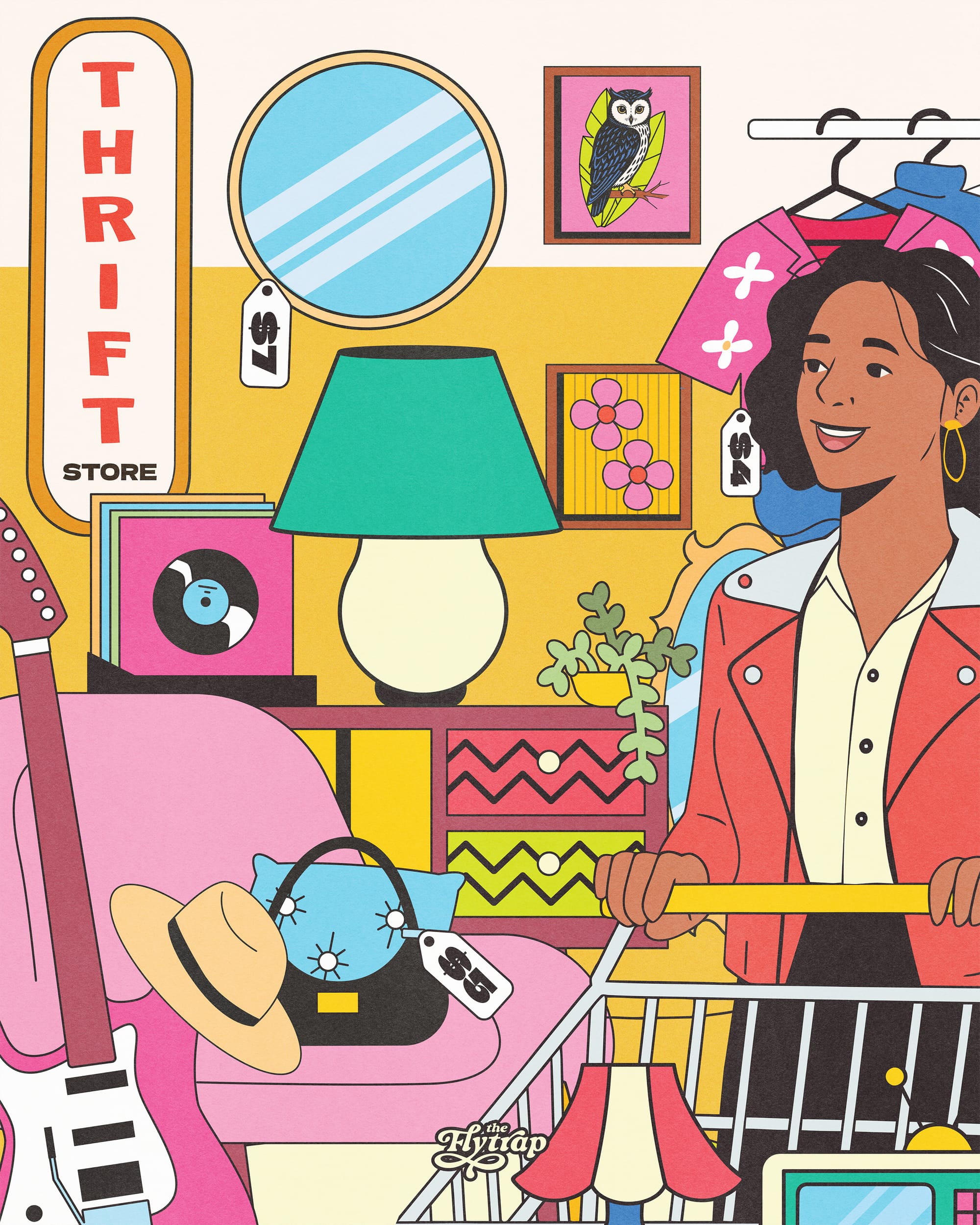
I still remember the first piece of thrifted clothing that made me feel special and beautiful, rather than sad and frustrated that my family was poor.
I was in elementary school when I stumbled across the dress while sorting through the racks at a giant thrift store in Southeast Los Angeles. The store was a favorite, its size holding a lot of promise for each member of my family: furniture for my mom, bikes and real Levi’s for my older brothers, and a huge array of broken shit that my dad could tinker with on the weekends. This was the store where I shopped for most of my school clothes. It was a months-long process, a system I still employ today for thrifting out of season. I began in early summer, squirreling away a top here and a pair of pants there, hoping that by the fall I had something that resembled a cool wardrobe.
The problem was that as a kid with weird tastes who only shopped at the thrift store, I had no real understanding of “cool.”
When a thrift store in my hometown received castoffs from a local Catholic private school, for example, I picked out a series of plaid jumpers that I wore obsessively. My Catholic dad was pleased with my piety, though my teachers were confused as to why a student would choose to wear a uniform at a public elementary school where it wasn’t required. I also loved moth-eaten grandpa sweaters because they reminded me of Mr. Rogers and Kurt Cobain in Nirvana’s “Unplugged in New York” performance. Nineties grunge factored heavily into my wardrobe, though not entirely by design.
My dad still repurposes Doña Maria mole jars as drinking glasses for guests; what the fuck am I doing buying frog-shaped Ercuis placecard holders from France, even if they were $28?
I had to wear my brothers’ hand-me-downs, including oversized flannels and a mustard yellow Mudhoney t-shirt that inappropriately featured two men at a urinal (and which now sells online for $500). To the chagrin of dudes who love to interrogate girls about their band t-shirts, I didn’t actually like Mudhoney. I just liked that the cotton was the kind of soft that’s only possible when you’ve worn the hell out of it.
Still, I knew I had found something special when I saw the dress’s color scheme out of the corner of my eye. Navy blue with—what’s that? Green apples printed all over? And it was corduroy, a fabric that very much aligned with my old-man aesthetic. Never one for wanting to stand out (especially by failing to blend in), it took a lot for me not to care that I dressed nothing like my white classmates, who dominated my school before Latino demographic shift reshaped the region.
But this corduroy dress really did the trick.
Years later, my full-fledged embrace of punk rock translated into a teenagerdom in which I was more than OK with standing out, as evidenced by my spiky hair and Bikini-Kill-meets-cholo wardrobe. At 14, it occurred to me that you could find an interesting piece of clothing at a thrift store and customize it to make it even weirder. For the first day of my freshman year of high school, I thrifted a white Victorian-looking blouse with a high-neck lace collar. I removed the cotton fabric around the lace, creating a cutout that framed my clavicle, with the collar now a lace choker that worked double duty holding up the blouse. I felt beautiful walking onto campus for my first year of high school, and to my shock, a senior looked me up and down before reluctantly complimenting my top.
Decades later, I’m a woman in her 40s who sometimes battles low-grade insomnia by spending late nights mindlessly scrolling through videos of mostly young, conventionally attractive white women who have amassed hundreds of thousands of followers through monetized content showcasing similar “thrift flips.” My Instagram algorithm is filled with these videos, which often double as free advertising for influencers’ online shops where they resell exorbitantly priced vintage wares. These items are usually thrifted as part of an excursion that’s also filmed, edited, packaged, and monetized as adorable “thrift with me” content. It’s one of my favorite genres.
I’ve actually learned a lot from the thrifting corner of the internet, like how to get weird smells out of suede using baking soda and vodka, and how Barkeeper’s Friend wipes out tarnish on brass. Still, as a former poor person, I have complicated (and admittedly shady feelings) about people who can afford to live in perfectly aesthetic New York City apartments pilfering thrift stores because they can—and because it’s incredibly profitable to cheaply buy old, beautiful things and resell them for five times the price.
To be clear: I understand that my consumption of this content only lines influencers’ pockets, and I also don’t mean to imply that I should be the sole arbiter of who gets to shop at thrift stores. (If only I had the time.) Plus, there’s a plethora of sincerely good reasons to thrift, high among them that Americans throw away over 13 million tons of clothing each year, most of which ends up in landfills where synthetic materials take hundreds of years to break down.
Still, I am beginning to waver on whether my personal thrifting habit—and it is a habit, according to my husband—is just a more affordable, higher quality form of mindless consumerism. As a member of a society that favors fast fashion and mass production to the detriment of nature, our health, and the planet, I had previously convinced myself that I am not like other thrifters; I’m a cool thrifter. I understand the nuances. I lean into the complexities. I contain multitudes.
But more recently, I have come to a more complicated conclusion, in no small part because these days, I’m in a different income bracket than the one I grew up thrifting in. There’s a lot of childhood trauma (and a sprinkling of hypocrisy) wrapped up in my obsessive love for shopping secondhand.
Do you love The Flytrap's art from amazing freelance artists and Art Director rommy torrico? You can find posters, tees, and more at our merch store!
Thrifting Evolution
While I am a lifelong thrifter, I technically haven’t needed to thrift my clothing and homewares for about a decade, since I got my first newsroom job that yanked me out of poverty. But even after becoming a salaried employee, I still dabbled here and there. As bookworms, my husband Ben and I sometimes hit up a thrift store on weekends to peruse the book aisle. Thrifting was done casually, occasionally, and usually together. And when we were unwilling to pay the kind of big money required for a new, large bookcase for our living room, we turned to the thrift store.
But something shifted a couple of years ago. My best friend, decidedly not the kind of gay who loves shopping, married a man who loves shopping—and shopping at thrift stores in particular, where he hunts for vintage Pyrex and antique furniture that he painstakingly restores. I was in my late 30s, and it never before occurred to me that you could thrift quality items.
I was transformed.
Almost overnight, my thrifting habits changed. No longer was I seeking clothing I simply liked or that was on trend; I began looking for quality. Key to my new mission: looking at clothing labels. Very quickly I realized that Americans donate a wide array of very expensive items, and that we spend an astounding amount of money on clothing made out of totally synthetic materials.
Before, I would have counted a quirky, $5 Anthropologie dress as a thrifting win, having previously purchased dresses from the pricey, chic brand at full price. Now I usually put Anthropologie items back on the rack, because much of the brand’s clothing is 100 percent polyester or viscose, a material made out of wood pulp that’s intended to mimic silk. Not only do real, raw materials look and feel differently on your body, climate change is real and I live in the muggy, humid South, y’all. I can’t sweat through another summer wearing polyester.
My new mission meant I left a lot behind. But it also led to a more intensive (and admittedly obsessive) hunt for well crafted clothing. And oh boy, have I amassed a load of beautiful things.
Cashmere and cotton cardigans, silk and linen dresses, wool sweaters and trousers, and a plethora of suede, fur, and union-made wool coats. Italian leather purses and loafers. Vintage Ralph Lauren blazers and Levi’s jeans. Let’s not forget the vintage lucite bangles, Taxco necklaces, art deco earrings and brooches, and moonstone rings. These are a few of my favorite things—all thrifted, mostly under my $20 threshold.
Soon, I realized that I could turn my radar to homewares. As a younger thrifter, I can’t recall ever sincerely checking out the perimeter of the thrift store, usually lined with furniture, linens, kitchenware, and other homegoods. As a homeowner in her 40s, this is now one of my favorite places in the thrift store.
This past fall, I went on a bit of a bender in a quest to further cozify my home for my favorite season. I thrifted a series of 100 percent wool Pendleton throw blankets and a Longaberger basket to display them in. Velvet tablecloths, homemade quilts, and hand-embroidered linen napkins thrilled me. I discovered a love for the Hollywood Regency-style, torchiere table lamps, and brass, leading me to quickly amass a small fortune of brass planters, vases, animal-themed bookends, picture frames, sconces, and candle holders. One of my favorite thrift finds ever—an oil painting of a barred owl just like the one we often see in our backyard—led to a flurry of art buying, mostly food-themed paintings and prints for a dining room gallery wall.
As an avid home cook, I was shocked to see the quality of the items people donated. A copper Mauviel double boiler, a Le Creuset saucepan, Waterford crystal, Cuisinart stainless steel skillets, a Sabatier carving set, Limoges porcelain plates, a Neiman Marcus marble charcuterie board, and 1960s Kalmar Designs cocktail forks and salad tongs from Italy. I snatched it all up—some as gifts, though mostly for myself.
Before the thrifting reboot inspired by my friend’s husband, I had almost no idea what any of this stuff was. There’s been a real educational component to my thrifting evolution, making me a more discerning shopper and expanding my worldview—something that feels particularly meaningful as a 41-year-old Latina without a passport.
It’s also meaningful because, as someone from a low-income family of low-wage workers, I’m basically a unicorn in the journalism industry, especially because I only have a high school diploma. I now have a leadership position in a newsroom, but for most of my career, money—the lack or existence of it—has been the root cause of so much agony and insecurity.
Love this post and The Flytrap in general? Consider getting a gift membership for a friend or colleague who would appreciate more feminist cultural criticism in their life.
Cents on the Dollar
I didn’t grow up in the kind of family or community where people in my life could explain what “business casual” meant, so as a young reporter, I had no earthly idea how to dress myself for meetings, interviews, or work conferences. Outside of a couple of years of community college journalism classes, I didn’t really experience higher education. This pivotal life experience is where it seems most people in my industry—even those from similar backgrounds to mine—learned “professional” operating norms and developed important networks. In my most overwhelming moments of imposter syndrome, it seemed that all of my colleagues (a word no one in my family uses) innately knew how to dress and carry themselves. I felt woefully inadequate.
Now I happily disregard many of the standards that I once wanted so badly to know how to adhere to. In large part this is because I realized that the norms I was chasing were not only boring, but shaped by a race, gender, and class I would never belong to. I largely no longer care about appearing “professional.” I want to be approachable and relatable. Increasingly, I also want to be “fashionable,” though I’m still figuring out what that means to me (and you probably wouldn’t guess it by looking at me, because my tastes remain weird).
But my husband, who tends to be the financial voice of reason in our home, recently pointed out that the shifting nature of my wardrobe, and the cumulative amounts of money I spend on thrifting and thrifting-adjacent activities, doesn’t really say “approachable and relatable.”
It’s true I am a bit of a hypocrite, deriding affluent influencers for thrifting when I too can afford not to thrift. When I look around my favorite thrift stores, located in neighborhoods I don’t reside in, I do not see people hunting for Le Creuset or Ralph Lauren. I see newly-arrived immigrant families and Black and white people who live in the rural outskirts of town who, like my parents previously, are simply looking for an affordable way to clothe their families.
It is rare when the few and wildly divergent men in my life overlap in their opinions. While I’m never one to take the opinions of men very seriously, I have to admit that it did feel like a gut punch when, while visiting my dad in Southeast L.A., he commented that I was “starting to dress like an anglo person.”
To my husband’s broader fiscal point, there are, actually, a lot of costs associated with my newfound love for The Good Stuff. It is a cruel fate to love vintage as a 5'3" size 12. The old world was not made for us, but thankfully there are tailors who can perform magic… for a pretty penny. I’ve also become a person who regularly requires dry cleaning—you know, for all the wool, silk, and cashmere I now own.
In an embrace of “girl math,” I have convinced myself that I’m actually saving money by thrifting otherwise wildly expensive goods that even now, I could not afford to buy new. But when you add up the associated costs, which I refuse to do, I’m sure the math doesn’t look very good.
I realized that things might have gotten a little out of control when I started to map out the thrift stores I planned to visit on work trips, or otherwise manufactured road trips with Ben around thrift stores I want to visit. And when thrifting largely became a solo activity, because no one really wants to spend three hours in a single store as I carefully comb every inch and aisle. And when Saturdays, my only real day off, became devoted to “processing” my recent finds: staining a martini table, hanging paintings, washing thrifted clothing or otherwise carting clothes around to the tailor and dry cleaners, painting a picture frame, ironing linen napkins, removing the tarnish from brass and silver, etc.
There have been moments when I thought: Who do you think you are? My dad still repurposes Doña Maria mole jars as drinking glasses for guests; what the fuck am I doing buying frog-shaped Ercuis placecard holders from France, even if they were $28? Who is this for?
While I think it’s okay to like beautiful things (and I certainly do), I fear the insecure child who’s still very much a part of me is trying to keep up with the Joneses, though I don’t live near them, have never met them, and probably wouldn’t even like them. To my great dismay, it’s not actually empowering to fill an emotional void with expensive things you do not need, even if you are buying them for cents on the dollar.
Theoretically, I know that as corporations, countries, and billionaires gleefully pollute, bomb, and destroy the planet and its inhabitants, a love for thrifting barely registers on the scale of sins. My therapist, God bless her, constantly reminds me of the sphere of control. I cannot save the planet, for example. But I can control how I spend my money, and I can continue to wrestle with the complicated reasons why I feel guilt for wanting nice things.
And while I do so, I am decidedly not pumping the breaks on thrifting. In our burning world, we all deserve a little joy, and it just so happens that the state of my mental health hinges very heavily on my ability to thrift a $5 silk blouse. Plus, a recent interaction at a conference resulted in the kind of thrifter’s high that’s usually only achieved while sifting through the racks.
It was a usual nightmare conference scenario, standing in the lunch line alone, awkward, as unsure of myself as I once felt receiving the free lunch at my elementary school cafeteria. But then something amazing happened.
I felt a gentle tap on my back and turned around to find two young women smiling at me.
“We just had to tell you how amazing your sweater is,” they said, of my particularly fantastic vintage, Nordic-style wool cardigan with ornate brass clasps down the center.
“Thanks,” I said smugly. “It’s thrifted.”
This piece was edited by Andrea Grimes and copyedited by s.e. smith.