
Male Rape is No Joke
But pop culture often treats it that way.

The Flytrap is collaborating with Bitch Media to reprint select posts from their archive, keeping the history of feminist cultural criticism accessible. These posts will never be paywalled; become a member to support them!
This story was originally published by Bitch Media on June 9, 2016.
In the 2002 comedy 40 Days and 40 Nights, Matt Sullivan (Josh Hartnett) decides to abstain from having sex for Lent. He, of course, meets the “girl of his dreams” during his period of abstinence, so toward the end of his sexual fast, he handcuffs himself to his bed to ensure he won’t break his promise. But his ex-girlfriend has made a bet that he’ll fail. So while he’s handcuffed, she climbs on top of him and forces him to penetrate her. This is rape. But it’s not called that in the movie; instead, it’s portrayed as Matt “cheating.” He winds up apologizing to his dream girl for the incident—meaning he has to apologize for being raped. This is all supposed to be funny. Rape is not a punch line. It’s a horrific, dehumanizing experience that can have a lasting impact on the victim. So why is it that when we see men being raped on TV and in movies, it’s often played for laughs?
Toxic masculinity would have us believe that the idea of a male rape victim is absurd. Rare, even. Men are supposed to be hungry for sex always—so they can’t be raped. Men should be strong enough to fight off attackers—so they can’t be raped. Both of those myths, rooted in traditional concepts of masculinity, contribute to a culture in which male rape is dismissed, ignored, and woefully underreported. The tragic and dangerous idea that male rape is a joke comes through loud and clear in our pop culture. When men are sexually assaulted in TV and films, the assaults are often not named for what they are, and the characters are portrayed quickly picking up and moving on. They are stoic dudes who exact swift, violent revenge and then have no lasting trauma.
The most recognizable example of this is the 1972 movie Deliverance starring Burt Reynolds and Jon Voight. Even if you haven’t seen the movie, chances are you’re familiar with jokes about the famous banjo music and the lines “squeal like a pig” and “he’s got a real pretty mouth.” These rape jokes are inspired by an extremely disturbing scene in the movie in which two of the men (Jon Voight as Ed and Ned Beatty as Bobby) are forced into the forest at gunpoint by two locals. The locals tie Ed’s own belt around his neck and restrain him to a tree. They force Bobby to strip naked, and then one of the men yanks Bobby’s ear and tells him to “squeal like a piggy.” The man then rapes Bobby violently in front of Ed. The two locals then turn to Ed and are about to rape him orally when Lewis (Burt Reynolds) finds them and shoots one of the attackers with an arrow.
It’s clear the media has a history of treating male rape victims with a serious lack of validation and compassion, exacerbating a culture that is already quick to deny a rape victim’s story regardless of where that person falls on the gender spectrum.
So, yes, those are rape jokes. But they’ve become cultural catchphrases. The most common is “I’m gonna make you squeal like a pig,” which is sometimes used as a way of saying “I’m going to make this a really unpleasant experience for you,” but is most often just used to joke about male rape, much like how male prison rape has become a popular joke. The same goes for “if you hear banjo music, paddle faster.” The classist (and classless) implication here is: Rural denizens are going to rape you if you let them catch you, so you’d better paddle your canoe as fast as you can before they get you. There are so many problems with this, not the least of which is the exacerbation of the rape culture myth that rapists are scary, dark figures, when, most often, they are actually people victims know. This catchphrase can still be found on T-shirts and bumper stickers— as if rape is so funny, it needs to be advertised.
Really funny, right? A lot of people seem to think so:
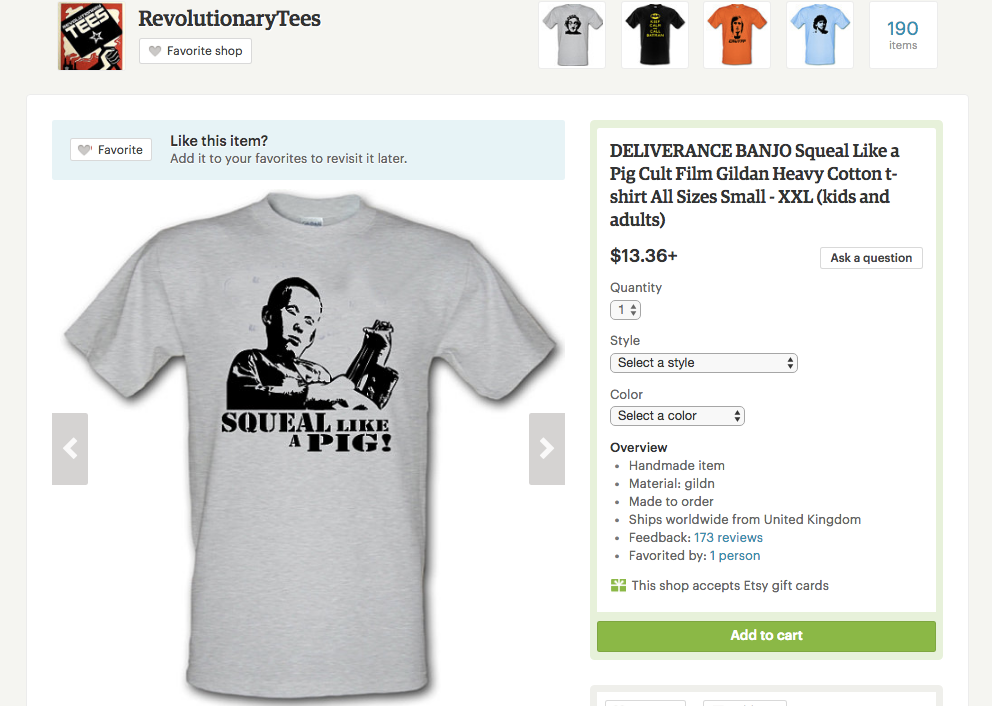
If you’re struggling to see the problem with these jokes, imagine the protagonists in Deliverance as women. Still funny? Aside from Bobby’s insistence that he doesn’t want it “gettin’ around,” Deliverance does not address the impact of this brutal rape on Bobby. The core conflict of this movie is the group’s decision not to report the incident to the police but to cover it up themselves. They literally bury Bobby’s rape by burying the body of his rapist. It’s a complex, interesting movie that has been turned into one of the biggest rape punch lines in the history of media. Rather than see Bobby as the victim he is, audiences see Bobby and his “hillbilly” rapist as a funny, classist cautionary tale.
Perhaps it’s this very notoriety that motivates today’s TV- and movie-makers to use male rape victims for shock value. Quentin Tarantino borrowed from Deliverance in his iconic 1994 film Pulp Fiction. The film includes a scene in which mob boss Marsellus Wallace (played by Ving Rhames) and boxer Butch Coolidge (played by Bruce Willis) are kidnapped by pawn shop owner Maynard (Duane Whitaker), his cousin Zed (Peter Greene), and their leather-clad servant, the Gimp (Stephen Hibbert). Coolidge and Wallace are ball-gagged and tied to chairs, and through a game of eenie-meenie-miney-mo, Zed chooses Wallace as the first to be raped anally in the next room. “Part of the fun of Pulp,” Tarantino said in a 2014 interview with Rolling Stone, “is that if you’re hip to movies, you’re watching the boxing movie Body and Soul and then suddenly the characters turn a corner and they’re in the middle of Deliverance. And you’re like, ‘What? How did I get into Deliverance? I was in Body and Soul, what’s going on here?”
The scene doesn’t do much for the plot, either. It provides Coolidge with a way to pay off his debt to Wallace (Coolidge gets free and saves Wallace from the rapists), eliminating the character’s major conflict. However, this could have been achieved in any number of ways—ways that didn’t need to include a Deliverance-inspired rape scene that is remembered only for its shock value, not the severe trauma the character in the scene suffers. Trauma, by the way, that is flippantly addressed when Wallace tells Coolidge, “I’m pretty fucking far from okay.” Wallace deals with his rape the way we expect him to: with extreme violence against his rapist. After all, the effects of trauma can be mitigated with revenge, right?
While not inspired by Deliverance directly, the fifth season premiere of American Horror Story: Hotel takes this same kind of shock value tactic to an even darker level. In what co-creator Ryan Murphy called “the most disturbing scene we’ve ever done,” Max Greenfield’s junkie character is raped brutally with a conical dildo resembling a drill bit. While Murphy maintains that the rape scene is a metaphor for the character’s heroin addiction, former Vanity Fair critic Richard Lawson saw the punch line differently:
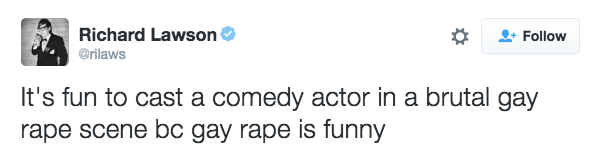
Greenfield’s character appears to die, then comes back to life, but the violence itself is not addressed at all in this episode. All the viewer gets is a gratuitous rape scene with no explanation of its relevance to the plot. Unfortunately, this rape scene was just one part of a gore-fest episode that was full of violence but completely devoid of plot. Like the rest of the violence in the episode, the rape scene was only there to shock and titillate.
Don't miss the latest Cancel Me, Daddy, a Flytrap Media production...
The depiction of male rape victims takes a truly frightening turn in comedies. Rape of men is frequently played for laughs, often making a violent act unrecognizable as rape to the audience. In the 2005 film Wedding Crashers, Gloria Cleary (Isla Fisher) ties Jeremy Grey (Vince Vaughn) to a bed while he’s sleeping. When he wakes up, she stifles his protests by gagging him with a sock so she can finish what Jeremy later describes as a “midnight rape.” Being raped obviously wasn’t all that traumatic for Jeremy, though, because he ends up falling in love with Gloria and marrying her. Huh.
A similarly disturbing scene happens in Season 2 of The Mindy Project, when Mindy (Mindy Kaling) drops off the blackout-drunk Dr. Paul Leotard (James Franco) at his apartment. Mindy kisses him, and he reacts by yelling, “Woah, neighbors!,” so Mindy covers his mouth and tells him, “Nothing happened. You liked it.” As if that isn’t rapey enough, Christina (Chloe Sevigny), the ex-wife of Mindy’s coworker Danny, shows up after Mindy leaves and rapes the blackout-drunk Dr. Leotard. Yet who pays the consequences for the rape? Dr. Leotard, who ends up quitting his job. If Dr. Leotard had been a woman, this would have been a clear depiction of a sexual predator taking advantage of someone incapable of consent. Unfortunately, because Dr. Leotard is a man, the scene is played for laughs as a man’s supposed uncontrollable desire for sex getting the better of him.
Some films and TV shows have treated male rape with seriousness, but they don’t get it totally right either. In the 1994 film The Shawshank Redemption, Andy Dufresne (Tim Robbins) is beaten and raped repeatedly by a group of men called the Sisters. Red (Morgan Freeman) comments through narration that if “it” (he never uses the word “rape”) had continued, prison would’ve gotten the best of Andy, but Andy himself never appears fazed by the violence. This depiction of rape would have been more accurate if the film portrayed the massive trauma sexual assault victims experience. Once the rapes end in The Shawshank Redemption, there are no further mentions of them in the movie, and Andy goes on as if nothing had ever happened. After all, men are strong enough to simply shrug off the trauma of rape, right? This film would have been stronger in its portrayal of rape if it had shown how the trauma of the assaults doesn’t just disappear.
The 1998 film American History X offers a similarly realistic portrayal of prison rape but minimal depiction of its aftermath. Derek Vinyard (Edward Norton) is attacked in the shower by a group of skinheads. The group restrains Derek while the leader rapes him. When he’s done, the leader smashes Derek’s head into the shower wall. As the camera pans away from his motionless body, we see blood flowing out from beneath him and down the shower drain. Later, Derek is shown in the prison infirmary lying on his stomach. When his former history teacher, Dr. Bob Sweeney (Avery Brooks), visits him, he breaks down and cries. This is what the world needs to see: a man reacting emotionally to being raped. The scene is incredibly powerful. But the movie could have taken it even further. Rather than depict the two characters discussing Derek’s emotional state as a result of being raped, the characters quickly move on to how Derek can help his younger brother. Ultimately, Derek is just another stoic man who doesn’t need help recovering from sexual violence.
It’s clear the media has a history of treating male rape victims with a serious lack of validation and compassion, exacerbating a culture that is already quick to deny a rape victim’s story regardless of where that person falls on the gender spectrum. In order to create more awareness of the true severity of rape culture’s effect on victims, we need to see more depictions of male rape victims like we see in season one of Outlander. The show takes two episodes to show how “Black Jack” Randall (Tobias Menzies) rapes and psychologically and physically tortures Jamie Fraser (Sam Heughan) in an English prison. What separates Outlander from other TV shows and movies is that it shows Jamie getting an erection and ejaculating during the rape, physical responses that are completely normal during rape. After Jamie is rescued, he doesn’t just magically recover and move on with his life; he becomes suicidal, refusing to eat and attempting to gain access to a knife. Here we see that when men are raped, it is often a complex experience that has a severe and lasting impact on the victim. Jamie cries. He admits feeling shame and worthlessness. He reacts to being raped.
Perhaps if Bobby reacted to being raped as Jamie did, it would’ve been harder to turn Deliverance into the punch line that is perpetuated to this day. If TV shows and movies continue to portray male rape as “no big deal” or even something to laugh about, rape victims of all genders will continue to be met with skepticism, denial, and even flat out derision. And that’s definitely no laughing matter.
This story was updated to include more up-to-date references, dates, and statistics.
Mika Doyle is a queer, half-Japanese poet and writer based in Rockford, Illinois. Her work has appeared in Bitch, Bustle, and Elite Daily, with poetry in Artemis Journal, The Dime Show Review, and On Loss: An Anthology. Her creative nonfiction is featured in The Rockford Anthology, and her short play was selected for the 2019 Rockford New Play Festival. Her name is pronounced Mee-ka.