Haidt Crimes: On Moral Foundations Theory and the Normalization of Fascism
Powerful centrists with milquetoast politics are once again demanding we have empathy for people who would destroy us.

I suppose it was inevitable. When Donald Trump was voted back into power—more nakedly authoritarian and backed as enthusiastically as ever by authoritarian Christians—somewhere, some cringe white men with sociology PhDs were going to do it.
They would trim their salt-and-pepper beards, straighten their ties, crack their knuckles, and—by the power vested in them by public intellectual Jonathan Haidt, the creator of moral foundations theory—they’d “well, actually” any American who would listen into treating Trump’s Christofascist supporters with respect and deference. Accolades would surely follow. Maybe even TED conference invitations. Hey, a balding white man with a sociology PhD can dream.
And so it came to pass that sociologists Kerby Goff, Eric Silver, and John Iceland began using their study published in October 2024 to call American liberals and leftists to, as it were, calm our tits and learn to love our Christian nationalist neighbors. In the study, based on a nationally representative sample of 1,125 Americans, our Haidt-loving heroes take issue with moral critiques of Christian nationalism focused solely on its consequences, including support for anti-LGBTQ, anti-trans, anti-Muslim, anti-abortion, and anti-gun control policies, as well as “heightened punitiveness” and “skepticism toward claims of racial injustice.”
Before we can dissect exactly what’s going on there, however, it’s important to understand two things: the basics of moral foundations theory (don’t worry, the theory is hella basic) and how the Christian nationalism discourse functions in the American public sphere.
Christian Nationalism: A Brief History of an Inadequate Critical Framework
In the 2010s, sociologists Andrew Whitehead and Sam Perry began publishing research about Christian nationalism, a term they defined through an index derived from people’s self-reported answers to questions about, among other things, whether the United States was founded as a Christian nation and whether it should be a Christian nation. In 2020, those efforts culminated in a book, Taking America Back for God: Christian Nationalism in the United States (Oxford University Press).
I grew up in what was certainly a Christian nationalist environment. The typical evangelical Christian school routine involves three pledges at the beginning of the day: to the American flag, to the Christian flag, and to the Bible. Our talent shows concluded with audience sing-alongs of Lee Greenwood’s god-awful hit “God Bless the USA.” And all this Christian nationalism came with a whole slate of conformist, authoritarian beliefs and practices, including fighting to bring Christian prayers back into public schools, to end legal abortion, and to oppose civil rights for LGBTQ people.
As a queer exvangelical, the Christianity I grew up with was immensely harmful to me. I’m far from the only one. I have spent a long time trying to get the general public to understand what a serious threat conservative, mostly white evangelicalism is to democracy and human rights, and so, when the major papers and pundits began chattering about Christian nationalism, which became a buzzword during the (*sigh*) first Trump administration, that seemed like an improvement to me. Finally, the major papers and magazines were confronting authoritarian Christianity in America. Or were they?
Once Christian nationalism became a mainstay of the national conversation about religion and politics, many Americans proved ready to gleefully insist that Christian nationalists are “fake” Christians. Then came the slick documentaries about Christian nationalism in which not only was the authentically Christian nature of Christian nationalism denied, but “respectable” right-wing, anti-abortion, and anti-LGBTQ evangelicals were held up as heroes simply because they spoke out against this narrowly defined version of Christian nationalism.
Over time, it became clear to me that this “Christian nationalist” framing, with its narrow definition, was often used precisely to elide serious criticism of toxic forms of Christianity rather than address them head on. The punditocracy is invested in protecting Christianity’s reputation rather than exploring how Christianity can (and often does) break bad. Sure, it can also break good. But Christianity is not inherently good. No religion is, since religions are complex cultural systems full of tensions and contradictions and always subjected to communal mediation in their interpretations and expressions. In other words, they are what their adherents make of them.
And as it turns out, when scholars and pundits frame the problem of authoritarian Christianity as “Christian nationalism,” it’s easy for those with immense privilege and power to distance “Christian nationalism” from Christianity. Those involved in the Christian nationalist discourse pull this off by implying that Christian nationalism is more politics than religion, or maybe entirely politics. But this purported stark distinction between religion and politics is nonsense; politics runs through all complex human phenomena.
Christianity is not inherently good. No religion is, since religions are complex cultural systems full of tensions and contradictions and always subjected to communal mediation in their interpretations and expressions. In other words, they are what their adherents make of them.
To be sure, Perry and Whitehead, the (white, male, Christian) sociologists who introduced the term “Christian nationalism” and published related data, were careful not to directly state that Christian nationalists aren’t real Christians. However, they walked right up to that line, as they were (and remain) clearly defensive about Christianity’s reputation.
In 2022, for example, when Republican congressional representative Lauren Boebert made a tasteless joke about Jesus and AR-15s, Whitehead tweeted this hot take: “She has literally no clue that Jesus gave up his life. He didn’t pursue power over others, but sacrifice for others.” Never mind that in mere minutes of Googling, I found a clip of Boebert talking about Jesus’s sacrificial death, showing she does in fact have a clear understanding of basic Christian atonement theology.
Clearly, “Christian nationalism” is too narrow a framework to be useful for criticizing patriarchal, anti-LGBTQ, racist, authoritarian Christianity. But as it turns out, the joke is once again on me, because now that the authoritarian Christians—right-wing evangelicals, most Mormons, and traditionalist Catholics—are in power and implementing the goals laid out in Project 2025 at breakneck speed, some hand-wringing scholars are rushing to launder the reputation not just of Christianity, but of Christian nationalism itself.
Some Morals are Bad, Actually
That brings us back to Goff, Silver, and Iceland’s October 2024 study, which they promoted this year in The Conversation, a website where scholars bring their research to a broader, more mainstream audience. Evan Derkacz, my editor at Religion Dispatches, forwarded me these gentlemens’ article with “Haidt Crime” in the subject line. (I have stolen the phrase with his blessing.) In the body of the email, he wrote, “Why won’t moral foundations theory just die already? It’s so patently silly. So clearly a finger on the scale.” He’s right; it is.
Moral foundations theory (henceforth MFT) is a clearly contrived academic apparatus designed to protect conservatives, the privileged, and the powerful by making an argument from “morality.” It’s similar, in that respect, to the emphasis on “intellectual diversity” some university administrators were deploying to weaken DEI programs and shore up white male power before the current Trump regime cracked down on those programs.
MFT is seductive, because who, after all, can argue with morals? And morals, as everyone knows, correspond to precisely six foundational principles that are derived from “evolutionary psychology,” which is definitely not mostly a bullshit field used to justify the fever dreams of reactionaries. In any case, according to MFT, the six moral foundations are: care/harm, fairness/cheating, loyalty/betrayal, authority/subversion, sanctity/degradation, and liberty/oppression.
Now that authoritarian Christians are in power and implementing the goals laid out in Project 2025 at breakneck speed, some hand-wringing scholars are rushing to launder the reputation not just of Christianity, but of Christian nationalism itself.
For those not familiar with the MFT shtick as pioneered by Haidt, here’s how it goes. We namby-pamby liberals and leftists focus primarily on care and fairness. Meanwhile the hardened, reality-pilled conservatives (who are definitely not just assholes justifying their selfish impulses) draw on all six foundations but put more emphasis on authority, in-group loyalty, and sanctity than on care and fairness. Logic OBVIOUSLY dictates that those who draw their morality from a larger number of foundations are more moral and more serious than the people who draw their morality from fewer foundations. That’s just math, ergo liberals and leftists all need to go to our rooms and think about how we should stop being mean to conservatives, QED.
Now, Goff, Silver, and Iceland’s study isn’t quite that bad, but at the end of the day they are using MFT to normalize Christian nationalism. Covering their asses bases, these sociologists concede that “a moral evaluation of the consequences of CN is important,” citing a biting assessment made by historian Anthea Butler in her book White Evangelical Racism: The Politics of Morality in America (University of North Carolina Press, 2021).
But then they direct readers’ attention away from the consequences of Christian nationalism to “the underlying moral concerns,” because apparently when you’re pro-gun, pro-incarceration, pro-death penalty, and seek to control Black, brown, queer, and women’s bodies (none of which Goff, Silver, or Iceland possess), what people really ought to care about is “the narratives, norms, values, beliefs, dispositions, and intuitions” that underlie the harmful beliefs and actions of the privileged.
To see how this works, in practice, it’s best to quote from the study:
CN’s association with anti-abortion attitudes and greater punitiveness is often seen as evidence of authoritarianism. In a recent critique, Whitehead and Perry (2023) argue that despite CN adherents’ claims to be “pro-life” they are really “pro-order” and thus willing to punish women for having an abortion. Our finding that a binding concern for social order is positively associated with CN supports this assessment. However, the social order orientation of CN is driven by in-group loyalty and sanctity—not authority.
Reading this, you might think, “Why the fuck should I care about that last sentence?” I’m glad you asked. What we’re dealing with here is sophisticated wordplay, derived from a sophisticated statistical apparatus grounded in a frankly bullshit theory adored by America’s “very serious people,” amounting to a claim that we should not call Christian nationalists authoritarians (or, presumably fascists) if they are not motivated by the moral foundation of authority. I mean, it’s not like authoritarianism is associated with punitive attitudes toward out-groups, is it? (It is.)
In the study’s conclusion, its authors argue that understanding the moral intuitions behind Christian nationalism “is essential” because it “has practical ramifications.” In their Conversation article, they go even further, writing that their research shows “that support for Christian nationalism isn’t merely about racism or being ultrareligious.” After all, Christian nationalists are simply “more sensitive to violations of loyalty, sanctity and liberty, and less sensitive to violations of fairness.”
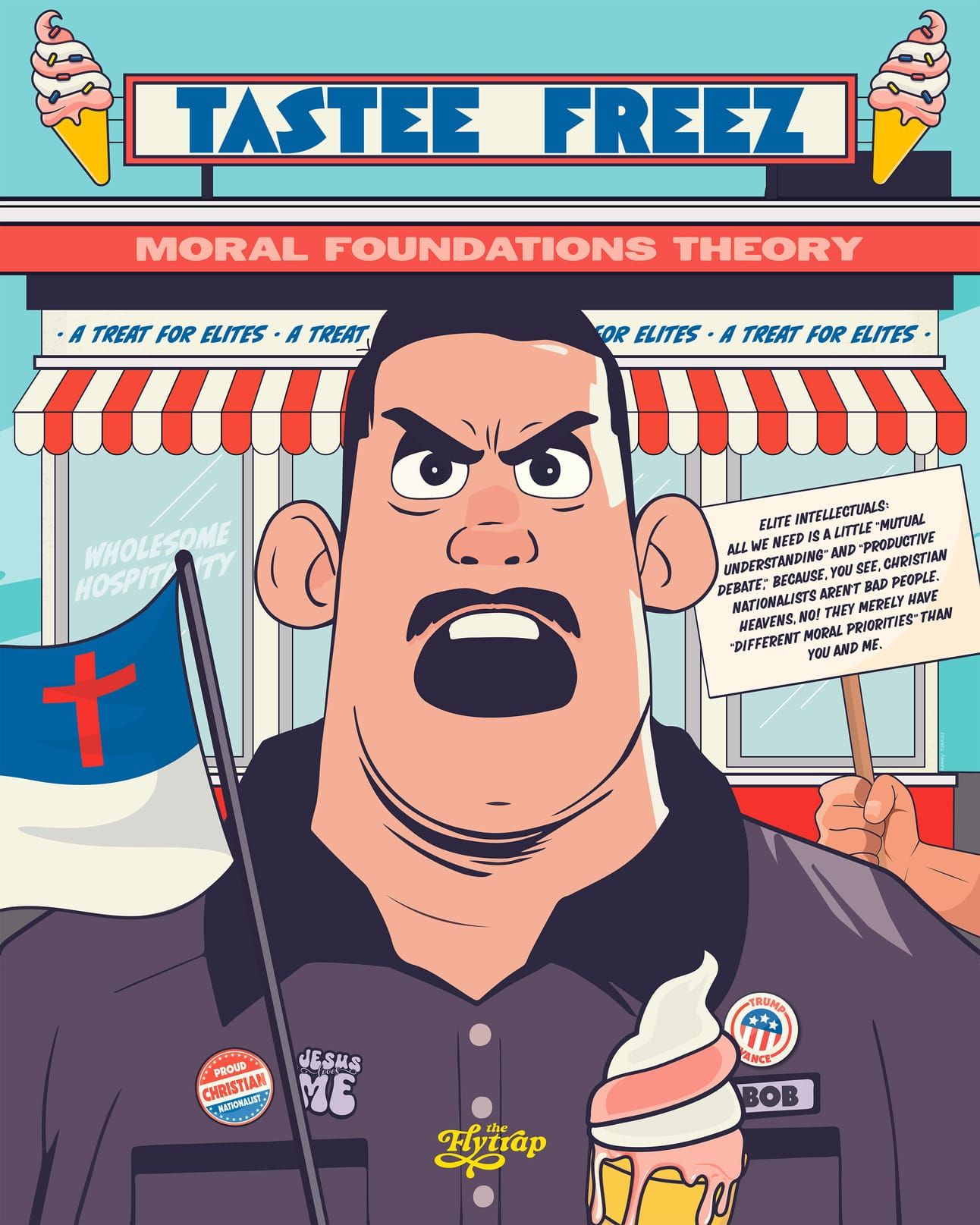
This understanding, they absurdly claim, “may help build bridges between those who are sympathetic to and those who are skeptical toward Christian nationalism.” All we need is a little “mutual understanding” and “productive debate,” because, you see, Christian nationalists aren’t bad people. Heavens, no! They merely have “different moral priorities” than you and me.
No Bad Christians: The MFT and Christian Nationalism Double-Bind
You can see why MFT is all the rage with university presidents, pundits, milquetoast Democrats, and other centristy types. You can also see the obvious flaws in the MFT framework, the ways its advocates use a complex scholarly apparatus and rhetorical sleight-of-hand to arrive at conclusions that favor the already privileged.
But, in the immortal words of LeVar Burton, you don’t have to take my word for it. In a 2012 review of Haidt’s book The Righteous Mind, published in the prestigious journal Science, New York University social psychologist Jonathan T. Jost argued that Haidt’s “purely subjectivist approach risks replacing what he perceives as a liberal bias in the psychological study of moral behavior with a conservative one.” Jost maintains that Haidt’s work relies on insufficiently grounded assumptions. Jost writes:
A prominent theory of human reasoning holds that there are two cognitive systems: System 1 is quick, intuitive, low-effort, and association-based. System 2 is slow, deliberate, high-effort, and logical. In Haidt’s view, system 2 is really just a bullshitter—a dissembler, a post hoc rationalizer. He asserts that humans make lousy scientists and logicians but excellent lawyers and press secretaries (people who consider only one side of an issue and defend it to the end). Haidt then proceeds to make a virtue of necessity: Because we are so emotionally driven and so bad at thinking rationally about morality, it must be that morality itself is and can only be based on gut-level (often emotional) intuitions.
According to Jost, the “biggest flaw” in Haidt’s book is the contradictory way “he swings back and forth between an allegedly value-neutral sense of ‘moral’… and a more prescriptive sense he uses mainly to jab liberals.” Jost further contends that Haidt’s affected posture as an unbiased observer is “unconvincing” and that it’s nonsensical to argue that “more is better” with respect to gut-level moral intuitions.
Haidt’s critics also often note that his concepts of authority, sanctity, and in-group loyalty are not grounded in traditional moral philosophy. But Christopher Douglas, a Canadian scholar of American evangelicalism, offered up the most prescient and succinct assessment of MFT in a paper published in 2024: “Indeed, a simple thought experiment suggests the obviousness of this problem: MFT might regard Nazis as very good people, scoring high on authority, loyalty, and purity scales—just very good in ways different from, but not worse than, their victims.”
Goff, Silver, and Iceland have made one giant leap toward doing exactly that in their defense of the “morality” of Christian nationalists. As I’ve argued before, one way to sum up the de facto civil religion of the United States is faith in faith itself. There’s a tendency in our elite public sphere to treat “sincerely held beliefs”—particularly in Christianity or various New Age teachings—as unassailable, and often even as admirable. There is simply no room in the legacy media for anyone who wants to argue that religion and spirituality are not always and inherently pro-social and all-around GOOD THINGS™.
But it does not matter which discursive approach an individual centrist prefers. If you don’t like that there are millions of Christians supporting and implementing Trump’s harmful policies, then you can argue that Christian nationalists are not “real Christians.” You can also argue that Christian nationalists have “different moral priorities” that just need to be understood so we can have “dialogue” and “debate” and never do anything that seriously challenges the horrific injustices authoritarian Christian theology legitimates. But the impact is the same: millions of Christians enthusiastically back a regime attempting to reverse birthright citizenship, engaging in mass deportations of immigrants, and targeting trans people like me with viciously discriminatory executive orders. Legacy media outlets will treat those Christians as basically good people and misunderstood “real Americans,” because to do otherwise would be to challenge white, straight, male, and Christian privilege.
The message is clear: The national Democratic leadership, the punditocracy, and a contingent of celebrated public intellectuals will never consider me, a transgender American woman, as deserving of the treatment bestowed on the everyday Trump voter down at the Tastee-Freez. As long as Trump voter “Bob” identifies as Christian, then his life and his opinion matter and deserve to be legitimized. The argument from liberal Christians and their fellow travelers that Bob is “not a real Christian” doesn’t matter to The New York Times and other legacy media offenders; they will only ever treat authoritarian Christians with kid gloves. But so what if they didn’t? The only impact of arguing that Christians who make respectable people uncomfortable are not actually Christians at all is to reinforce Christian hegemony and privilege anyway. That’s the only thing that can result from equating Christianity with goodness—and that Christian privilege protects Bob just as well as the liberal Episopcal priest in the nearest big city.
The national Democratic leadership, the punditocracy, and a contingent of celebrated public intellectuals will never consider me, a transgender American woman, as deserving of the treatment bestowed on the everyday Trump voter down at the Tastee-Freez.
But wait! Bob is a Christian nationalist, you say? Should that give his journalistic admirers pause? Of course not! Bob has his moral reasons to be a Christian nationalist, as Goff, Silver, and Iceland have shown. The fix is in. It doesn’t matter which language game is in play: Christian nationalism is bad, but Christian nationalists aren’t real Christians; or Christian nationalism isn’t bad.
And what about those of us harmed by the regime Bob enthusiastically supports? Those who aren’t cisgender, straight, white, male, and/or Christian? We simply don’t matter—or at least not as much. That’s where MFT was always inevitably going to lead. And now that MFT has been applied to Christian nationalism, even the slight critical value that discourse might have had has been defanged.
To borrow Audre Lorde’s framing, these language games are the master’s tools, and we’ll never dismantle American authoritarianism with them. At the risk of reviving a rhetorical trope we Flytrap founders said we were going to avoid, moral foundations theory is not feminist. You do not, under any circumstances, gotta hand it to good Christian Bob down at the Tastee-Freez, and the same goes for the people who claim Bob needs our understanding and empathy when he would never extend the same to us. Fuck that, fuck moral foundations theory, and fuck the algorithm!
This post was edited by Evette Dionne and copyedited by Andrea Grimes.