Does Playing Grand Strategy Games Make Me a Fascist?
Living a life without autonomy has led me to seek out control through video games.
A 2022 Instagram post by Swedish influencer Saskia Cort in which she asked her boyfriend how often he thinks about the Roman Empire spawned one of the biggest memes of the first half of this decade. Now, “This is my Roman Empire” has become an instantly recognizable catchphrase, with folks all over social media and IRL using the phrase to describe almost anything they think about multiple times a day. It could be some anime or something as ubiquitous as Survivor. It could be a niche cake maker on TikTok or a lesbian sheep shearer on YouTube. But in my case, my Roman Empire is quite literally the Roman Empire—just not the way you would think.
You see, while I am a self admitted giant history nerd, the Roman period actually isn’t that interesting to me. So when I say I think about the “Roman Empire” a lot, I’m talking about video games.
For most of my life, I have been obsessed with grand strategy games, sometimes lovingly referred to as “map painting games.” This genre of games consist of controlling a country or civilization, represented with a distinct color and borders and making every little decision towards a greater goal—like world domination.
One of the tropes about Paradox games is that if you play it for more than a thousand hours, you’re either a trans woman or a fascist.
Hey there, free member! Did you know we run original features every Tuesday for the paid members who support The Flytrap? Consider upgrading your membership to keep reading and get full access to our archives! Our memberships start at $6.66/month for the budget conscious.
It started young for me, playing the popular board game Risk at my best friend’s house, before I moved on to the Civilization computer games as a teen. Civ offered a more complex and randomized map, along with a full combat system and a technology tree to fully customize your country the way you like. You took control of a “Civilization” starting in the Stone Age and guided it all the way through the course of history, even into an imagined future full of space travel or giant death robots.Want to dominate the waves as Carthage, you can. Want to terrorize the plains with Mongol horse archers, you can do that too!
These games offered me a chance to make decisions and have control over my destiny (in-game) that I just never had in my own life growing up as a closeted trans girl.
I promise you, there’s a map painting game for everyone. Want to murder your way to the head of an empire, or sleep with every king or queen in Europe? Try Crusader Kings 3 (think: The Sims meets Game of Thrones). Want to stave off the Nazi invasion in 1940 France? There’s Hearts of Iron 4. Want to conquer and manage literal galaxies? Stellaris! All of these games are even made by the same developer, Paradox Interactive.
It wasn’t until I discovered another Paradox game, Europa Universalis IV (EU4), in 2014, that I truly found my home in the map painting genre. The Roman Empire I always think about was my first ever world conquest in that game; I started as the medieval kingdom of Aragon, then conquered out to the borders of the height of the Roman Empire, reclaimed the mantle of Rome, and then went on to conquer the rest of the world.
EU4 feels like the Civ games on steroids, although it’s more limited in its historical scope. You start in 1444 just after the failed Crusade for Varna when the King of Poland famously died in battle against the Ottomans and steer your country all the way through the end of the Napoleonic period in 1821.
At the start, the medieval age is quickly coming to a close. The Ottoman Empire is on the verge of taking Constantinople, which then triggers Western Europe’s search for alternative trade routes to India and the far east, which triggers the European discovery of the New World. (They have since released a sequel, Europa Universalis 5, but I haven’t taken to it yet. I’m not ready to give up the comfort of my favorite game yet.)
The game is not without its problems, obviously. It’s essentially a colonialism simulator in which acts of genocide are whitewashed with innocuous-sounding mechanics such as “Converting Religion,” or “Culture Conversion.” But you don’t have to play as a colonizer. You can choose any country or political entity you want that existed in 1444. Or you can create your own custom kingdom. Recently I got an achievement for conquering all of Africa as Kongo, keeping the continent completely out of the hands of European colonizers. There’s even an achievement for starting as the Aztecs and reverse-colonizing Europe.
But there’s something immensely satisfying about building up a small country and watching the color of your burgeoning empire spread into ever expanding parts of the map and building the type of world you wish existed.
One of the tropes about Paradox games is that if you play it for more than a thousand hours, you’re either a trans woman or a fascist.
The political writer Joshua Cohen, better known perhaps as Ettingermentum, wrote a piece last year for his newsletter about how map painting games by EU4’s publisher, Paradox Interactive, have become a sort of breeding ground for fascist ideology. Defense Secretary Pete Hegseth has several crusader-themed tattoos that I recognize from their representation in my favorite game. One reads “deus vult,” which means “God wills it,” a common rallying cry for medieval crusaders.
Deus Vult is also the name of a well known idea in EU4 which gives you a special “casus belli,” a reason to go to war with any neighboring country of a different religion. Hegseth also has a tattoo with the royal coat of arms of the Kingdom of Jerusalem, despite being a Protestant (Protestants didn’t exist until the crusades for the Holy Land were over).
Looking to support The Flytrap and buy some cool merch? Pick up a poster at the merch store!
You can also find all kinds of other Flytrap goodies including our Fuck the Algorithm Charity Bandana (May proceeds will be donated to Red Canary Song, a grassroots collective of sex workers organizing transnationally) at our merch store! Impress your friends with your good taste and support independent feminist media.
Of course, Hegseth could have just as easily found inspiration for both tattoos in Ridley Scott’s epic Kingdom of Heaven (2005), in which both are featured prominently. Either way, he is now heading up what he considers a religious war against a Muslim country, and Pentagon leaders are reportedly telling troops that the war is “God’s will.”
Ironically, I think it’s the control over decisions and destiny that draws both trans people and fascists to these types of games. In the fascists’ case, they are unhappy with the existence of the people they hate and a game like EU4 offers them a chance to build a world in which those people don’t exist. The control is the fantasy for the trans woman and fascist alike.
As Cohen wrote, referencing HOI4’s fandom, these games present a cosplay fantasy in which murderous, historically world devastating political forces are presented as normal game mechanics. “[T]eenage right-wing losers looked inwards and found direction in their greatest passion: spending thousands of hours pretending to be Adolf Hitler in a game that presented him as just another strong world leader and taking it all at face value.”
Yes, you can just play as Hitler in HOI4. You can play as Napoleon, or commission Chistopher Columbus’ voyage to the New World in EU4. You can take part in the Crusades and the Reconquista in Crusader Kings III. If you play as Byzantium and reclaim the Anatolian peninsula from the Ottomans, there’s a decision that will “naturally convert” the Turkish provinces to Greek. Mechanically it is almost always the correct gameplay move to make this decision.
This has led to a lot of self-questioning for myself over the years. Is my desire for control—even in this fictional gaming world—fascistic itself?
I make in-game decisions that my real life self never would, like playing as Spain and conquering the Aztecs. If you aim to win the game as designed, this is objectively the correct move as the Mexican region is resource-rich and doing so will propel your empire through the rest of the game.
Don't miss the latest Cancel Me, Daddy, a Flytrap Media production...
But colonization is real and ongoing, affecting billions of people over the last 500 years. Peoples, cultures, languages, and religions were wiped out all across the globe in pursuit of European capitalist and crown profits.
When I listen to the story of how Spanish conquistadors took down and ultimately wiped the Aztecs off the face of the map, I get incredibly angry. Try it for yourself: Listen to the Aztec episode of the Fall of Civilizations podcast sometime and try not to get angry by the end of it.
I tell myself that my own desire to find control in a life lived without autonomy is just like giving water to someone traversing a desert. Fascists falsely but sincerely believe they are oppressed like Western trans people actually are today. My Flytrap colleague Andrea Grimes called this false perception “weaponized victimhood” in a 2023 piece for Dame Magazine. These guys (and they’re almost always guys), are not actually oppressed and in fact are the ones who are doing the oppressing. They see restrictions on their ability to oppress others as persecution against themselves.
They desire to dominate and control everyone around them, especially minorities, and Paradox games give them a viable outlet to do so in a virtual setting.
But in my case—and I suspect for other trans women—we’re just playing a damn game to escape the horrors of our real life existence. In addition to being a hobby we can do without interacting with others (and thus running into transphobia), these games offer us a chance to have control over key decisions in a way we can’t find in other parts of our lives.
I grew up in a world that demanded I comply with the rules set out by society: Dress in boy clothes, wear your hair short, makeup is for sissies. Of course you’ll never be a real woman. Even after transitioning as an adult, I’m still beholden to doctors to continue living this life. Any moment, my government could make it illegal for those doctors to live my life.
These games offered me a chance to make decisions and have control over my destiny (in-game) that I just never had in my own life growing up as a closeted trans girl.
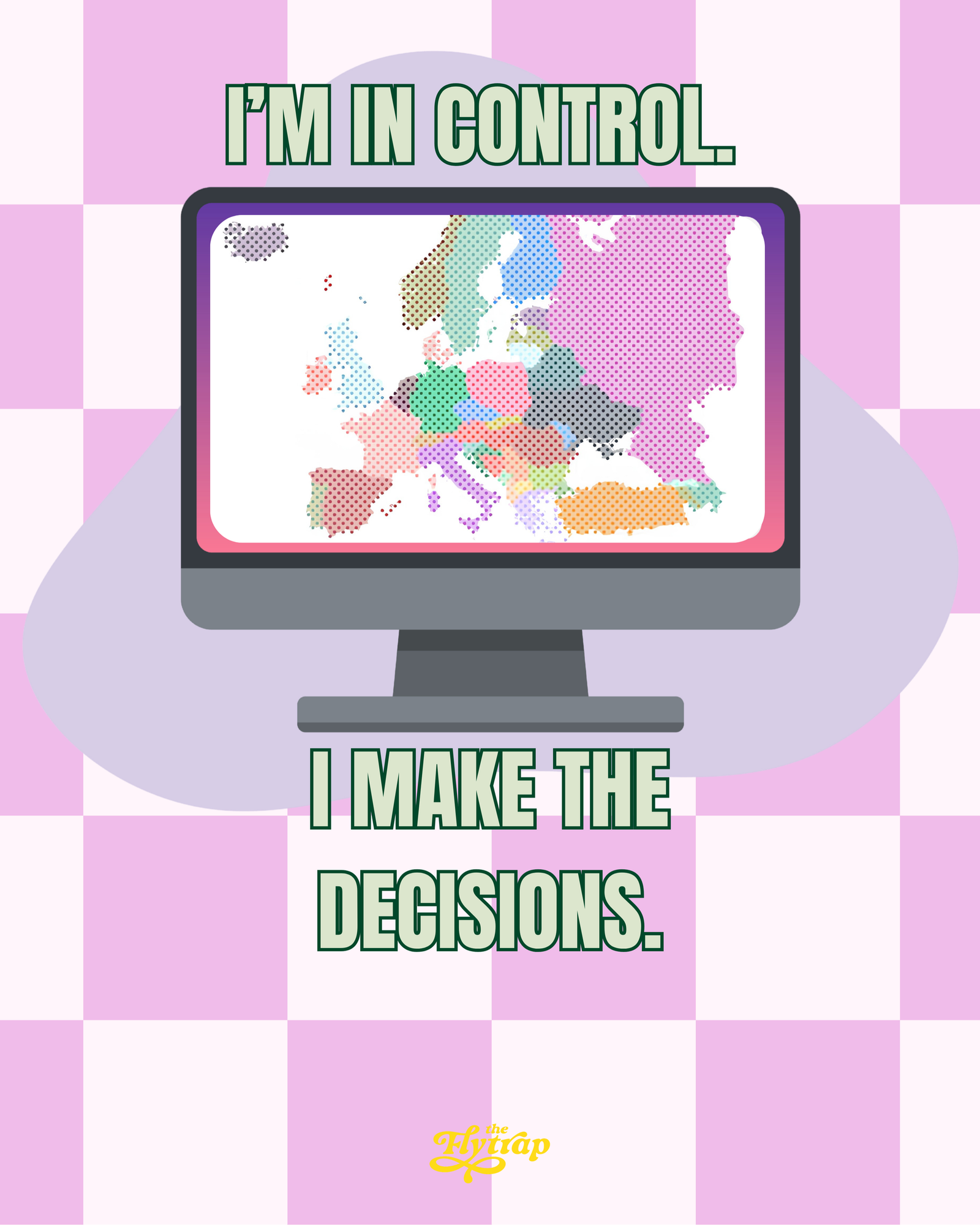
But in EU4, I’m in control. I make the decisions. I scale my country and stage the heroic last stand. If a neighbor pisses me off, I can just take them over with no real-life consequences. It’s literally the point of the game.
As a trans woman, I am scoffed at, derided, jeered at, banned from public spaces, denied needed health care by a society that hates me. In my make-believe worlds, I am the mistress of my domain. If I want to build a society of battle nuns in the middle of France, I can do that. If I want to take over the entire world, I can do that too.
There’s a comfort and a sense of power I find in painting the map. It’s no wonder I have over 6,300 hours in this game.
This piece was edited by Andrea Grimes and copyedited by Nicole Froio.