
Christopher
Fearing the man society could have made me into.
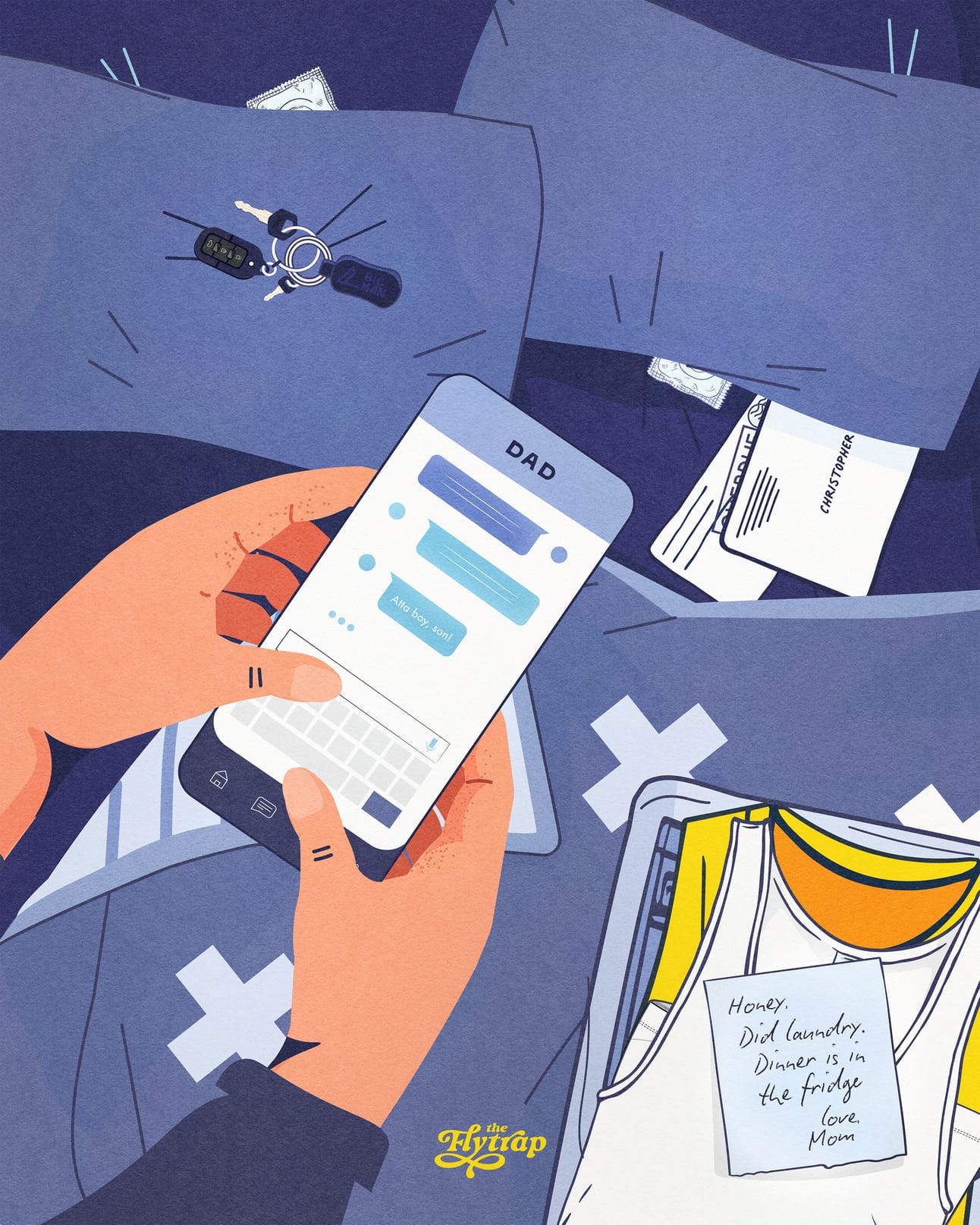
“Christopher,” my parents planned to name me. They declined to learn my assigned sex in utero. “Que Sera, Sera (Whatever Will Be, Will Be),” my mom used to sing the Doris Day song, which lifted an Old English heraldic motto that had cosplayed Italian for 400 years and mistranslated it into grammatically incorrect Spanish.
The force of my fetal kicks nevertheless had my parents convinced I’d be a boy. Christopher was the boy’s name they chose.
Ultrasounds were just starting to become standard prenatal care in the 1980s when Mom squeezed into her little red Monza—no, not a Mazda—and drove from Staten Island into the city for her obstetrical checkups. Cold War-era doctors could not fathom the new millennium’s genetic screening tests nor their ethical considerations for abortion, ableism, and autonomy, all the while projecting sex onto a developing fetus the size of a Castelvetrano olive at 10 weeks’ gestation.
What Ronald Reagan lacked in technology, he made up for in so-called culture wars, the accelerant for pyrotechnic “gender reveals” that would spark 21st-century wildfires in a changed climate. “Girl power” was still a few years off from its Bikini Kill zine origins turned Spice Girls marketing catchphase that would lose further meaning when a pound sign evolved into a hashtag. Government agencies like NASA relied on early versions of the Internet while lay people like my mother, nearly 40 weeks pregnant, watched the Space Shuttle Challenger explode on her Zenith television set.
I was born ten days later.
Positioned on my back, I stared through the C-section incision into the surgical lighting, harsh as high noon and a reality check.
“She’s like a sunny-side up egg,” announced the doctor, another man outnumbering and out-earning women in the field.
A sunny-side up egg is a strange description of newborn anatomy on display, as if there were no ambiguity about “what” I was and no interest in “who” I might be. Mom maintains the doctor said it because both of my eyes were wide open. She incorporated it into her birth story, repeating the phrase with a tenderness I craved from her almost as much as her approval after my indistinct cooing hardened into opinionated consonants.
My parents got their surprise. “Que Sera, Sera.” They kept the root of their chosen baby name planted in Christ, their Lord, and pruned the suffix to conform to all the gendered expectations that lay ahead for their daughter.
This is how I became Christine, their only child.
The Christopher I could have been became my worst-case scenario for the life I did not want: insular, obedient, tethered.
According to red sauce gender roles, daughters do not leave. Sons stay. What would be an obligation for Christine would be a choice for Christopher. That is how gendering works under the patriarchy, a system replicated in Northeast U.S. Italian American communities and the world over.
I planned my escape. I was a Y2K teenage prepper with a go-bag of extracurriculars, extra credit, and other essentials, as I understood them in my very narrow, very white perspective, to social and educational mobility. Christopher would have been too comfortable to find such verve within himself, or in his parents’ basement, the man cave he called home.
According to red sauce gender roles, daughters do not leave. Sons stay. What would be an obligation for Christine would be a choice for Christopher.
In that alternate timeline, Mom did Christopher’s laundry, a literally thankless task for another grown-ass man sprawled on a mattress without a bedframe. The ladies Christopher brought home didn’t seem to mind, not that he cared if they came underneath him. He got off, just as he’d gotten away with pulling a chubby cheeked preschooler’s pants down in the schoolyard and 20 years later, pushing a faceless woman’s head down in his car.
Whether Christopher had a blue collar job fixing cars, toilets, or electrical wiring, or a white collar “career” in insider trading, he did not pay rent. He would internalize toxic masculinity whether The Joe Rogan Experience blasted from a boombox while he worked underneath some schmuck’s Tesla Cybertruck, or from his own Tesla Cybertruck’s speakers on his daily commute to FiDi. If what can only be called his Douchemobile happened to kill pedestrians and got recalled despite our present-day tech oligarchy, Christopher would take the New Jersey Transit bus with the rest of the plebes. He’d pipe Jordan Peterson through his Airpods into his taper fade that would never, ever look as good as Luigi Mangione’s.
Mom scrubbed ziti stains out of Christopher’s white tank tops that he flashed as a cultural uniform or hid underneath his dress shirts to save that piece of himself from “the man,” without recognizing he had become “the man.” Bleached of their symbol of queer liberation, the ribbed fabric fit Christopher, another stereotypical Italian American in a “wife beater” or “guinea tee” with no wherewithal to fight the sexist and anti-Black racist origins of those terms.
Perhaps the Cautionary Tale of Christopher is an inversion, or perversion, of George W. Bush’s “soft bigotry of low expectations,” the most enduring racist pull quote from the former president’s address to the 2006 NAACP Annual Convention. Christopher is a cisgender—a word that has existed since we were children—white man. This land is his land.
It is no mistake that entitlement to scarce water and polluted air originated with a genocidal colonizer who shared Christopher’s name and conquered and enslaved in the name of Christ, The Prefix. What Christopher expects, he gets, along with all the kings, presidents, and tech oligarchs, all the missionaries, televangelists, and Instagram influencers, past, present, and, I’m sorry to predict, future.
Anyone else who craves power like a sour candy that will rot your teeth and burn a hole through your stomach must settle for proximity to power. What do countless white women and a finite number of Black police officers, “Latinos for Trump,” and Biden administration Secretary of State Antony Blinken, who betrays Jewish values with his Zionist politics, have in common with Christopher? Upholding the same systems that disproportionately harm people of color and ultimately harm us all.
Saint Christopher, protect us from the wounds we inflict upon others and ourselves.
To coddle a man is to curdle his masculinity like protein powder added to a warm bowl of oatmeal and choked down to suffer for the cause of manning up.
Yet I feel—I don’t know if what I feel is pity, compassion, or some mix thereof—for Christopher. This world is his world because his earliest teachers, among them his parents and his favorite Saturday morning cartoons, taught him to dominate it rather than respect it.
"Big boys don’t cry," Christopher’s teacher told him on the elementary school playground where I would have been allowed to shed tears over a scraped knee.
“Boys will be boys,” Christopher heard when a boy like him pantsed preschool me as a little joke and a man like him pressured grown-up me for a little roadhead.
"Be a man," Christopher’s friend told him at the college party where I would have guarded my drinks against what that phrase implied.
“Attaboy,” Christopher’s father said when he found condoms strewn around the basement. On visits to my childhood bedroom, I’d bury my birth control pills in my purse or suitcase, out of sight for Dad and out of mind for Mom.
What I do not expect from Christopher is better in concept or action.
My already low expectations for cis white men hit rock bottom for Christopher because my alt and I come from a working-class family. We are two generations removed from ancestors who exchanged their early 20th century “dark white”-coded racial solidarity for the white flight and supremacy that James Baldwin called “the price of the ticket.”
Sometimes I’m bewildered that I busted my parents' chops into borrowing as much credit as Sallie Mae would give them for my fancy college three hours away. Bleary-eyed, I can forget that I wake up in a home I own through marriage, another form of privilege, rather than my parents’ basement, too.
“She’s like a sunny-side egg” turned out to be the right guess. My assigned gender fits me like the white tanks I love to femme up with reappropriated gold chains. From a young age, I looked at what the world would give Christopher without question and I decided to ask for it: the higher education that my better-off peers seemed to take for granted, a given, a D.A.R.E.-era gateway drug to independence and respect that someone named Christine had to earn. I say “ask” because “demand” is incomprehensible for a good girl like me and the kind of insufferable white lady I try not to be.
In return, the world gave me the equivalent of 73 cents to the dollar, the 2023 pay gap for white women that widens for Black, Latina, Native American, and Asian American, Native Hawaiian and Pacific Islander women, according to the National Partnership for Women and Families. “Run The World? (Girls)” Beyoncé titled one of her most famous songs. Given the escalating Trump-tech backlash against diversity, equity, and inclusion, I’d have to answer ”men,” with help from my fellow cis white women trying to please them for a seat at the table or the creature comforts of a well-kept home.
There is a difference between that kind of coddling, and caring. I experienced both, perhaps as an only child with my doting octogenarian grandmother attending to my every need, from “dinner’s ready” to “I’ll clean it.” At best, coddling did not prepare me for the real world. I was saved from the worst of myself, because I am not Christopher. I am not a man.
To coddle a man is to curdle his masculinity like protein powder added to a warm bowl of oatmeal and choked down to suffer for the cause of manning up.
Christopher would not have escaped this fate. He would have been allowed to watch The Sopranos in high school and re-watched it during those first pandemic summer months before he heard about Ivermectin. The worst stereotype the show perpetrates is not the mob stuff, it is the mom stuff: the indulgence of the son at the expense of the daughter.
It is the pressure on Meadow Soprano, the mafia princess, always studying, scoring speed to get through her SATs, reach the Ivy League, and manage it all—her own career and a family of men incapable of fixing their own goddamned dinner plates.
It is the indulgence of A.J. “So what, no fuckin' ziti now?” Soprano, the failson. A.J. could get away with literal murder, the family business, if not glued to the computer in his childhood bedroom. And of course, the show’s recurring bit features Christopher—”Christafuh”—Moltisanti writing a typo-riddled screenplay that sounds more like a manifesto from the manosphere.
Online, I imagine Christopher would find his purpose. His mother, an alt mother I do not recognize as my own, would have stormed the U.S. Capitol with him like "Zip-Tie Mom" and fought for his Indigenous cosplay diet like "QAnon Shaman Mom," who defended her son in a 60 Minutes interview: "What do you mean by wrong?" she retorted.
"My son can do no wrong," she might as well have said.
That's essentially what Derek Chauvin's mother said after his conviction for George Floyd's murder. Watching Kyle Rittenhouse's mother sob through the trial of her unrepentant son, I questioned if Christopher too would be exonerated under maternal law.
Before I became a parent and mother, I conceptualized Christopher as a literary exercise in which I held boys accountable so they don’t become unaccountable men. But accountability is often as reactive as it is carceral.
In another courtroom, a Black mother watched her 12-year-old son, charged in a fatal alleged carjacking after she turned him in to the D.C. police. “The mother listened in tears as her son’s attorney described all she had done to avoid getting to that point with her son,” a local newscast reported. If having middling role models of any gender is not a fix, neither is the police. This Black boy’s mother knew the stakes better than any white tears shed for white sons. That she could love her son without excuses is, I think, the link I’ve been seeking.
What would have happened if the doctor had said, “He’s like a sunny side up egg”? I worry family, society, history, culture, would have enabled the worst version of myself: tanned and gelled, living in my parents’ basement.
The truth is, I don’t know how to raise a child of any gender. I’m ad libbing parenthood every day with a Borscht Belt comedian of a toddler whose gender will be one of the joys for her to discover and for me to celebrate as much or more than I affirm. Christopher is instead a lesson in my own accountability.
What would have happened if the doctor had said, “He’s like a sunny side up egg”? I worry family, society, history, culture, would have enabled the worst version of myself: tanned and gelled, living in my parents’ basement. Lest I sound like I’m ceding Christopher’s agency, I am not. Everyone else told Christopher that the agency he had was to be abused. And Christopher is just one name, one man, in the man problem.
Christopher may be the center of our universe. But he is a dying planet that is not our individual responsibility to save so much as a collective necessity to address for our own survival. He can flame out, for all I care.
It is not your job, especially not if you are a woman, definitely not if you are a woman of color, to teach Christopher how to be a better man. Accepting the Christopher I could have been teaches me how I want to show up in the world. He is a mirror to my personhood, stripped of all gender to my basic humanity. “What do you need? I ask. “How can I support you?” I do.
This is how I can be a role model for the all Christophers out there without making men my fucking job. I choose to expect better from Christopher to better us all. I will put my body between his, and yours.
This piece was edited by Katelyn Burns and copyedited by Nicole Froio.